
Dust and Respiratory Hazards Toolbox Talk Template
Download our free Dust and Respiratory Hazards Toolbox Talk Template. A structured starting point for WHS discussions with your team.
Dust and Respiratory Hazards Toolbox Talk Template
DOCX • 139 KB + PDF
Updated Oct 2026
No signup required
Purpose of this document
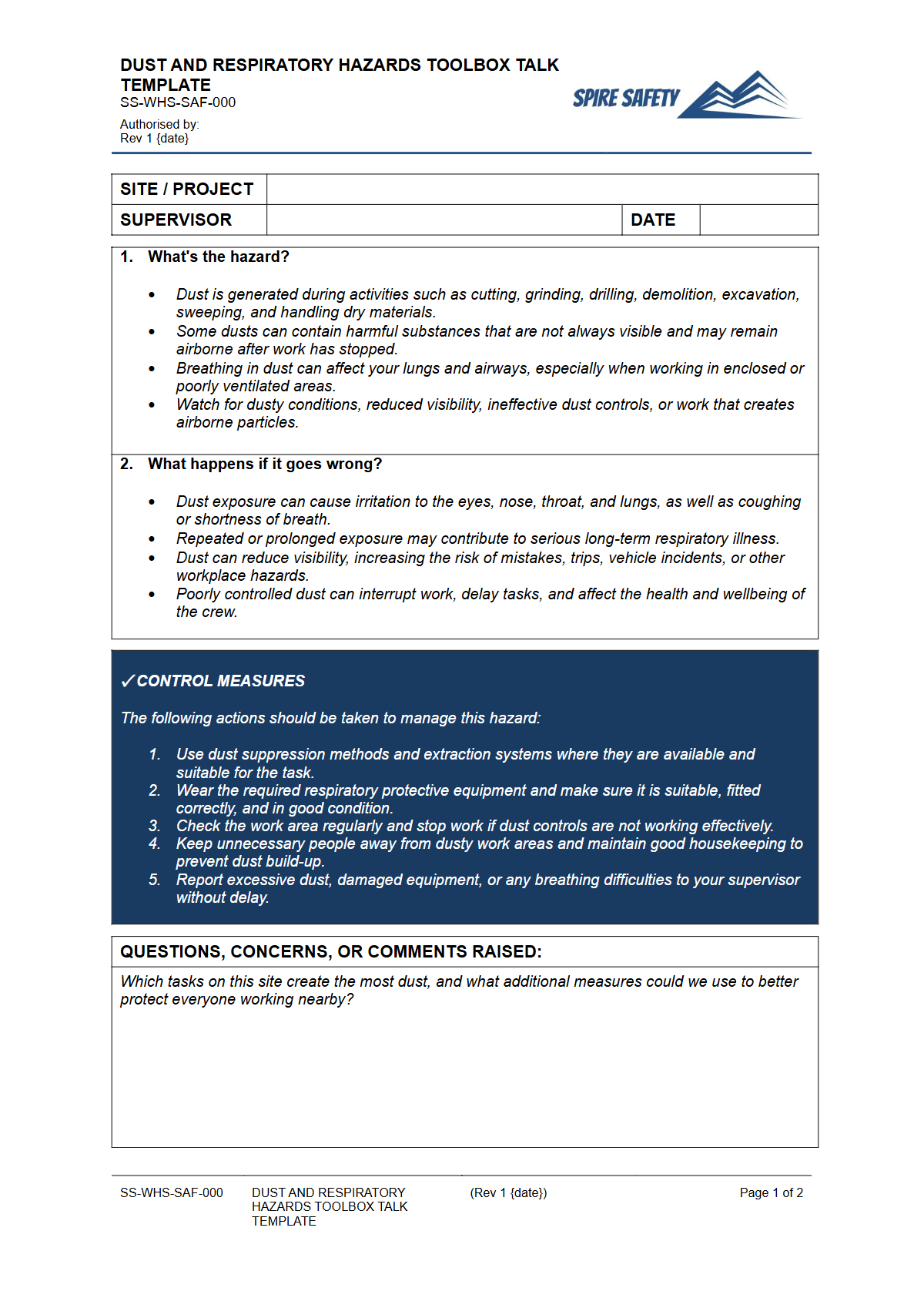
This free Dust and Respiratory Hazards Toolbox Talk Template is designed as a structured starting point for conducting essential workplace safety discussions. It provides a framework to help supervisors and managers communicate critical information regarding the risks associated with dust exposure and other respiratory hazards, and the control measures required to protect workers' health. By using this template, organisations can facilitate regular, focused conversations that reinforce safe work practices and enhance the overall health and safety culture on-site. It aims to ensure workers recognise potential dangers, understand their responsibilities, and know how to implement appropriate controls.
Video walkthrough
How to use this Toolbox Talk
Our Dust and Respiratory Hazards Toolbox Talk Template is provided in an editable DOCX format, making it easy to adapt to your specific operational needs. Simply download the document and populate it with details relevant to your workplace, including specific dust types encountered, control measures currently in place, and site-specific procedures. You will need to customise sections to reflect your organisation's policies, risk assessments, and the particular tasks being performed. This template is a guide; I must stress that it needs to be customised to your workplace conditions, specific hazards, and control measures to be effective and aligned with Australian WHS practice. Once customised, deliver the talk to your team, encouraging open discussion and feedback. Retain records of attendance and any issues raised. For comprehensive WHS oversight, explore our WHS management systems development services.
When to use it
This Toolbox Talk should be used regularly in any workplace where dust and respiratory hazards are present. This includes, but is not limited to, construction sites, manufacturing facilities, workshops, and any environment involving chemicals, airborne fibres, or fine particulates. It is particularly relevant:
- Before commencing new tasks that involve potential dust exposure.
- Following any incident or near-miss related to respiratory health.
- As part of ongoing WHS training refreshers.
- When introducing new equipment, materials, or processes that generate dust.
- During routine safety meetings to maintain awareness.
Regular use helps embed a proactive safety culture and ensures workers remain informed about current risks and control measures.
Who should use it
This Dust and Respiratory Hazards Toolbox Talk Template is intended for anyone with responsibility for workplace health and safety. This includes:
- Site supervisors and forepersons.
- Team leaders and managers.
- WHS officers and representatives.
- Project managers in dusty environments.
- Anyone conducting inductions or safety briefings.
It serves as an excellent resource for facilitating discussions and ensuring that all workers, including contractors and new employees, are fully informed about respiratory hazards. For further support, consider our expert WHS consulting services at Spire Safety or download more resources from our free WHS resources library.
Common mistakes
Common mistakes to avoid
- Not customising the Toolbox Talk to specific site conditions and tasks.
- Failing to encourage worker participation and feedback during the session.
- Not consistently enforcing control measures discussed in the Toolbox Talk.
- Neglecting to provide appropriate and properly fitted respiratory protective equipment (RPE).
Legal references
Legal considerations
The following legal requirements may be relevant to this type of work.
- Work Health and Safety Act (Harmonised) — Provides the primary duties for protecting workers and other people from work health and safety risks.
- Work Health and Safety Regulations (Harmonised) — Sets out requirements supporting the management of workplace hazards and risks.
The following codes may be relevant to this type of work.
- Managing WHS Risks Code of Practice — Provides practical guidance on identifying hazards, assessing risks and applying effective controls.
- Work Health and Safety Consultation, Cooperation and Coordination Code of Practice — Provides practical guidance on consulting workers and coordinating with other duty holders.
- Managing the Work Environment and Facilities Code of Practice — Provides practical guidance on safe work environments, workplace facilities and related controls.
Did you know
Invisible Danger
Many hazardous dust particles, such as respirable crystalline silica, are too small to be seen with the naked eye, meaning workers can be exposed without immediate awareness of the danger.
Serious Health Impacts
Prolonged exposure to hazardous dusts can lead to severe and irreversible lung diseases such as silicosis, asbestosis, and chronic obstructive pulmonary disease (COPD), highlighting the importance of stringent controls.
FAQ
Frequently asked questions
01What kind of dusts are considered respiratory hazards?
02How often should I conduct a Toolbox Talk on dust hazards?
03What is the primary goal of a Dust and Respiratory Hazards Toolbox Talk?
04Can this template be used for psychosocial hazards?
Share this resource
Dust and Respiratory Hazards Toolbox Talk Template
Browse Categories
How To Use It
- 1Download and open in Word or PDF.
- 2Replace the placeholders with your business details.
- 3Get it reviewed by a WHS specialist before rollout.
Need it customised?
Our WHS consultants can adapt this template to your site, run a gap analysis, or audit what you already have in place.
Book a Free Consultation WHS consulting servicesor call 1300 156 382
Related templates
- Electrical Safety on Construction Sites Toolbox Talk Template
- Elevated Work Platform Safety Toolbox Talk Template
- Emergency Procedures Awareness Toolbox Talk Template
- Environmental Awareness on Site Toolbox Talk Template
- Ergonomics and Sedentary Work Toolbox Talk Template
- Events and Crowd Safety Toolbox Talk Template