
Environmental Awareness on Site Toolbox Talk Template
Download our free Environmental Awareness on Site Toolbox Talk Template in DOCX/PDF.
Environmental Awareness on Site Toolbox Talk Template
DOCX • 142 KB + PDF
Updated Oct 2026
No signup required
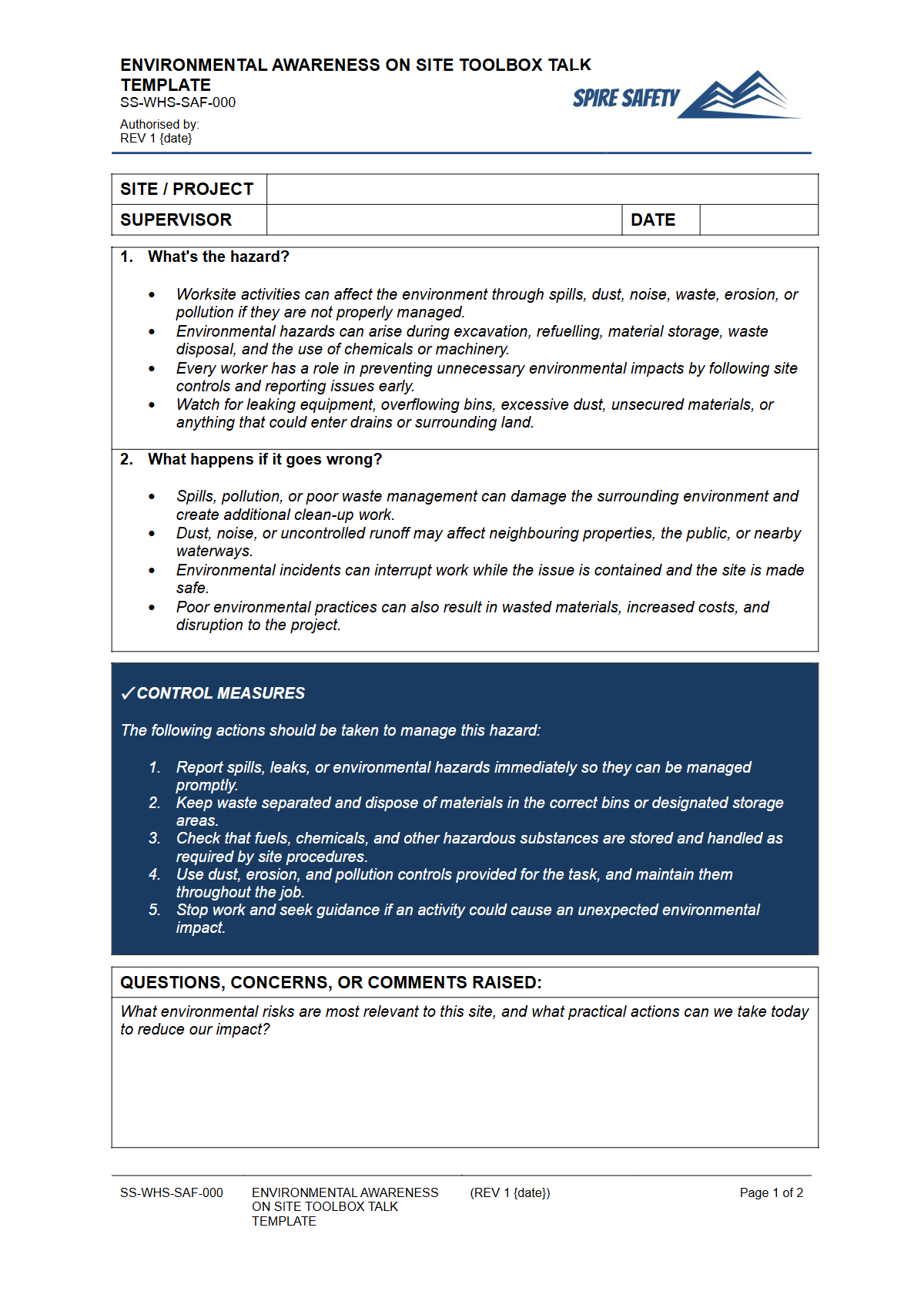
Environmental Awareness on Site Toolbox Talk Template
Our Environmental Awareness on Site Toolbox Talk Template provides a comprehensive framework for discussing crucial environmental issues directly with your team. This tool is designed to facilitate meaningful conversations about environmental responsibilities and sustainable practices on job sites, helping your organisation minimise its environmental footprint.
Regularly addressing environmental awareness through free WHS resources library like this template is a proactive step towards better WHS and environmental outcomes, ensuring all workers understand their role in protecting natural resources and preventing pollution.
This Toolbox Talk focuses on key areas such as waste management, spill prevention, water conservation, and energy efficiency. By using this template, you can effectively communicate expectations, identify site-specific environmental hazards, and collaboratively develop strategies to mitigate risks.
It serves as an essential component of a robust WHS management system, promoting a culture of environmental stewardship among your workforce.
What is a Toolbox Talk?
A Toolbox Talk is a short, informal workplace meeting, typically conducted before shifts, to discuss specific WHS topics directly relevant to the tasks being performed. These talks are crucial for reinforcing safety messages, discussing site-specific hazards, and ensuring all workers are aware of their responsibilities.
They provide an opportunity for workers to ask questions and contribute to discussions, enhancing engagement and understanding of WHS procedures and, in this case, environmental awareness on site.
Why is Environmental Awareness on Site Important?
Environmental awareness on site is critical for several reasons. Firstly, it helps prevent environmental harm, such as pollution of soil and waterways, and reduces waste.
Secondly, it supports your compliance efforts with environmental regulations and standards, avoiding potential fines and reputational damage. Thirdly, it promotes sustainable practices, contributing to the long-term health of our planet.
Finally, a strong environmental awareness program often aligns with broader WHS goals, fostering a more responsible and conscientious work culture.
Video walkthrough
Purpose of this document
The purpose of this Environmental Awareness on Site Toolbox Talk Template is to equip supervisors and WHS officers with a structured agenda for conducting effective discussions on environmental responsibility within the workplace. It aims to:
- Provide a consistent format for delivering key environmental messages.
- Encourage proactive identification and management of environmental risks.
- Educate workers on best practices for waste reduction, resource conservation, and pollution prevention.
- Foster a culture of environmental accountability amongst all site personnel.
- Support compliance with environmental regulations and internal policies.
How to use this Toolbox Talk
This template is designed to be a flexible guide for your Toolbox Talk. To use it effectively:
Download the DOCX version to customise it. We recommend that you:
- Tailor the content to reflect your specific site conditions, environmental hazards, and operational activities.
- Include recent incidents or near misses related to environmental matters, if applicable, to make the discussion more relevant.
- Add details of your organisation's environmental policies and procedures.
- Encourage open discussion, questions, and worker contributions.
- Ensure that all attendees sign the attendance register provided within the template.
- Keep a record of all Toolbox Talk sessions as part of your WHS management system documentation.
Please note: This template provides a foundational structure and key discussion points. It must be customised to your workplace's specific environmental risks, operations, and WHS policies to be effective and reflective of your organisation's compliance obligations.
When to use it
This Toolbox Talk template should be used regularly to maintain a high level of environmental awareness among your workforce. Ideal times include:
- At the start of new projects or phases of work.
- Before commencing tasks with higher environmental risks (e.g., refuelling, chemical handling).
- Following an environmental incident or near-miss.
- As part of routine site inductions or WHS team meetings.
- Whenever there are changes to environmental regulations or site procedures.
Who should use it
This Environmental Awareness on Site Toolbox Talk Template is primarily intended for:
- Site Managers and Supervisors responsible for daily operations and WHS oversight.
- WHS Officers and Coordinators tasked with promoting and maintaining WHS standards.
- Team Leaders who conduct pre-start meetings and manage work teams.
- Any individual responsible for delivering training or communicating WHS and environmental information to a workgroup.
Common mistakes
Common mistakes to avoid
- Not customising the talk to specific site conditions and risks.
- Presenting information as a lecture rather than an interactive discussion.
- Failing to record attendance and topics discussed.
- Not following up on actions or concerns raised during the talk.
Legal references
Legal considerations
The following legal requirements may be relevant to this type of work.
- Work Health and Safety Act (Harmonised) — Provides the primary duties for protecting workers and other people from work health and safety risks.
- Work Health and Safety Regulations (Harmonised) — Sets out requirements supporting the management of workplace hazards and risks.
The following codes may be relevant to this type of work.
- Managing WHS Risks Code of Practice — Provides practical guidance on identifying hazards, assessing risks and applying effective controls.
- Work Health and Safety Consultation, Cooperation and Coordination Code of Practice — Provides practical guidance on consulting workers and coordinating with other duty holders.
- Managing the Work Environment and Facilities Code of Practice — Provides practical guidance on safe work environments, workplace facilities and related controls.
Did you know
Waste Reduction Impact
Did you know that construction and demolition waste accounts for approximately 38% of Australia's total waste generation? Effective waste management on site can significantly reduce this environmental burden.
Spill Prevention Benefits
Proactive spill prevention strategies not only protect the environment but can also save businesses substantial costs associated with cleanup, regulatory fines, and potential legal action.
FAQ
Frequently asked questions
01What is included in the Environmental Awareness on Site Toolbox Talk Template?
02How often should an Environmental Awareness Toolbox Talk be conducted?
03Can this template be used for any industry?
04Does this template ensure WHS compliance?
Share this resource
Environmental Awareness on Site Toolbox Talk Template
Browse Categories
How To Use It
- 1Download and open in Word or PDF.
- 2Replace the placeholders with your business details.
- 3Get it reviewed by a WHS specialist before rollout.
Need it customised?
Our WHS consultants can adapt this template to your site, run a gap analysis, or audit what you already have in place.
Book a Free Consultation WHS consulting servicesor call 1300 156 382