
Fatigue and Sleep Management Toolbox Talk Template
Download this free Fatigue and Sleep Management Toolbox Talk Template to help your team recognise and manage fatigue risks in the workplace. Get your copy now!
Fatigue and Sleep Management Toolbox Talk Template
DOCX • 142 KB + PDF
Updated Oct 2026
No signup required
Purpose of this document
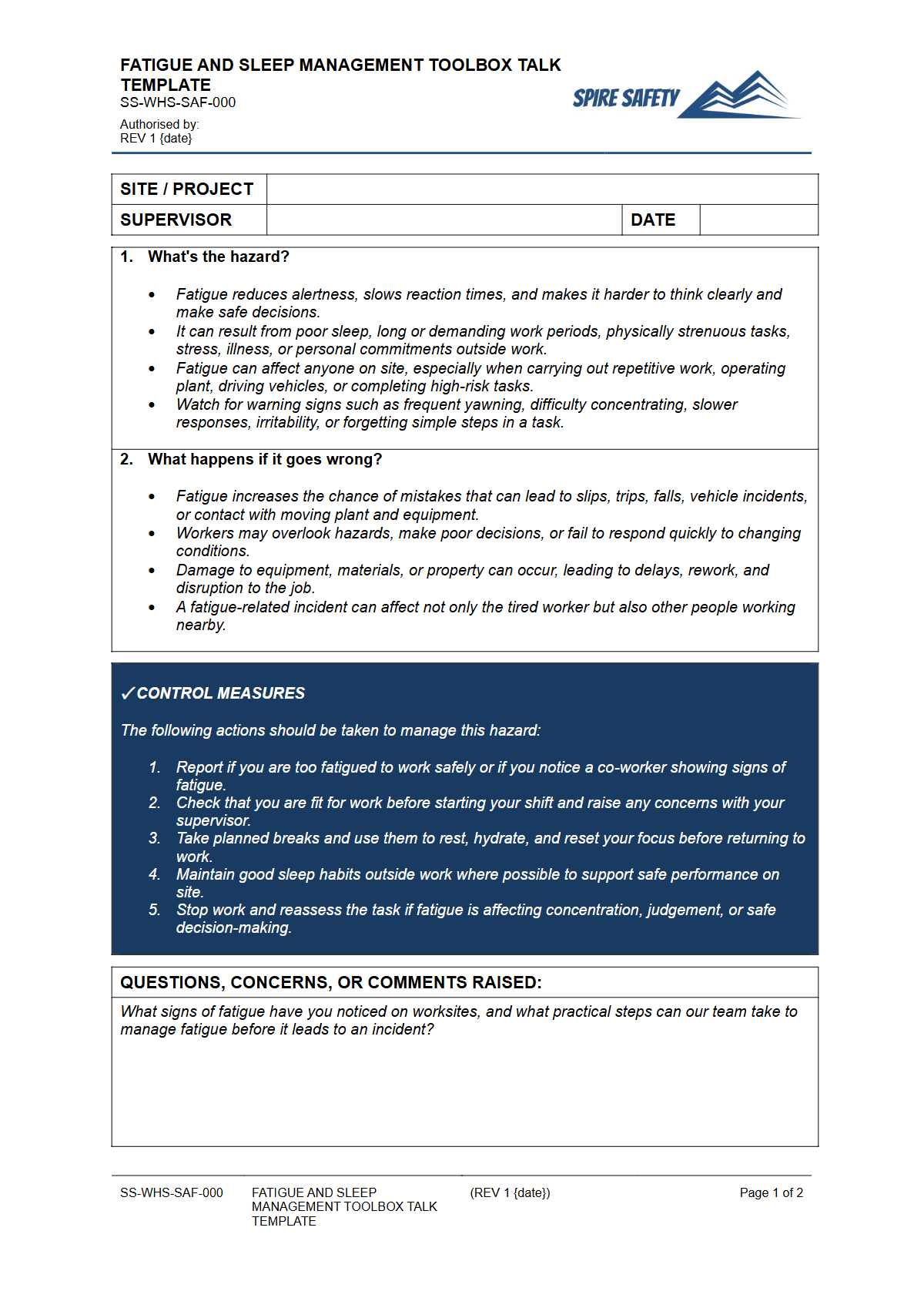
This Fatigue and Sleep Management Toolbox Talk Template provides a structured starting point for discussions on fatigue hazards and controls in Australian workplaces. Fatigue is a significant WHS risk that can impair judgment, reduce concentration, and increase the likelihood of incidents.
This template is designed to help organisations foster an open dialogue about the importance of sleep and effective fatigue management strategies among their workers and supervisors. It covers key topics such as recognising the signs of fatigue, understanding its impacts on safety and productivity, and implementing practical control measures both at work and in personal life.
Our free Fatigue and Sleep Management Toolbox Talk Template aims to support proactive risk management, contributing to a safer and healthier working environment for all.
Video walkthrough
How to use this Toolbox Talk
This Toolbox Talk template is provided in DOCX format for easy customisation. To use it effectively, download the document and adapt it to the specific needs, hazards, and control measures present in your workplace.
This includes adding details relevant to your industry, shift patterns, specific roles, and existing WHS management systems.
Remember, this is a template; it must be customised to your workplace to be effective and relevant. Consider incorporating real-life examples or near-miss incidents (anonymously) that have occurred in your organisation related to fatigue.
Encourage interactive discussion, questions, and worker input during the Toolbox Talk session. Document attendance, key discussion points, and any actions agreed upon during the talk.
Regular review and updates are crucial to ensure its ongoing effectiveness as part of your overall WHS strategy.
This resource is aligned with Australian WHS practice but does not constitute legal advice. For tailored assistance with your WHS obligations, consider engaging WHS consulting professionals.
When to use it
This Toolbox Talk template is ideal for regular safety meetings, pre-shift briefings, or as part of an induction program for new workers. It is particularly useful:
- Before periods of increased workload or extended hours.
- When introducing new equipment or processes that may impact worker concentration.
- Following any incident or near-miss where fatigue may have been a contributing factor.
- As a refresher to reinforce the importance of fatigue awareness and management.
- During consultation sessions to discuss psychosocial risks, including those related to work-related stress and fatigue.
Who should use it
This document is primarily for supervisors, team leaders, WHS representatives, and managers responsible for conducting Toolbox Talks and managing worker safety. It also serves as a valuable resource for WHS officers and safety committees in developing and implementing their fatigue management strategies.
Workers should also be encouraged to review and contribute to the content to ensure it addresses their practical concerns and experiences. Anyone involved in maintaining or improving WHS management systems will find this a practical tool for engaging workers on a critical safety topic.
Common mistakes
Common mistakes to avoid
- Not customising the template to specific workplace hazards and operational realities.
- Presenting the talk as a lecture rather than an interactive discussion.
- Failing to document attendance and key outcomes of the Toolbox Talk.
- Not following up on actions or concerns raised during the session.
Legal references
Legal considerations
The following legal requirements may be relevant to this type of work.
- Work Health and Safety Act (Harmonised) — Provides the primary duties for protecting workers and other people from work health and safety risks.
- Work Health and Safety Regulations (Harmonised) — Sets out requirements supporting the management of workplace hazards and risks.
The following codes may be relevant to this type of work.
- Managing WHS Risks Code of Practice — Provides practical guidance on identifying hazards, assessing risks and applying effective controls.
- Work Health and Safety Consultation, Cooperation and Coordination Code of Practice — Provides practical guidance on consulting workers and coordinating with other duty holders.
- Managing the Work Environment and Facilities Code of Practice — Provides practical guidance on safe work environments, workplace facilities and related controls.
Did you know
Impact on reaction time
Being awake for 17 hours can lead to performance impairment equivalent to having a Blood Alcohol Concentration (BAC) of 0.05%.
Fatigue-related incidents
Fatigue is estimated to be a contributing factor in 20-30% of all road accidents and a significant percentage of workplace incidents across various industries.
FAQ
Frequently asked questions
01What is a Toolbox Talk?
02Why is fatigue management important in the workplace?
03How often should fatigue management be discussed?
04What are common signs of worker fatigue?
Share this resource
Fatigue and Sleep Management Toolbox Talk Template
Browse Categories
How To Use It
- 1Download and open in Word or PDF.
- 2Replace the placeholders with your business details.
- 3Get it reviewed by a WHS specialist before rollout.
Need it customised?
Our WHS consultants can adapt this template to your site, run a gap analysis, or audit what you already have in place.
Book a Free Consultation WHS consulting servicesor call 1300 156 382