
Fatigue Management Toolbox Talk Template
Download our free Fatigue Management Toolbox Talk Template to engage your team on critical safety topics. Reduce risks in your workplace today.
Fatigue Management Toolbox Talk Template
DOCX • 140 KB + PDF
Updated Oct 2026
No signup required
Purpose of this document
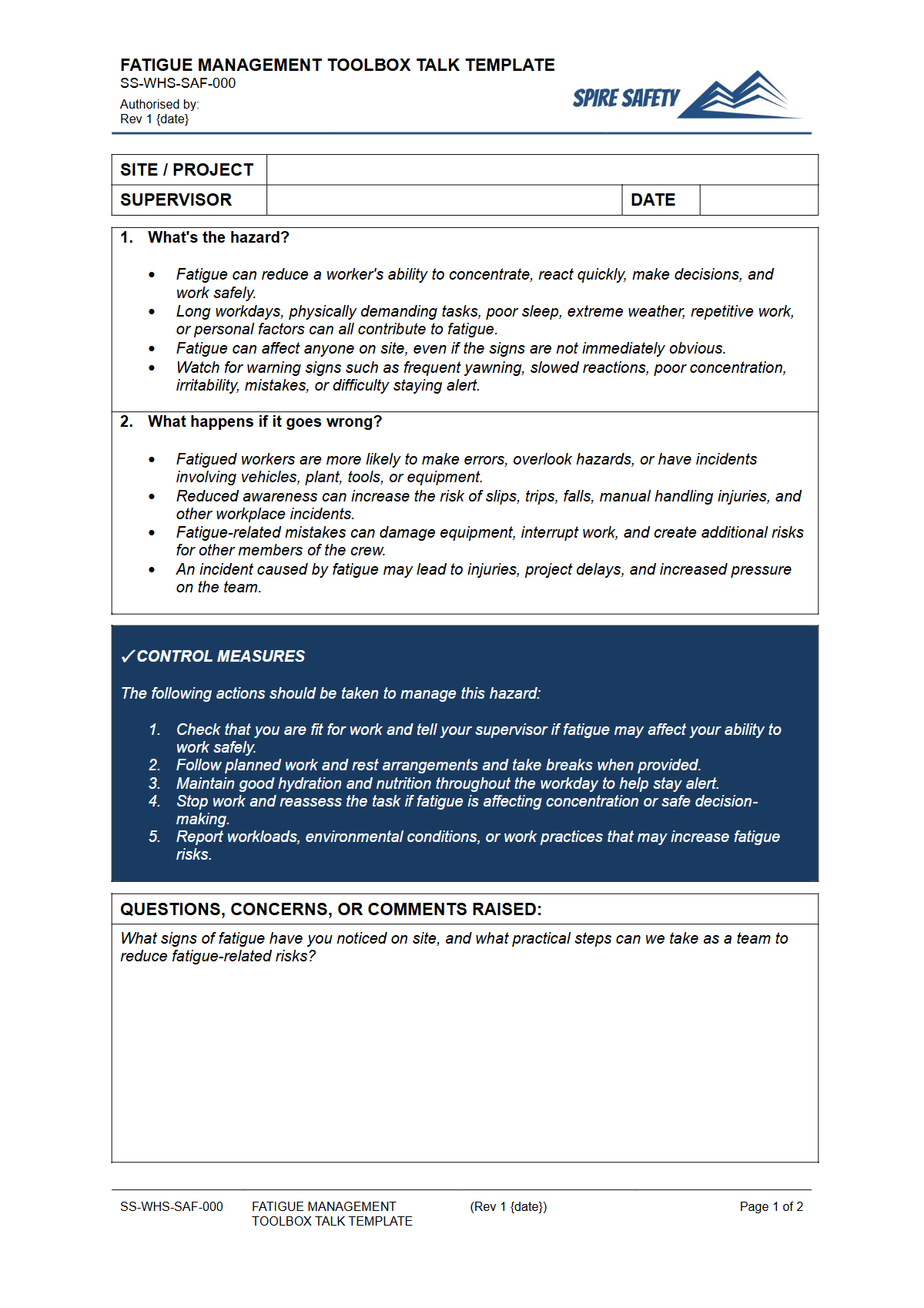
This free Fatigue Management Toolbox Talk Template is designed to assist Australian organisations in discussing the significant risks associated with worker fatigue. Fatigue can impair cognitive function, reduce reaction times, and increase the likelihood of incidents and injuries. This template provides a structured starting point for leading productive discussions with your team about recognising the signs of fatigue, understanding its causes, and implementing effective controls to manage it.
By regularly addressing fatigue management, workplaces can foster a proactive safety culture, encourage workers to report fatigue concerns, and collectively implement strategies to mitigate risks. This aligns with good WHS practice by promoting open communication and shared responsibility for health and safety outcomes.
Video walkthrough
How to use this Toolbox Talk
This Fatigue Management Toolbox Talk Template is provided as a foundational document. It must be customised to your specific workplace conditions, hazards, and control measures. Download the DOCX file (or PDF for reference), review the content, and tailor it by adding examples relevant to your operations, including details of your organisation's specific policies for managing fatigue, shift arrangements, rest breaks, and reporting procedures. Consider integrating it with your existing WHS management systems. Before presenting, ensure you are familiar with the content and prepared to answer questions or facilitate discussion among your team. Document attendance and any actions agreed upon during the talk as objective evidence of your safety briefings.
When to use it
This Toolbox Talk on fatigue management is ideal for regular safety meetings, particularly:
- Before shifts that are known to be physically or mentally demanding.
- Following any incidents or near misses where fatigue may have been a contributing factor.
- During periods of increased workload, extended hours, or shift changes.
- As part of induction for new workers or ongoing training for existing staff.
- After reviewing your organisation's risk assessments or control measures related to fatigue, to communicate any updates or changes.
Consistent use ensures that fatigue remains a prioritised safety topic, reinforcing its importance to your workers.
Who should use it
This template is primarily for supervisors, team leaders, WHS representatives, and managers who are responsible for conducting safety briefings and monitoring worker wellbeing. It can also be a valuable resource for WHS officers, safety committees, and anyone involved in developing or implementing WHS policies. While designed for those leading the discussion, the content is intended for all workers, encouraging active participation and understanding of fatigue management strategies across all levels of the organisation. For broader support, consider exploring WHS consulting services.
Common mistakes
Common mistakes to avoid
- Not customising the Toolbox Talk to specific workplace hazards and operational contexts.
- Failing to document attendance and any actions agreed upon during the discussion.
- Presenting the talk as a monologue rather than an interactive discussion.
- Neglecting to follow up on reported fatigue-related concerns or suggested improvements.
Legal references
Legal considerations
The following legal requirements may be relevant to this type of work.
- Work Health and Safety Act (Harmonised) — Provides the primary duties for protecting workers and other people from work health and safety risks.
- Work Health and Safety Regulations (Harmonised) — Sets out requirements supporting the management of workplace hazards and risks.
The following codes may be relevant to this type of work.
- Managing WHS Risks Code of Practice — Provides practical guidance on identifying hazards, assessing risks and applying effective controls.
- Work Health and Safety Consultation, Cooperation and Coordination Code of Practice — Provides practical guidance on consulting workers and coordinating with other duty holders.
- Managing the Work Environment and Facilities Code of Practice — Provides practical guidance on safe work environments, workplace facilities and related controls.
Did you know
Fatigue-related incidents cost more
Studies indicate that incidents caused by fatigue are often more severe and costly than those from other causes, due to impaired judgment and slower response times.
Sleep debt accumulates
Ongoing inadequate sleep leads to a 'sleep debt' that cannot be fully repaid by one or two long nights of sleep; consistent, good quality sleep is essential for preventing chronic fatigue.
FAQ
Frequently asked questions
01What is worker fatigue in a WHS context?
02What are the common signs of worker fatigue?
03How can organisations manage risks associated with fatigue?
04Where can I find more free WHS resources?
Share this resource
Fatigue Management Toolbox Talk Template
Browse Categories
How To Use It
- 1Download and open in Word or PDF.
- 2Replace the placeholders with your business details.
- 3Get it reviewed by a WHS specialist before rollout.
Need it customised?
Our WHS consultants can adapt this template to your site, run a gap analysis, or audit what you already have in place.
Book a Free Consultation WHS consulting servicesor call 1300 156 382