
Electrical Safety on Construction Sites Toolbox Talk Template
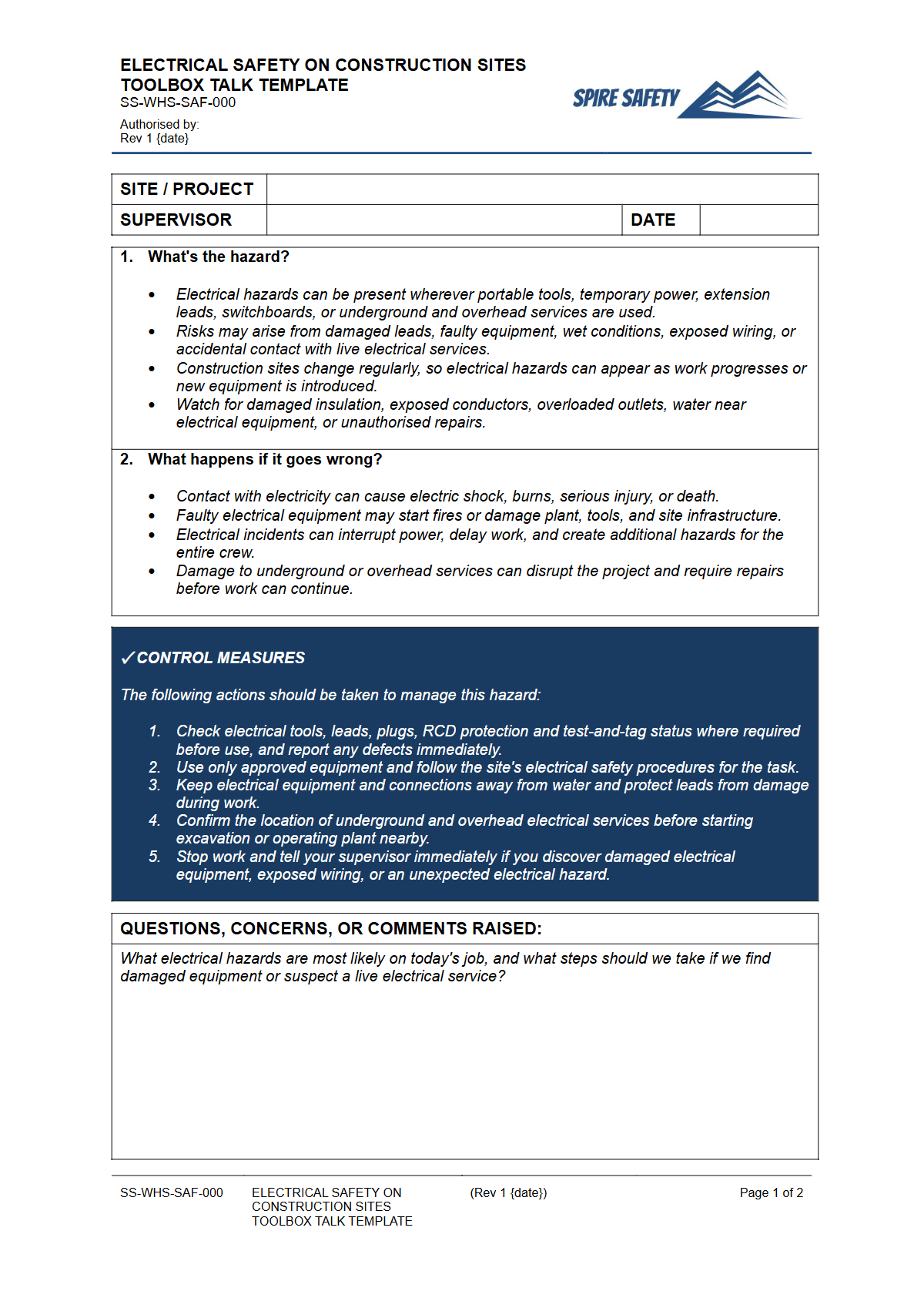
Download this free Electrical Safety on Construction Sites Toolbox Talk template for Australian workplaces. A structured starting point for your team.
Electrical Safety on Construction Sites Toolbox Talk Template
DOCX • 141 KB + PDF
Updated Oct 2026
No signup required
Purpose of this document
This free Electrical Safety on Construction Sites Toolbox Talk Template provides a structured starting point for conducting essential safety discussions with your team. Electrical hazards on construction sites pose significant risks, including electric shock, burns, fires, and explosions. Regular toolbox talks are a crucial control measure for managing these risks, ensuring that workers are consistently reminded of safe work practices, potential dangers, and emergency procedures. This template helps facilitators cover key aspects of electrical safety specific to construction environments. It's designed to promote a proactive safety culture where potential electrical risks are identified and addressed before they lead to incidents.
By utilising this template, organisations can reinforce the importance of electrical safety, encourage worker participation in risk identification, and contribute to a safer work environment. It supports an organisation’s broader WHS risk management strategy by providing a practical tool for ongoing safety education and engagement, helping to align practices with Australian WHS principles.
Video walkthrough
How to use this Toolbox Talk
This Electrical Safety on Construction Sites Toolbox Talk template is a foundational document designed to be adapted to your specific site conditions, work tasks, and crew capabilities. It offers a framework, but it must be customised to your workplace and the specific electrical hazards present on your construction site. Before conducting the talk, review the content and add details relevant to current projects, equipment, or recent incidents. For example, if you are working near overhead power lines, expand on the specific controls and exclusion zones required. If new electrical plant is introduced, ensure its safe operation and maintenance are discussed. Encourage open dialogue, questions, and worker feedback during the session.
Ensure all participants sign an attendance register, which should be kept as a record of training. Following the toolbox talk, assess whether the information was understood and if any further training or hazard controls are necessary. This template is a key component of effective WHS management systems and contributes to continuous improvement in workplace safety. For more support in developing robust safety documentation, consider our WHS consulting services.
When to use it
This Electrical Safety on Construction Sites Toolbox Talk should be used regularly, especially when:
- Commencing new construction projects or phases that involve significant electrical work.
- New electrical equipment or plant is introduced to the site.
- There are changes in work procedures or site layouts that could impact electrical safety.
- After any electrical incidents, near misses, or observations of unsafe electrical practices.
- As part of ongoing WHS training refreshers to maintain a high level of electrical safety awareness.
- Bringing new workers, particularly those unfamiliar with site-specific electrical hazards, into the team.
- Preparing for or following WHS compliance auditing to demonstrate commitment to safety education.
Who should use it
This Toolbox Talk template is suitable for:
- Construction site supervisors and forepersons responsible for daily safety briefings.
- WHS officers and managers who need to deliver consistent safety messaging.
- Project managers looking to integrate safety discussions into project planning and execution.
- Anyone facilitating team meetings on a construction site where electrical hazards are a concern.
- Organisations aiming to strengthen their electrical safety protocols and educate their workforce.
- Businesses seeking to implement or enhance their ISO 45001 certification efforts.
Common mistakes
Common mistakes to avoid
- Not regularly inspecting and testing electrical equipment (e.g., leads, tools).
- Failing to establish and maintain exclusion zones around overhead and underground power lines.
- Allowing unqualified workers to carry out electrical work or repairs.
- Overloading power boards or using damaged extension cords.
Legal references
Legal considerations
The following legal requirements may be relevant to this type of work.
- Work Health and Safety Act (Harmonised) — Provides the primary duties for protecting workers and other people from work health and safety risks.
- Work Health and Safety Regulations (Harmonised) — Sets out requirements supporting the management of workplace hazards and risks.
The following codes may be relevant to this type of work.
- Managing WHS Risks Code of Practice — Provides practical guidance on identifying hazards, assessing risks and applying effective controls.
- Work Health and Safety Consultation, Cooperation and Coordination Code of Practice — Provides practical guidance on consulting workers and coordinating with other duty holders.
- Managing the Work Environment and Facilities Code of Practice — Provides practical guidance on safe work environments, workplace facilities and related controls.
Did you know
Danger of Hidden Electrocution
It's estimated that even small currents (as low as 1mA) can be dangerous, as muscle contraction and 'freezing' to a live conductor can occur. Higher currents can stop the heart or damage internal organs.
RCD Lifesaver
Residual Current Devices (RCDs) are mandatory on most Australian construction sites. They can detect small imbalances in electrical current and quickly cut power, significantly reducing the risk of electric shock and electrocution.
FAQ
Frequently asked questions
01What is an Electrical Safety Toolbox Talk?
02How often should Electrical Safety Toolbox Talks be conducted on construction sites?
03What are common electrical hazards on construction sites?
04Can this template be used for other industries?
Share this resource
Electrical Safety on Construction Sites Toolbox Talk Template
Browse Categories
How To Use It
- 1Download and open in Word or PDF.
- 2Replace the placeholders with your business details.
- 3Get it reviewed by a WHS specialist before rollout.
Need it customised?
Our WHS consultants can adapt this template to your site, run a gap analysis, or audit what you already have in place.
Book a Free Consultation WHS consulting servicesor call 1300 156 382
Related templates
- Elevated Work Platform Safety Toolbox Talk Template
- Emergency Procedures Awareness Toolbox Talk Template
- Environmental Awareness on Site Toolbox Talk Template
- Ergonomics and Sedentary Work Toolbox Talk Template
- Events and Crowd Safety Toolbox Talk Template
- Excavation and Trenching Safety Toolbox Talk Template