
Confined Spaces Toolbox Talk Template
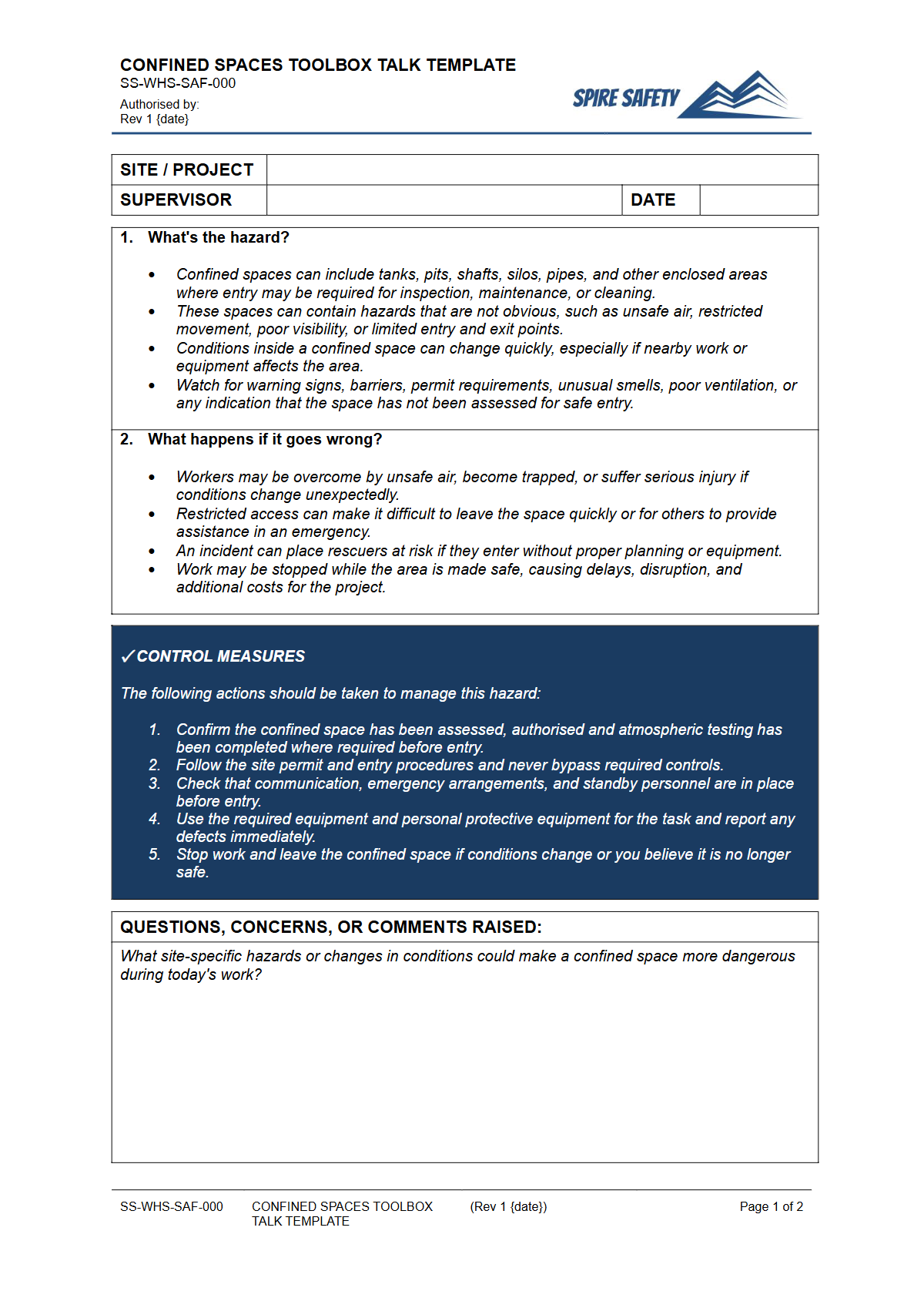
Download this free Confined Spaces Toolbox Talk Template to help facilitate critical safety discussions with your team.
Confined Spaces Toolbox Talk Template
DOCX • 142 KB + PDF
Updated Oct 2026
No signup required
Purpose of this document
This free Confined Spaces Toolbox Talk Template provides a structured framework for facilitating essential safety discussions with your workers. Confined spaces present significant hazards, and regular, focused communication is vital for preventing incidents.
This template is designed to help persons conducting a business or undertaking (PCBUs) and their supervisors address key safety aspects related to working in and around confined spaces.
Using this template allows you to systematically cover critical topics such as hazard identification, risk control measures, permit-to-work systems, emergency procedures, and the importance of appropriate personal protective equipment (PPE). It serves as a foundational tool to help reinforce safe work practices and enhance hazard awareness, contributing to a proactive safety culture within your organisation.
It is aligned with Australian WHS practice and helps fulfil obligations for providing information, training, and instruction to workers.
Video walkthrough
How to use this Toolbox Talk
This Toolbox Talk template is provided in an editable DOCX format for easy customisation. To effectively use this resource, download the template and tailor it specifically to the unique confined spaces, work tasks, and control measures relevant to your workplace. This includes:
- Identifying the specific confined spaces within your organisation.
- Detailing the unique hazards associated with those spaces (e.g., atmospheric hazards, engulfment risks, hazardous chemicals).
- Outlining the specific control measures implemented, including ventilation, isolation procedures, and monitoring equipment.
- Specifying the emergency procedures, including rescue plans and equipment, and detailing who is responsible for what.
- Identifying the required PPE for your specific confined space entries.
- Adding details about who to contact for assistance or to report hazards.
Please note: This template is a starting point. It must be customised to your workplace’s specific operations and legal obligations to be effective and relevant.
Generic information is not sufficient for managing WHS risks.
We also offer WHS consulting services if you need expert assistance in tailoring WHS documentation or developing comprehensive WHS management systems.
When to use it
A Confined Spaces Toolbox Talk should be conducted:
- Before any work involving entry into, or working near, a confined space commences.
- As part of induction training for new workers who may be involved with confined space work.
- Following any incident, near-miss, or safety deviation related to confined spaces to reinforce lessons learned.
- When there are changes to confined space procedures, equipment, or control measures.
- At regular intervals (e.g., monthly, quarterly) as part of your ongoing WHS training and communication program.
- During routine safety meetings or pre-start briefings to refresh worker knowledge and address any emerging concerns.
Who should use it
This Confined Spaces Toolbox Talk template is ideal for:
- Supervisors and team leaders responsible for overseeing work in or near confined spaces.
- WHS officers and managers responsible for developing and implementing WHS procedures.
- Anyone conducting WHS training or inductions for workers.
- Business owners and PCBUs seeking to reinforce safety culture and meet their duty of care regarding confined space safety.
- Workers who are required to enter, work near, or act as stand-by persons for confined spaces, to help them understand their responsibilities and safe work practices.
For more free WHS resources library, visit our website. Our resources are designed to provide practical support for Australian businesses in managing their WHS obligations effectively.
Common mistakes
Common mistakes to avoid
- Failing to conduct proper atmospheric testing before entry.
- Not having a designated and trained stand-by person.
- Bypassing permit-to-work systems for 'quick' entries.
- Inadequate or unpractised emergency and rescue plans.
Legal references
Legal considerations
The following legal requirements may be relevant to this type of work.
- Work Health and Safety Act (Harmonised) — Provides the primary duties for protecting workers and other people from work health and safety risks.
- Work Health and Safety Regulations (Harmonised) — Sets out requirements supporting the management of workplace hazards and risks.
The following codes may be relevant to this type of work.
- Managing WHS Risks Code of Practice — Provides practical guidance on identifying hazards, assessing risks and applying effective controls.
- Work Health and Safety Consultation, Cooperation and Coordination Code of Practice — Provides practical guidance on consulting workers and coordinating with other duty holders.
- Managing the Work Environment and Facilities Code of Practice — Provides practical guidance on safe work environments, workplace facilities and related controls.
Did you know
Invisible Hazards
Many confined space hazards, such as toxic gases or oxygen deficiency, are invisible and odourless, making continuous atmospheric monitoring essential before and during entry.
Rescue Training Critical
Most fatalities in confined spaces involve rescuers, highlighting the critical importance of proper training and equipment for emergency response teams.
FAQ
Frequently asked questions
01What is considered a confined space in Australia?
02Is a permit required for all confined space entries?
03What is the role of a stand-by person for confined spaces?
04How often should confined space training be refreshed?
Share this resource
Confined Spaces Toolbox Talk Template
Browse Categories
How To Use It
- 1Download and open in Word or PDF.
- 2Replace the placeholders with your business details.
- 3Get it reviewed by a WHS specialist before rollout.
Need it customised?
Our WHS consultants can adapt this template to your site, run a gap analysis, or audit what you already have in place.
Book a Free Consultation WHS consulting servicesor call 1300 156 382