
Concrete Safety Toolbox Talk Template
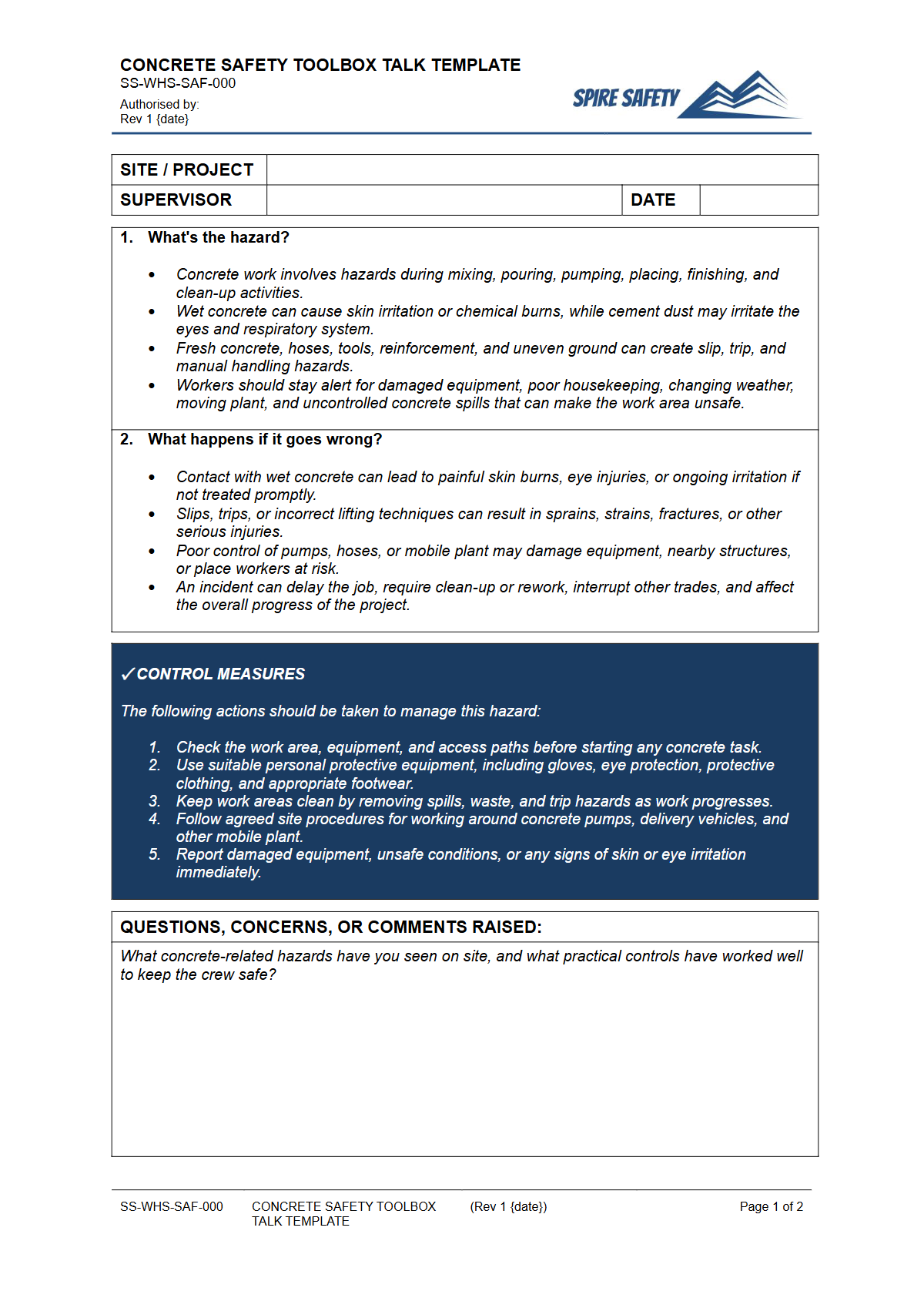
Download your free Concrete Safety Toolbox Talk Template. A structured starting point for discussing key WHS topics related to concrete work. Get it now!
Concrete Safety Toolbox Talk Template
DOCX • 141 KB + PDF
Updated Oct 2026
No signup required
Purpose of this document
This Concrete Safety Toolbox Talk Template provides a structured framework for delivering essential safety discussions related to concrete work. It is designed to help organisations facilitate regular, concise, and effective safety briefings, ensuring that all workers understand the potential hazards and necessary control measures when working with concrete.
Working with concrete involves various risks, including chemical burns, manual handling injuries, respiratory issues from dust, and plant-related incidents. This template serves as a vital tool for communicating these risks and reinforcing safe work practices. By regularly addressing these topics, businesses can foster a proactive safety culture and reduce the likelihood of incidents and injuries on site.
Video walkthrough
How to use this Toolbox Talk
Our Concrete Safety Toolbox Talk Template is provided in both DOCX and PDF formats for your convenience. The DOCX version allows for full customisation to suit your specific workplace, projects, and WHS management systems. This template must be customised to your workplace, specific tasks, and the hazards identified on your site to be effective. Consider adding your company logo, specific site rules, hazard assessment outcomes, and details about incidents or near misses relevant to your operations. Use it as a guide to cover critical areas, but always adapt the content to reflect your actual work environment and legislative requirements.
Before delivering the talk, review the content, familiarise yourself with the topics, and prepare to lead an interactive discussion. Encourage worker participation, questions, and feedback. Document attendance and any key outcomes or actions agreed upon during the session. Regularly review and update the content to ensure it remains relevant and effective for ongoing safety training.
When to use it
This Concrete Safety Toolbox Talk Template should be used regularly wherever concrete work is performed. This includes at the start of a new project involving concrete, before commencing specific concrete-related tasks (e.g., pouring, cutting, finishing), or following any changes to work procedures, plant, or materials used in concrete operations. It's also beneficial to schedule these talks periodically as part of your ongoing commitment to WHS, perhaps weekly or monthly, to keep safety front of mind. Consider using it after a safety incident or near miss to reinforce critical lessons learned. Incorporating regular toolbox talks is a key component of effective WHS management systems.
Who should use it
This template is primarily intended for supervisors, team leaders, WHS representatives, project managers, and anyone responsible for overseeing concrete work or delivering safety briefings to workers. It is also a valuable resource for WHS officers or managers who are developing or reviewing their organisation's safety training materials. Workers can also benefit from reviewing the template to understand the topics that will be covered and to prepare questions or points for discussion. For more general free WHS resources library, explore our other offerings at Spire Safety.
Common mistakes
Common mistakes to avoid
- Not customising the toolbox talk to specific site hazards and tasks.
- Presenting the talk as a lecture rather than an interactive discussion.
- Failing to document attendance and any actions agreed upon.
- Not consistently conducting talks, especially when new risks or tasks emerge.
Legal references
Legal considerations
The following legal requirements may be relevant to this type of work.
- Work Health and Safety Act (Harmonised) — Provides the primary duties for protecting workers and other people from work health and safety risks.
- Work Health and Safety Regulations (Harmonised) — Sets out requirements supporting the management of workplace hazards and risks.
The following codes may be relevant to this type of work.
- Managing WHS Risks Code of Practice — Provides practical guidance on identifying hazards, assessing risks and applying effective controls.
- Work Health and Safety Consultation, Cooperation and Coordination Code of Practice — Provides practical guidance on consulting workers and coordinating with other duty holders.
- Managing the Work Environment and Facilities Code of Practice — Provides practical guidance on safe work environments, workplace facilities and related controls.
Did you know
Silica Dust Risk
Exposure to crystalline silica dust, common when cutting or grinding concrete, can lead to serious lung diseases like silicosis, highlighting the importance of dust control.
Alkaline Burns
Wet concrete is highly alkaline and can cause severe chemical burns to skin and eyes, often without immediate pain, requiring prompt washing and medical attention.
FAQ
Frequently asked questions
01What are the main hazards when working with concrete?
02How often should concrete safety toolbox talks be conducted?
03Does this template ensure WHS compliance for my business?
04Can this template be used for pre-start meetings?
Share this resource
Concrete Safety Toolbox Talk Template
Browse Categories
How To Use It
- 1Download and open in Word or PDF.
- 2Replace the placeholders with your business details.
- 3Get it reviewed by a WHS specialist before rollout.
Need it customised?
Our WHS consultants can adapt this template to your site, run a gap analysis, or audit what you already have in place.
Book a Free Consultation WHS consulting servicesor call 1300 156 382
Related templates
- Confined Space Awareness Toolbox Talk Template
- Confined Spaces Toolbox Talk Template
- Contractor Safety Responsibilities Toolbox Talk Template
- CPR and AED Awareness Toolbox Talk Template
- Crane and Lifting Operations Safety Toolbox Talk Template
- Customer Aggression and Personal Safety Toolbox Talk Template