
Biological Hazards Awareness Toolbox Talk Template
Download our Biological Hazards Awareness Toolbox Talk Template to educate your team on workplace biological risks and control measures.
Biological Hazards Awareness Toolbox Talk Template
DOCX • 139 KB + PDF
Updated Oct 2026
No signup required
Purpose of this document
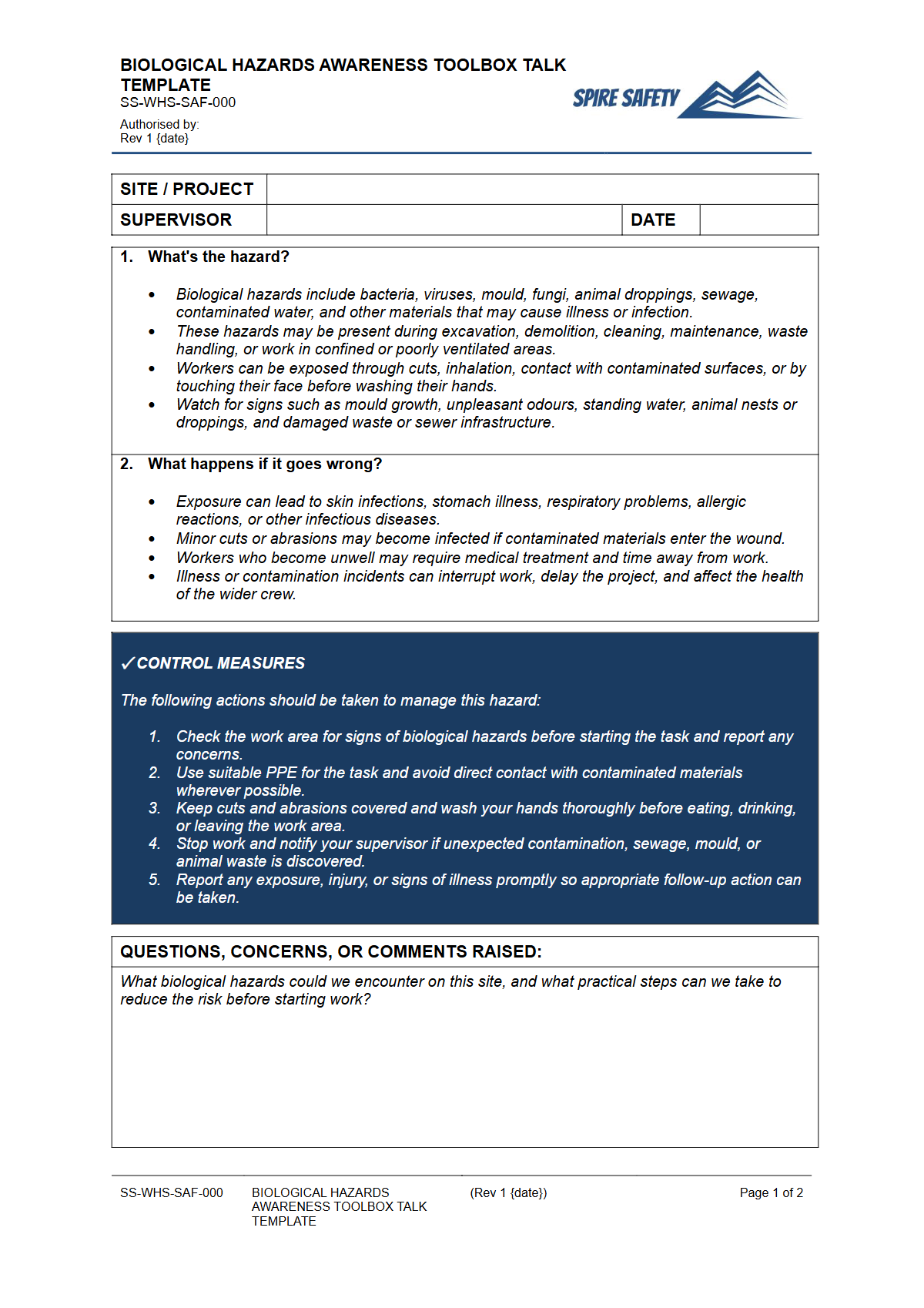
This Biological Hazards Awareness Toolbox Talk Template provides a structured starting point for discussing biological hazards in your workplace. Biological hazards include bacteria, viruses, fungi, parasites, and other living organisms that can cause harm to human health. This template aims to raise awareness among workers about the potential sources of biological hazards, the health risks associated with exposure, and the essential control measures required to minimise these risks. It promotes proactive discussions about safe work practices and encourages a culture of safety regarding biological agents, aligning with good Australian WHS practices for risk management.
Video walkthrough
How to use this Toolbox Talk
This Biological Hazards Awareness Toolbox Talk Template is designed to be a foundational document for facilitating short, focused discussions with your team. Before each session, review the template thoroughly and customise it to reflect the specific biological hazards present in your workplace and the control measures you have implemented. You must ensure that the content is relevant to your operations and the tasks your workers perform. Supplement the discussion with real-world examples, workplace-specific procedures, and demonstrations of personal protective equipment (PPE) where applicable. Remember, this template is a guide; your effective use of it, tailored to your unique workplace conditions, is crucial for fostering a safer environment. We recommend incorporating this into your broader WHS management systems.
When to use it
This Toolbox Talk template should be used regularly as part of your ongoing workplace health and safety program. It is particularly useful:
During new worker inductions, especially for roles involving potential exposure to biological agents.
When introducing new processes, equipment, or materials that may present new biological hazards.
Following any incident or near-miss involving biological exposure, to reinforce critical safety messages.
As a refresher training session to maintain a high level of awareness and reinforce safe work behaviours.
Periodically (e.g., quarterly, semi-annually) as part of a routine safety meeting schedule.
After reviewing your organisation's risk assessments related to biological hazards, updating your team on any changes in controls or procedures.
Who should use it
This template is primarily intended for persons conducting a business or undertaking (PCBUs), WHS managers, supervisors, team leaders, and safety representatives responsible for facilitating safety discussions and educating workers. Workers who may be exposed to biological hazards in their roles will be the audience for these toolbox talks. While general applicability is broad, industries such as healthcare, agriculture, waste management, hospitality, laboratory work, and cleaning services will find this free WHS resource particularly valuable due to their higher likelihood of encountering biological risks. However, any workplace, even an office environment, can benefit from awareness regarding common biological agents like cold and flu viruses.
Common mistakes
Common mistakes to avoid
- Failing to identify all potential sources of biological hazards in the workplace.
- Relying solely on PPE without implementing higher-level controls from the hierarchy.
- Not providing adequate training or information to workers on specific biological risks and safe procedures.
- Neglecting to review and update control measures after incidents or changes in work processes.
Legal references
Legal considerations
The following legal requirements may be relevant to this type of work.
- Work Health and Safety Act (Harmonised) — Provides the primary duties for protecting workers and other people from work health and safety risks.
- Work Health and Safety Regulations (Harmonised) — Sets out requirements supporting the management of workplace hazards and risks.
The following codes may be relevant to this type of work.
- Managing WHS Risks Code of Practice — Provides practical guidance on identifying hazards, assessing risks and applying effective controls.
- Work Health and Safety Consultation, Cooperation and Coordination Code of Practice — Provides practical guidance on consulting workers and coordinating with other duty holders.
- Managing the Work Environment and Facilities Code of Practice — Provides practical guidance on safe work environments, workplace facilities and related controls.
Did you know
Biological Warfare & Bioterrorism
While often associated with everyday workplace risks, some biological agents have been developed for use in biological warfare or bioterrorism, making their containment and safe handling critically important in specific research or security contexts.
Psychosocial Impact of Biological Incidents
Exposure to or even the threat of biological hazards can cause significant psychosocial stress, anxiety, and fear among workers, highlighting the need for robust support systems and clear communication post-incident.
FAQ
Frequently asked questions
01What are common biological hazards in Australian workplaces?
02How can I assess biological risks in my workplace?
03What control measures are effective for biological hazards?
04Why are Toolbox Talks important for biological hazard awareness?
Share this resource
Biological Hazards Awareness Toolbox Talk Template
Browse Categories
How To Use It
- 1Download and open in Word or PDF.
- 2Replace the placeholders with your business details.
- 3Get it reviewed by a WHS specialist before rollout.
Need it customised?
Our WHS consultants can adapt this template to your site, run a gap analysis, or audit what you already have in place.
Book a Free Consultation WHS consulting servicesor call 1300 156 382