
Workplace Bullying and Harassment Toolbox Talk Template
Download your free Workplace Bullying and Harassment Toolbox Talk Template.
Workplace Bullying and Harassment Toolbox Talk Template
DOCX • 141 KB + PDF
Updated Oct 2026
No signup required
Purpose of this document
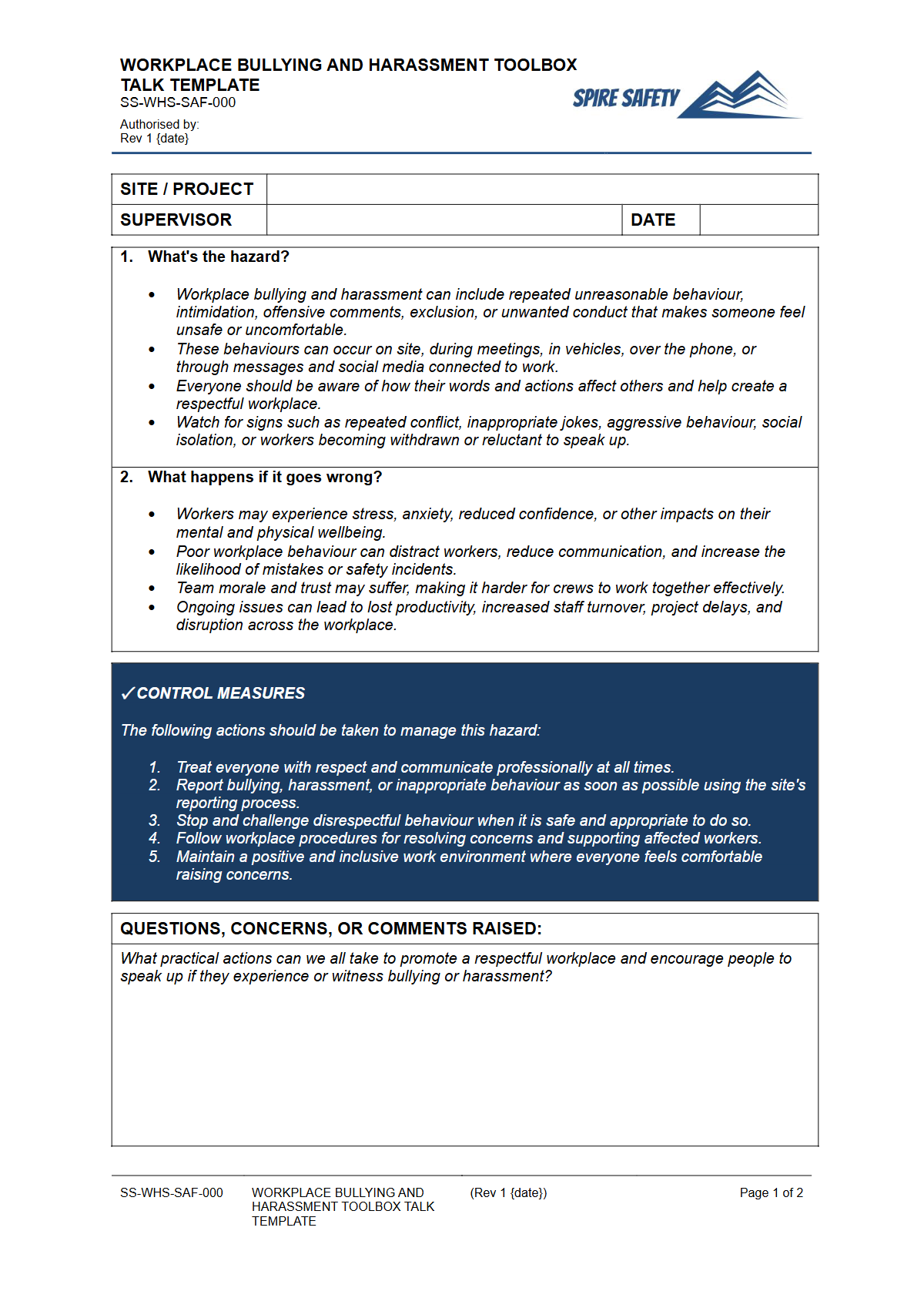
This free WHS resource provides a structured Workplace Bullying and Harassment Toolbox Talk Template. Designed to assist Australian organisations in fostering mentally healthy and respectful workplaces, this template is a critical tool for addressing psychosocial hazards.
It facilitates open discussions about workplace behaviour, identifying potential bullying and harassment, and understanding prevention strategies. By regularly conducting toolbox talks on this crucial topic, you can reinforce your organisation's commitment to psychological safety, ensuring all workers feel supported and aware of their responsibilities and reporting mechanisms.
The template covers key definitions, examples of bullying and harassment, the impact on individuals and the organisation, and the steps workers can take if they experience or witness such behaviour. It aligns with Australian WHS practice by promoting proactive risk management and encouraging consultation, which are fundamental to developing robust WHS management systems. Utilise this template to promote a culture where respectful interactions are the norm and inappropriate behaviour is not tolerated.
Video walkthrough
How to use this Toolbox Talk
This Workplace Bullying and Harassment Toolbox Talk Template is provided in an editable DOCX format, along with a PDF version for easy distribution. Before conducting your toolbox talk, download the DOCX file and customise it to reflect your specific workplace environment, policies, and procedures. This template is a starting point; it must be customised to your workplace, integrating your organisation's code of conduct, incident reporting procedures, and support services.
Review the content, add any specific examples relevant to your industry, and tailor the discussion points to address known psychosocial risks within your organisation. Present the information clearly, encourage participation, and be prepared to answer questions.
Ensure all workers in attendance sign the attendance register, which is crucial for demonstrating that information and training have been provided. Save the customised template and attendance record as part of your WHS documentation.
When to use it
This Toolbox Talk should be used regularly as part of your ongoing WHS program, particularly:
- During new worker inductions to establish expectations from the outset.
- When there are changes to workplace policies regarding conduct and behaviour.
- Following any reported incidents of bullying or harassment to reinforce preventative measures and reporting pathways.
- As a scheduled refresher to maintain awareness and ensure all workers remain informed about their rights and responsibilities.
- During periods of organisational change or increased workplace stress, which can sometimes heighten the risk of psychosocial hazards.
- As part of a broader strategy to address identified psychosocial risks, demonstrating a commitment to continuous improvement in workplace safety.
Who should use it
This Workplace Bullying and Harassment Toolbox Talk Template is designed for:
- Supervisors and Team Leaders responsible for managing teams and promoting positive workplace culture.
- Health and Safety Representatives (HSRs) who advocate for worker safety and well-being.
- WHS Managers and Coordinators tasked with implementing and maintaining WHS programs.
- Human Resources Professionals involved in developing and enforcing workplace behaviour policies.
- Any person responsible for facilitating team meetings or communicating WHS information to workers.
- Organisations committed to preventing workplace bullying and harassment and fostering a safe psychological environment for all workers.
Common mistakes
Common mistakes to avoid
- Failing to adapt the template to specific workplace policies and risks.
- Not encouraging open discussion or questions during the toolbox talk.
- Neglecting to record attendance for compliance and training records.
- Treating the toolbox talk as a one-off event instead of part of an ongoing strategy.
Legal references
Legal considerations
The following legal requirements may be relevant to this type of work.
- Work Health and Safety Act (Harmonised) — Provides the primary duties for protecting workers and other people from work health and safety risks.
- Work Health and Safety Regulations (Harmonised) — Sets out requirements supporting the management of workplace hazards and risks.
The following codes may be relevant to this type of work.
- Managing WHS Risks Code of Practice — Provides practical guidance on identifying hazards, assessing risks and applying effective controls.
- Work Health and Safety Consultation, Cooperation and Coordination Code of Practice — Provides practical guidance on consulting workers and coordinating with other duty holders.
- Managing the Work Environment and Facilities Code of Practice — Provides practical guidance on safe work environments, workplace facilities and related controls.
Did you know
Impact on Productivity
Workplace bullying and harassment can significantly reduce productivity, increase absenteeism, and lead to higher staff turnover, negatively impacting an organisation's overall performance.
Psychosocial Risks
Bullying and harassment are recognised as significant psychosocial risks that can lead to psychological and physical harm, requiring employers to proactively manage these hazards.
FAQ
Frequently asked questions
01What specifically constitutes workplace bullying in Australia?
02How does harassment differ from bullying?
03Are there different types of bullying?
04What are the legal obligations of employers regarding bullying and harassment?
Share this resource
Workplace Bullying and Harassment Toolbox Talk Template
Browse Categories
How To Use It
- 1Download and open in Word or PDF.
- 2Replace the placeholders with your business details.
- 3Get it reviewed by a WHS specialist before rollout.
Need it customised?
Our WHS consultants can adapt this template to your site, run a gap analysis, or audit what you already have in place.
Book a Free Consultation WHS consulting servicesor call 1300 156 382