
Working Safely After Natural Disaster Toolbox Talk Template
Download our free Working Safely After Natural Disaster Toolbox Talk Template. A structured starting point for your workplace safety discussions.
Working Safely After Natural Disaster Toolbox Talk Template
DOCX • 140 KB + PDF
Updated Oct 2026
No signup required
Purpose of this document
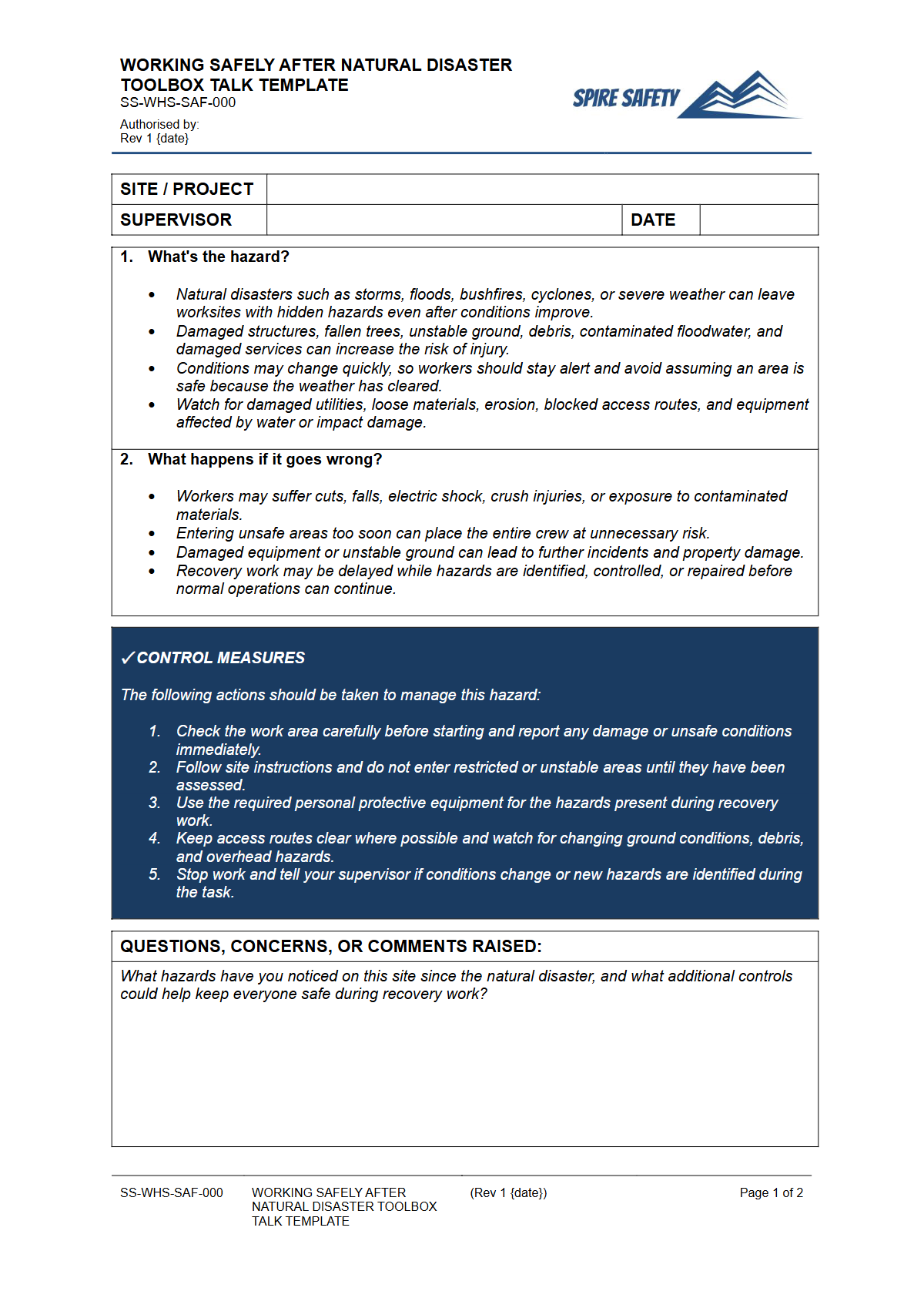
This free WHS resource provides a structured template for a Working Safely After Natural Disaster Toolbox Talk. It's designed to help Australian workplaces initiate critical discussions about hazards and safety protocols following natural disaster events such as floods, bushfires, storms, or cyclones.
The template supports organisations in reviewing their emergency procedures, assessing new risks, and reinforcing safe work practices. Utilising this template can assist in maintaining productivity while prioritising the safety and wellbeing of all workers during recovery operations.
Understanding and addressing the unique challenges presented by a post-disaster environment is crucial for preventing injuries and illnesses. This Toolbox Talk serves as a practical tool for engaging your team in essential safety conversations, promoting a proactive approach to risk management aligned with Australian WHS practice.
Video walkthrough
How to use this Toolbox Talk
Our Working Safely After Natural Disaster Toolbox Talk Template is provided in an editable DOCX format, making it easy to adapt to your specific workplace context. Organise a meeting with your team and use this template to guide a discussion on the potential hazards and necessary controls when returning to work after a natural disaster.
Encourage open dialogue, questions, and shared experiences from your workers.
Remember, this template is a structured starting point; it must be customised to your workplace's specific risks, work environment, and the unique conditions resulting from the natural disaster event. Update it with relevant site-specific information, emergency contacts, and control measures. Supplement the discussion with visual aids or practical demonstrations where appropriate, and ensure all attendees sign off to acknowledge their participation and understanding.
When to use it
This Toolbox Talk should be used as soon as reasonably practicable when resuming or commencing work in an area affected by a natural disaster. It is essential to hold this discussion before workers engage in tasks that may expose them to new or altered hazards.
It can also be beneficial as part of regular emergency preparedness drills, even outside of immediate disaster recovery, to ensure that workers are familiar with procedures and potential risks.
Regular refreshers may also be necessary, particularly if post-disaster conditions change, or if new teams or contractors are brought in to assist with recovery efforts. Early and consistent communication is key to managing safety effectively in these dynamic environments.
Who should use it
This Toolbox Talk Template is suitable for WHS managers, supervisors, team leaders, and anyone responsible for leading team meetings or induction sessions in an Australian workplace affected by a natural disaster. It is particularly relevant for industries involved in clean-up, reconstruction, or operations in areas physically impacted by such events.
All workers, including employees, contractors, and volunteers, should participate in this Toolbox Talk to ensure a shared understanding of safety protocols and responsibilities when working safely after a natural disaster.
It also serves as a valuable resource for organisations looking to build more robust WHS management systems and improve their overall emergency preparedness and response capabilities.
Common mistakes
Common mistakes to avoid
- Underestimating new or changed hazards in the post-disaster environment.
- Failing to properly inspect and assess the workplace before re-entry.
- Not involving workers in the discussion and identification of risks.
- Neglecting to customise generic safety advice to the specific disaster and workplace conditions.
Legal references
Legal considerations
The following legal requirements may be relevant to this type of work.
- Work Health and Safety Act (Harmonised) — Provides the primary duties for protecting workers and other people from work health and safety risks.
- Work Health and Safety Regulations (Harmonised) — Sets out requirements supporting the management of workplace hazards and risks.
The following codes may be relevant to this type of work.
- Managing WHS Risks Code of Practice — Provides practical guidance on identifying hazards, assessing risks and applying effective controls.
- Work Health and Safety Consultation, Cooperation and Coordination Code of Practice — Provides practical guidance on consulting workers and coordinating with other duty holders.
- Managing the Work Environment and Facilities Code of Practice — Provides practical guidance on safe work environments, workplace facilities and related controls.
Did you know
Invisible Hazards
Natural disasters can leave behind 'invisible' hazards like contaminated water, unstable structures, or compromised air quality due to mould or dust, which may not be immediately obvious but pose significant health risks.
Psychosocial Impact
Beyond physical safety, natural disasters can have a considerable psychosocial impact on workers. Providing support and acknowledging the stress experienced during and after such events is a critical aspect of WHS.
FAQ
Frequently asked questions
01What is a Toolbox Talk?
02Why is a Toolbox Talk important after a natural disaster?
03Who needs to attend a Working Safely After Natural Disaster Toolbox Talk?
04How often should we deliver this specific Toolbox Talk?
Share this resource
Working Safely After Natural Disaster Toolbox Talk Template
Browse Categories
How To Use It
- 1Download and open in Word or PDF.
- 2Replace the placeholders with your business details.
- 3Get it reviewed by a WHS specialist before rollout.
Need it customised?
Our WHS consultants can adapt this template to your site, run a gap analysis, or audit what you already have in place.
Book a Free Consultation WHS consulting servicesor call 1300 156 382