
Working Near Live Traffic Toolbox Talk Template
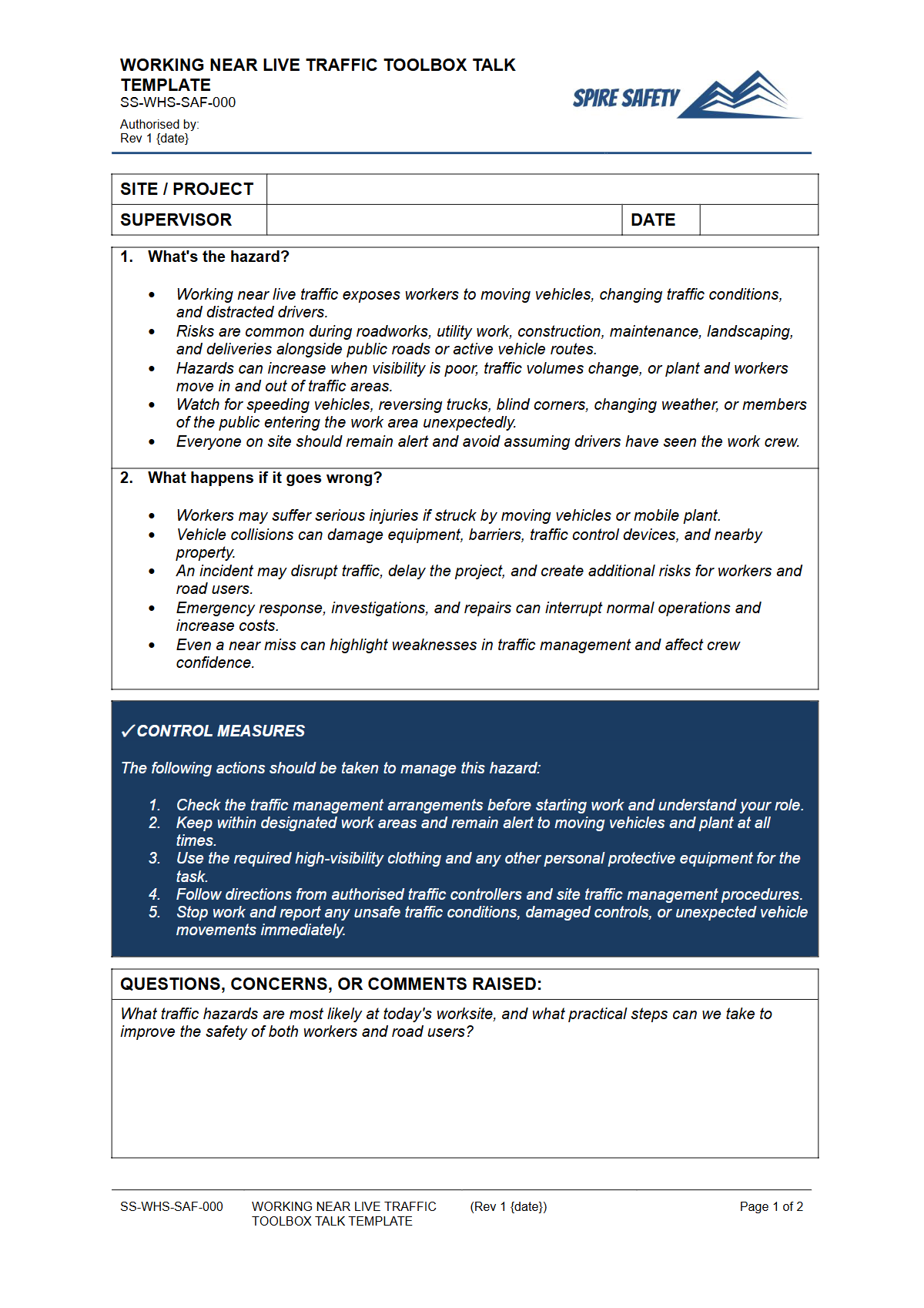
Download our free Working Near Live Traffic Toolbox Talk Template to discuss critical safety with your team.
Working Near Live Traffic Toolbox Talk Template
DOCX • 139 KB + PDF
Updated Oct 2026
No signup required
Purpose of this document
This free Working Near Live Traffic Toolbox Talk Template provides a structured framework for facilitating an essential safety discussion with your team. Working near live traffic environments presents significant risks, and effective communication is paramount to hazard identification and risk control.
This template is designed to help organisations address the unique challenges of pedestrian and vehicular interactions in workzones, promoting a proactive approach to WHS.
It covers key considerations for planning, implementing, and reviewing work activities where there's a risk of collision or incident involving moving vehicles and personnel. This resource is aligned with Australian WHS practice and informed by the model WHS framework, offering a valuable tool for regular safety briefings and discussions.
Video walkthrough
How to use this Toolbox Talk
Our Working Near Live Traffic Toolbox Talk Template is a downloadable, editable document intended for supervisors and safety officers to lead discussions with workers. To use it, simply download the DOCX file, review the content, and tailor it to the specific conditions of your workplace and the project at hand. We've included prompts and example discussion points, but these must be customised to your workplace’s specific hazards, control measures, and operational procedures.
Before conducting the talk, ensure you have a clear understanding of the site-specific traffic management plan, relevant WHS procedures, and any incident history. During the session, encourage active participation, questions, and feedback from all workers.
Document attendance and key discussion points for your records as part of your overall WHS management systems. This template serves as a starting point; robust safety outcomes depend on diligent customisation and application.
When to use it
This Toolbox Talk is ideal for use during pre-start meetings, project inductions, or as a recurring safety topic for teams regularly working near live traffic. It's particularly useful:
- Before commencing new projects or tasks involving traffic interactions.
- When there are changes to traffic conditions, site layout, or work procedures.
- Following an incident, near miss, or safety observation related to traffic.
- As part of ongoing safety education and refresher training.
- To reinforce WHS policies and procedures related to traffic management.
Regular communication using tools like this template helps maintain a high level of safety awareness among all personnel, contributing to a safer work environment for everyone involved.
Who should use it
This Working Near Live Traffic Toolbox Talk Template is primarily designed for:
- Supervisors and Team Leaders: To lead effective safety discussions with their work crews.
- Safety Officers and Managers: As a tool for promoting consistent safety messaging across different teams and projects.
- Project Managers: To ensure that traffic management risks are adequately addressed at the operational level.
- Workers: While not designed for workers to conduct the talk, they are the primary audience for the information and should actively participate in the discussion.
It's an essential resource for any organisation whose operations involve working on or adjacent to public roads, construction sites with vehicle movement, or any area where there's a risk of interaction with live traffic. For additional resources, explore our free WHS resources library.
Common mistakes
Common mistakes to avoid
- Not adequately separating workers from live traffic.
- Failing to review and update traffic management plans as conditions change.
- Inadequate signage or poor visibility of work zones and workers.
- Lack of communication between workers and vehicle operators.
Legal references
Legal considerations
The following legal requirements may be relevant to this type of work.
- Work Health and Safety Act (Harmonised) — Provides the primary duties for protecting workers and other people from work health and safety risks.
- Work Health and Safety Regulations (Harmonised) — Sets out requirements supporting the management of workplace hazards and risks.
The following codes may be relevant to this type of work.
- Managing WHS Risks Code of Practice — Provides practical guidance on identifying hazards, assessing risks and applying effective controls.
- Work Health and Safety Consultation, Cooperation and Coordination Code of Practice — Provides practical guidance on consulting workers and coordinating with other duty holders.
- Managing the Work Environment and Facilities Code of Practice — Provides practical guidance on safe work environments, workplace facilities and related controls.
Did you know
Pedestrian Worker Injuries
In Australia, a significant number of serious injuries and fatalities in the construction and road work sectors involve workers being struck by vehicles, highlighting the critical need for effective traffic management.
The 'Fatal Five'
Working near live traffic often involves risks associated with the 'Fatal Five' in construction: falling from heights, struck by moving objects, contact with electricity, excavating, and plant/vehicle rollovers.
FAQ
Frequently asked questions
01What is a Toolbox Talk?
02Why is working near live traffic considered high risk?
03How often should I conduct a Toolbox Talk on traffic safety?
04Does this template guarantee WHS compliance?
Share this resource
Working Near Live Traffic Toolbox Talk Template
Browse Categories
How To Use It
- 1Download and open in Word or PDF.
- 2Replace the placeholders with your business details.
- 3Get it reviewed by a WHS specialist before rollout.
Need it customised?
Our WHS consultants can adapt this template to your site, run a gap analysis, or audit what you already have in place.
Book a Free Consultation WHS consulting servicesor call 1300 156 382
Related templates
- Working Near Overhead Powerlines Toolbox Talk Template
- Working Safely After Natural Disaster Toolbox Talk Template
- Working Safely Under Pressure Deadlines Toolbox Talk Template
- Workplace Bullying and Harassment Toolbox Talk Template
- Aged Care Manual Handling Toolbox Talk Template
- Angle Grinder Safety Toolbox Talk Template