
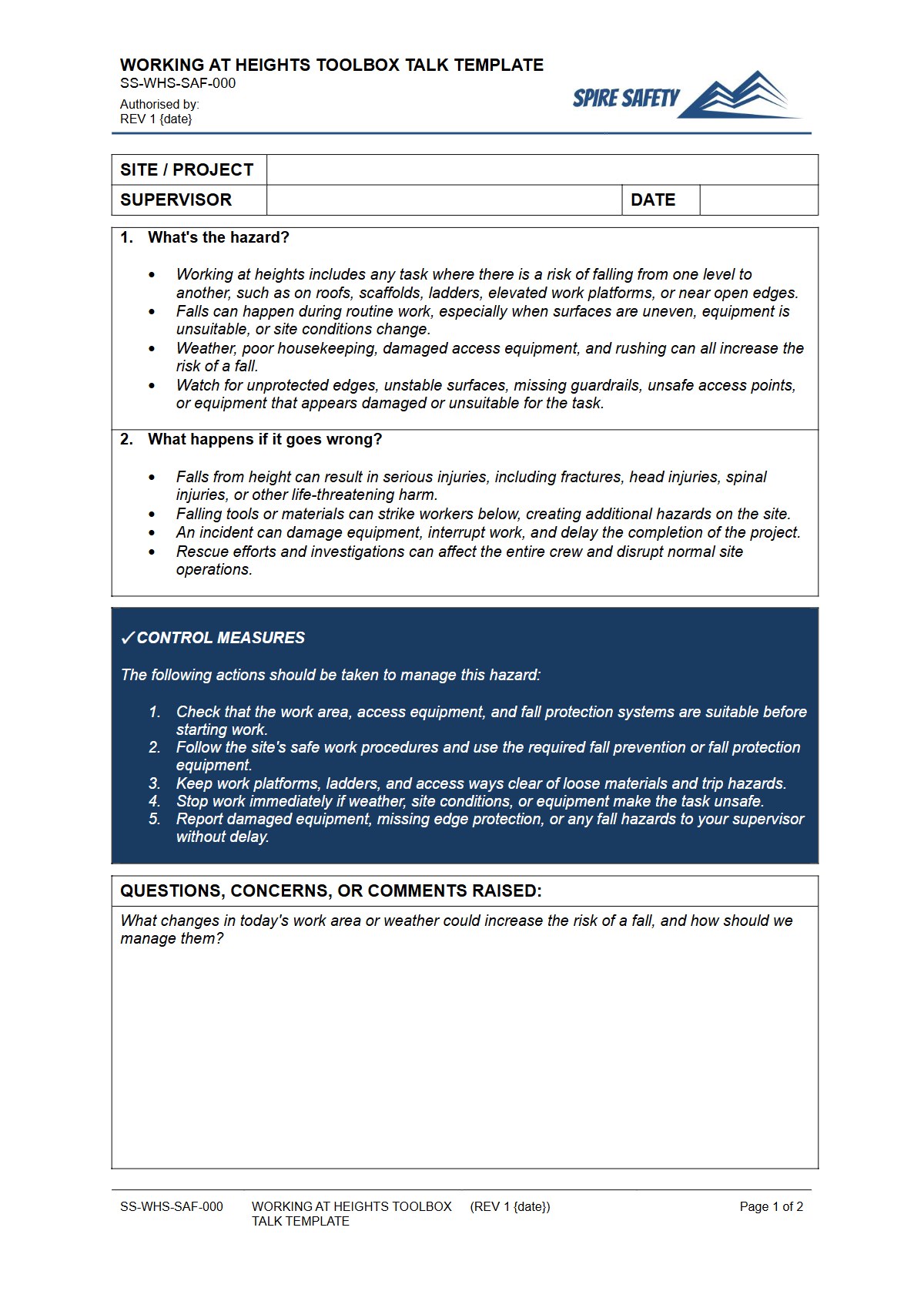
Working at Heights Toolbox Talk Template
Download our free Working at Heights Toolbox Talk Template, designed to help you conduct effective WHS discussions. Get your DOCX and PDF today!
Working at Heights Toolbox Talk Template
DOCX • 142 KB + PDF
Updated Oct 2026
No signup required
Purpose of this Toolbox Talk
Our free Working at Heights Toolbox Talk Template provides a structured starting point for conducting essential safety discussions with your team. This template is designed to help facilitators effectively communicate critical WHS information related to work at height, promoting a safer work environment and fostering a proactive approach to hazard identification and risk control.
Regular toolbox talks are a cornerstone of effective WHS management, ensuring that all workers are aware of potential risks and appropriate control measures.
This resource aligns with Australian WHS practice by focusing on key elements of fall prevention and safe work at heights, encouraging open dialogue, and reinforcing safe work procedures. It serves as a valuable tool for reinforcing safe work practices, discussing recent incidents or near misses, introducing new equipment, or addressing specific site conditions related to working at height.
Video walkthrough
How to use this Toolbox Talk
This Working at Heights Toolbox Talk Template is provided in both DOCX and PDF formats for your convenience. The DOCX version is fully editable, allowing you to tailor the content to the specific hazards, risks, and control measures relevant to your workplace and particular work activities.
Before conducting the talk, review the template thoroughly and customise it with examples, photos, or specific procedures from your site. Remember, this template must be customised to your workplace to be effective and relevant.
During the toolbox talk, encourage active participation from all attendees. Facilitate discussions, ask open-ended questions, and allow workers to share their experiences and concerns.
Document attendance and any key discussion points or actions agreed upon. This record serves as evidence of consultation and training, contributing to your overall WHS management systems.
When to use it
Regular toolbox talks, including those on working at heights, should be integrated into your WHS schedule. This template is ideal for use:
- Before commencing any work involving heights, especially new projects or tasks.
- As part of routine safety meetings on a weekly or fortnightly basis.
- Following a near miss or incident related to falls from height.
- When new equipment or work methods for working at height are introduced.
- After significant changes to site conditions or work environments that could impact fall risks.
- As a refresher training session for all personnel involved in work at heights.
Consistent application helps maintain a high level of WHS awareness and vigilance regarding fall prevention.
Who should use it
This Working at Heights Toolbox Talk Template is suitable for a range of individuals responsible for WHS and operational management, including:
- Site Managers and Supervisors who lead work teams.
- WHS Officers and Coordinators responsible for delivering safety training.
- Team Leaders overseeing specific tasks involving work at heights.
- Managers committed to fostering a strong safety culture within their organisation.
It is designed to be user-friendly for anyone tasked with communicating critical WHS information to workers, from seasoned WHS professionals to those new to facilitating safety discussions. Check out our free WHS resources library for more useful tools.
Common mistakes
Common mistakes to avoid
- Not customising the toolbox talk to specific site conditions or tasks.
- Relying solely on a template without facilitating genuine discussion or worker input.
- Failing to record attendance or key actions/decisions from the talk.
- Not following up on actions or concerns raised during the toolbox talk.
Legal references
Legal considerations
The following legal requirements may be relevant to this type of work.
- Work Health and Safety Act (Harmonised) — Provides the primary duties for protecting workers and other people from work health and safety risks.
- Work Health and Safety Regulations (Harmonised) — Sets out requirements supporting the management of workplace hazards and risks.
The following codes may be relevant to this type of work.
- Managing WHS Risks Code of Practice — Provides practical guidance on identifying hazards, assessing risks and applying effective controls.
- Work Health and Safety Consultation, Cooperation and Coordination Code of Practice — Provides practical guidance on consulting workers and coordinating with other duty holders.
- Managing the Work Environment and Facilities Code of Practice — Provides practical guidance on safe work environments, workplace facilities and related controls.
Did you know
Falls are a leading cause of workplace fatalities
Safe Work Australia statistics consistently show 'falls from a height' as one of the top causes of workplace fatalities and serious injuries across various industries.
A falling object can be as dangerous as a fall
It's not just falls by people that cause harm; falling objects from height can also result in severe injuries or fatalities to those below, highlighting the importance of exclusion zones and securing tools and materials.
FAQ
Frequently asked questions
01What is a Working at Heights Toolbox Talk?
02How often should working at heights toolbox talks be conducted?
03What topics should a Working at Heights Toolbox Talk cover?
04Are toolbox talks legally required in Australia for working at heights?
Share this resource
Working at Heights Toolbox Talk Template
Browse Categories
How To Use It
- 1Download and open in Word or PDF.
- 2Replace the placeholders with your business details.
- 3Get it reviewed by a WHS specialist before rollout.
Need it customised?
Our WHS consultants can adapt this template to your site, run a gap analysis, or audit what you already have in place.
Book a Free Consultation WHS consulting servicesor call 1300 156 382
Related templates
- Working at Night - Security and Safety Toolbox Talk Template
- Working in Cold Wet Conditions Toolbox Talk Template
- Working in Extreme Heat Toolbox Talk Template
- Working Near Live Traffic Toolbox Talk Template
- Working Near Overhead Powerlines Toolbox Talk Template
- Working Safely After Natural Disaster Toolbox Talk Template