
Wet Season Storm Preparation Toolbox Talk Template
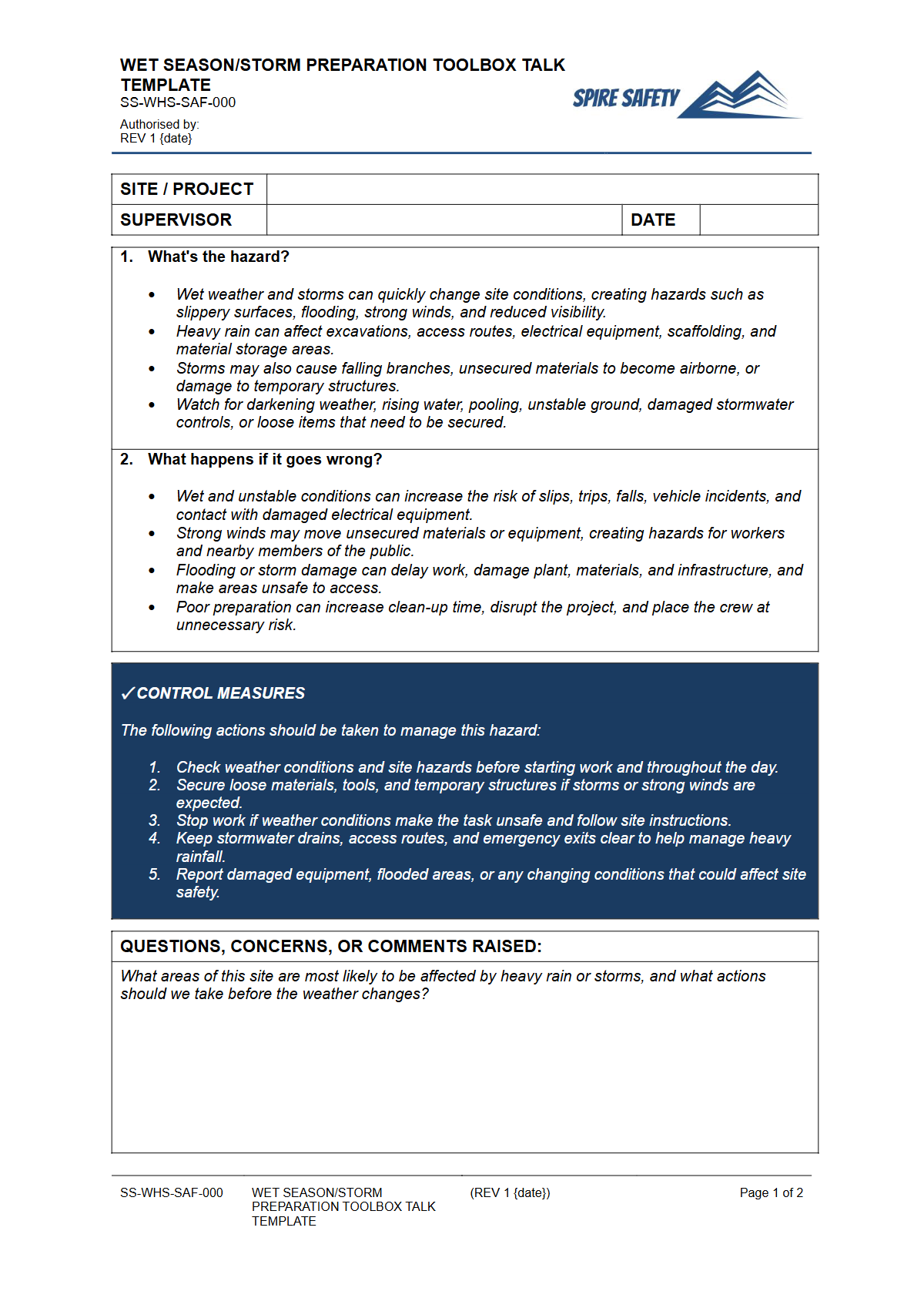
Download our free Wet Season Storm Preparation Toolbox Talk Template. A structured starting point for discussing critical safety procedures. Get yours now!
Wet Season Storm Preparation Toolbox Talk Template
DOCX • 142 KB + PDF
Updated Oct 2026
No signup required
Purpose of this document
Our Wet Season Storm Preparation Toolbox Talk Template provides a structured framework for facilitating discussions about preparing for and responding to severe weather events. This resource helps organisations communicate essential safety information, reinforce WHS procedures, and promote a proactive approach to risk management during Australia's wet seasons.
It aims to ensure workers understand their roles in maintaining a safe workplace when faced with adverse weather, covering topics from hazard identification to emergency response.
Video walkthrough
How to use this Toolbox Talk
This Wet Season Storm Preparation Toolbox Talk Template is a starting point designed to prompt discussion among your workers. It outlines key topics for a toolbox talk on wet season storm preparation.
To be effective, it must be customised to your workplace's specific risks, procedures, and local weather conditions. Consider adding details specific to your site, such as established evacuation routes, contact information for emergency services, and the location of storm-related equipment. Encourage open dialogue, questions, and worker contributions to tailor the content further and ensure it resonates with your team.
Remember, a successful toolbox talk is interactive and relevant to the daily operations and environmental context of your business.
When to use it
This Toolbox Talk is ideal for use during the lead-up to and throughout wet seasons, particularly in regions prone to heavy rainfall, cyclones, or severe storms. It should be conducted:
- Before the official start of the wet season, as part of pre-season preparations.
- Periodically during the wet season to reinforce safety messages and address emerging concerns related to specific weather forecasts.
- After any significant storm event to debrief, identify lessons learned, and update procedures.
- As part of induction for new workers who will be operating in areas susceptible to severe weather.
Integrating this discussion into your regular WHS management systems demonstrates a commitment to worker safety and proactive risk mitigation.
Who should use it
This Wet Season Storm Preparation Toolbox Talk Template is intended for:
- Supervisors and Team Leaders: Those responsible for leading teams and daily operations should use this to brief their workers.
- Safety Officers and WHS Managers: To ensure consistent messaging and reinforce organisational safety policies.
- Project Managers: To integrate storm preparedness into project planning and execution, especially for outdoor or remote work sites.
- Business Owners and PCBU representatives: To demonstrate due diligence and promote a strong safety culture across the organisation. For comprehensive support in this area, consider exploring WHS consulting services offered by Spire Safety.
Common mistakes
Common mistakes to avoid
- Not customising the template to specific site conditions and risks.
- Failing to encourage worker participation and feedback during the talk.
- Not reviewing and updating procedures based on actual storm events or near misses.
- Assuming all workers already know vital storm preparation steps without formal discussion.
Legal references
Legal considerations
The following legal requirements may be relevant to this type of work.
- Work Health and Safety Act (Harmonised) — Provides the primary duties for protecting workers and other people from work health and safety risks.
- Work Health and Safety Regulations (Harmonised) — Sets out requirements supporting the management of workplace hazards and risks.
The following codes may be relevant to this type of work.
- Managing WHS Risks Code of Practice — Provides practical guidance on identifying hazards, assessing risks and applying effective controls.
- Work Health and Safety Consultation, Cooperation and Coordination Code of Practice — Provides practical guidance on consulting workers and coordinating with other duty holders.
- Managing the Work Environment and Facilities Code of Practice — Provides practical guidance on safe work environments, workplace facilities and related controls.
Did you know
Australia's Cyclone Season
On average, Australia experiences around 10-13 tropical cyclones in its region each year, with around half making landfall. This highlights the critical need for robust wet season preparation.
Electrical Storm Safety
Lightning strikes are a significant hazard during wet season storms. Workers should be trained to recognise the risks and know when to cease outdoor work and seek shelter during electrical activity.
FAQ
Frequently asked questions
01What is a 'wet season' in the Australian context?
02How often should we conduct this Wet Season Storm Preparation Toolbox Talk?
03Can this template be adapted for different industries?
04What are some key elements to cover in a storm preparation toolbox talk?
Share this resource
Wet Season Storm Preparation Toolbox Talk Template
Browse Categories
How To Use It
- 1Download and open in Word or PDF.
- 2Replace the placeholders with your business details.
- 3Get it reviewed by a WHS specialist before rollout.
Need it customised?
Our WHS consultants can adapt this template to your site, run a gap analysis, or audit what you already have in place.
Book a Free Consultation WHS consulting servicesor call 1300 156 382