
Welding Safety Toolbox Talk Template
Download our free Welding Safety Toolbox Talk Template to conduct effective safety discussions with your team. A structured starting point for your workplace.
Welding Safety Toolbox Talk Template
DOCX • 140 KB + PDF
Updated Oct 2026
No signup required
Purpose of this document
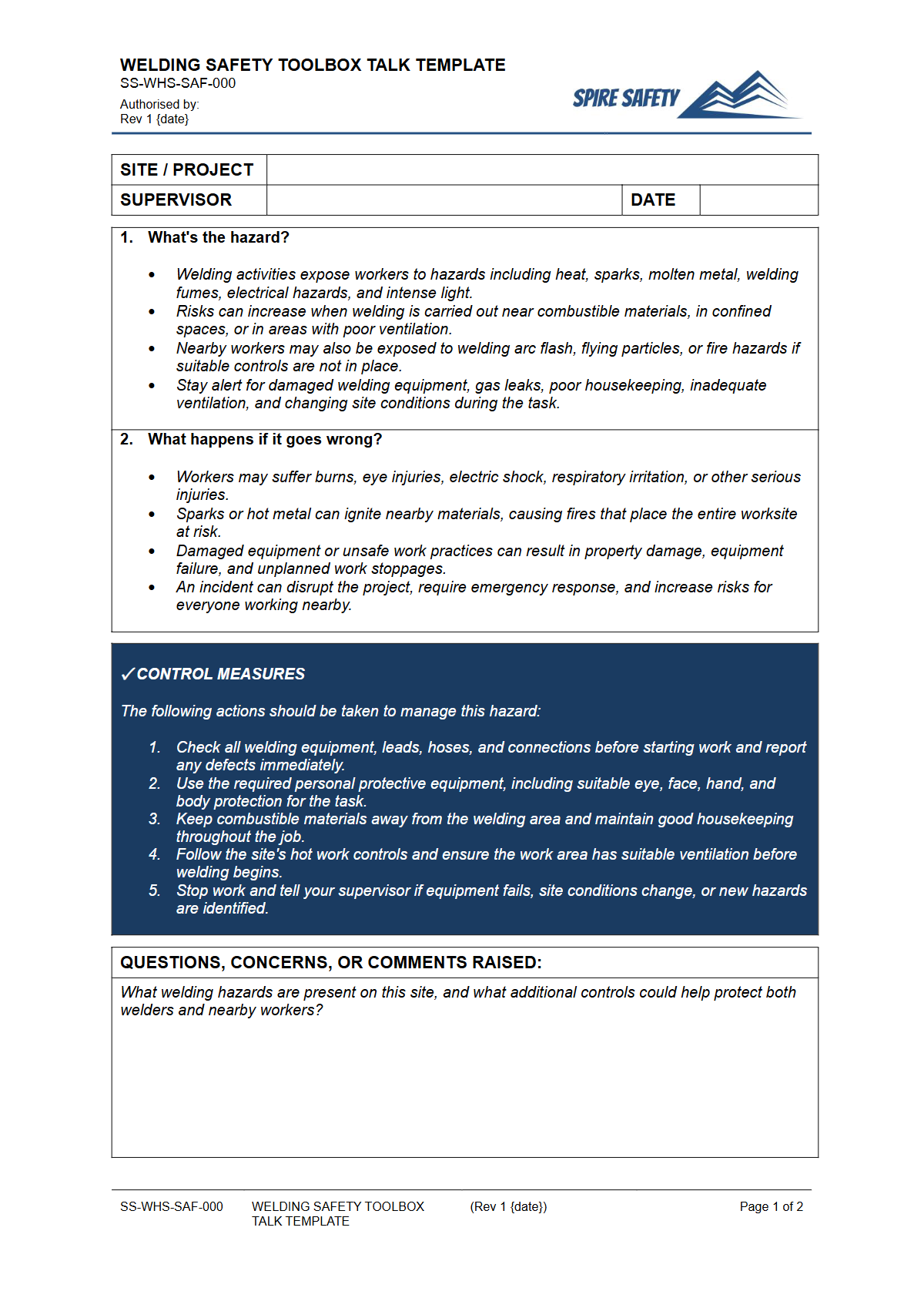
This Welding Safety Toolbox Talk Template provides a structured starting point for conducting essential safety discussions with your team. Welding operations, while fundamental to many industries, inherently involve significant risks, including exposure to fumes, burns, electric shock, fire, and eye injuries.
This template is designed to help organisations foster a proactive safety culture by facilitating regular, brief team meetings focused on identifying and mitigating these specific hazards.
By utilising this template, you can systematically cover critical safety topics related to welding, ensuring your workers are regularly reminded of best practices, control measures, and emergency procedures. It aims to improve hazard recognition, reinforce safe work behaviours, and encourage open communication about safety concerns on site.
Regular toolbox talks are a cornerstone of effective WHS management systems, helping to maintain a high level of safety awareness and contribute to a safer work environment for all involved in welding activities.
Video walkthrough
How to use this Toolbox Talk
Our Welding Safety Toolbox Talk Template is provided in an editable DOCX format, making it easy to adapt to your specific workplace conditions and welding tasks. To effectively use this template, first download the document and review its contents.
It outlines common welding hazards, relevant control measures, and discussion points. You must customise this template to your workplace's unique risks, equipment, and specific WHS policies and procedures. Remove sections that do not apply and add elements that are specific to your operations.
This might include details on particular types of welding equipment used, site-specific emergency protocols, or recent incidents that provide relevant learning opportunities.
Before conducting the toolbox talk, prepare by gathering any relevant visual aids, such as personal protective equipment (PPE) samples, equipment diagrams, or safety data sheets (SDS) for welding consumables. During the talk, encourage active participation from all workers.
Ask open-ended questions to stimulate discussion, clarify any misunderstandings, and gather feedback on existing safety procedures. Document attendance and key discussion points, including any actions agreed upon, to maintain a record of your safety efforts.
This template is a valuable tool to support your WHS obligations, but its effectiveness depends on thorough customisation and active engagement during the discussion.
When to use it
This Welding Safety Toolbox Talk Template is ideal for use during regular safety meetings, particularly before commencing new welding projects, when new welding equipment is introduced, or after any incident or near miss involving welding operations. It's also highly beneficial for refreshers when there's a perceived dip in safety awareness or if new workers join the team who require an induction into safe welding practices.
Consistent use of toolbox talks helps embed safety into the daily routine and ensures that welding safety remains a priority.
Who should use it
This resource is valuable for a wide range of individuals and roles involved in overseeing or conducting welding operations. This includes WHS managers, supervisors, team leaders, forepersons, and project managers responsible for maintaining a safe working environment.
It is also highly relevant for WHS committees and safety representatives seeking to facilitate meaningful safety discussions. Any organisation or individual committed to enhancing welding safety and fulfilling their WHS duty of care will find this template beneficial as part of their broader free WHS resources library.
Common mistakes
Common mistakes to avoid
- Failing to conduct a thorough pre-welding hot work permit assessment.
- Using incorrect or damaged Personal Protective Equipment (PPE).
- Inadequate ventilation in welding areas, leading to fume accumulation.
- Neglecting to properly isolate electrical equipment before maintenance or troubleshooting.
Legal references
Legal considerations
The following legal requirements may be relevant to this type of work.
- Work Health and Safety Act (Harmonised) — Provides the primary duties for protecting workers and other people from work health and safety risks.
- Work Health and Safety Regulations (Harmonised) — Sets out requirements supporting the management of workplace hazards and risks.
The following codes may be relevant to this type of work.
- Managing WHS Risks Code of Practice — Provides practical guidance on identifying hazards, assessing risks and applying effective controls.
- Work Health and Safety Consultation, Cooperation and Coordination Code of Practice — Provides practical guidance on consulting workers and coordinating with other duty holders.
- Managing the Work Environment and Facilities Code of Practice — Provides practical guidance on safe work environments, workplace facilities and related controls.
Did you know
Invisible Hazards
Welding fumes and gases can contain hazardous particulate matter and vapours that are often invisible, posing long-term respiratory and health risks if not properly controlled.
Arc Eye Risk
Exposure to intense UV radiation from welding arcs can cause 'arc eye' or photokeratitis, a painful but usually temporary inflammation of the cornea, highlighting the importance of proper eye protection.
FAQ
Frequently asked questions
01What is covered in the Welding Safety Toolbox Talk Template?
02How often should I conduct a welding safety toolbox talk?
03Can this template be used for all types of welding?
04Is this template a substitute for formal welding safety training?
Share this resource
Welding Safety Toolbox Talk Template
Browse Categories
How To Use It
- 1Download and open in Word or PDF.
- 2Replace the placeholders with your business details.
- 3Get it reviewed by a WHS specialist before rollout.
Need it customised?
Our WHS consultants can adapt this template to your site, run a gap analysis, or audit what you already have in place.
Book a Free Consultation WHS consulting servicesor call 1300 156 382