
Underground Services Awareness Toolbox Talk Template
Download your free Underground Services Awareness Toolbox Talk Template. A clear, structured tool to guide discussions on hazards for your team's safety.
Underground Services Awareness Toolbox Talk Template
DOCX • 139 KB + PDF
Updated Oct 2026
No signup required
Purpose of this document
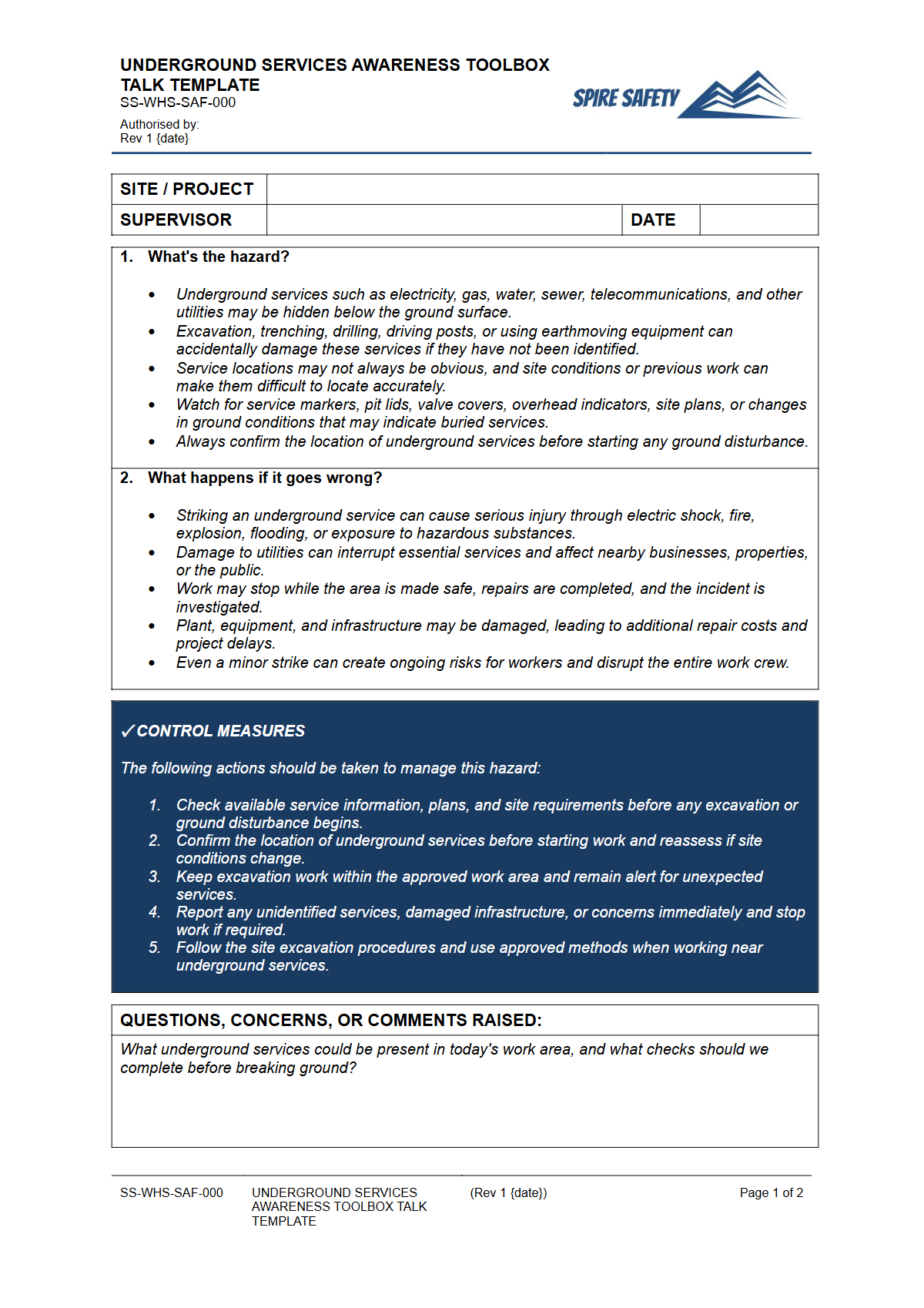
This Underground Services Awareness Toolbox Talk Template provides a structured framework for conducting essential discussions on the hazards associated with working near underground services. It’s designed to help organisations and work teams understand, identify, and control risks related to subterranean infrastructure like gas lines, electrical cables, water pipes, and communication conduits.
Utilising this template facilitates a proactive approach to hazard recognition and control, contributing to a safer work environment in line with Australian WHS practices.
Effectively managing WHS risks, particularly in complex areas like underground services, is a core component of robust WHS management systems. This template supports the consistent delivery of vital safety information, ensuring all personnel are aware of the potential dangers and necessary precautions before commencing work.
Video walkthrough
How to use this Toolbox Talk
Our Underground Services Awareness Toolbox Talk Template is provided in an editable DOCX format, making it easy to adapt for your specific workplace needs. The document includes sections for discussion points, hazard identification, control measures, and attendee sign-off. To use it effectively:
- Download the DOCX file and customise the content to reflect the specific underground services, risks, and control measures relevant to your work site and projects.
- Review the discussion points and, where necessary, add site-specific examples or scenarios relevant to your team’s daily tasks.
- Ensure that the information presented is accurate and reflects current site conditions and WHS procedures.
- Conduct the talk in an environment conducive to open discussion and worker participation.
- Emphasise the importance of communication, utility locating procedures, and emergency response plans.
- It is essential that this template is customised to your workplace’s specific risks, procedures, and conditions to be effective. This template should serve as a practical starting point, not a complete solution.
When to use it
This Underground Services Awareness Toolbox Talk Template should be used before commencing any work that involves or has the potential to impact underground services. This includes, but is not limited to, excavation, drilling, piling, landscaping, or any ground-penetrating activities. It’s also beneficial for:
- Pre-start meetings for new projects or phases of work where underground services are a known or potential hazard.
- As part of ongoing WHS training refreshers to reinforce safe work practices.
- Following any near-miss incidents or safety observations related to underground services, to highlight lessons learned.
- When new equipment or work methods are introduced that impact ground disturbance.
Who should use it
This template is suitable for anyone responsible for conducting or overseeing work that may encounter underground services in an Australian workplace. This includes:
- Site supervisors and project managers who lead work teams.
- Health and Safety Representatives (HSRs) looking to facilitate safety discussions.
- WHS officers seeking structured tools for training and awareness.
- Workers performing ground disturbance activities, as part of their pre-task briefing.
- Anyone involved in the planning or execution of work that could impact underground infrastructure.
Providing regular, targeted WHS education through tools like this toolbox talk is a cornerstone of effective WHS consulting and sound workplace safety culture.
Common mistakes
Common mistakes to avoid
- Failing to conduct a thorough site investigation and 'Dial Before You Dig' enquiry before any excavation.
- Assuming the location or depth of services based on old plans or anecdotal evidence without verification.
- Not using appropriate personal protective equipment (PPE) or safe digging methods (e.g., hand digging within an exclusion zone).
- Failing to clearly mark and communicate the location of identified underground services to all workers involved.
Legal references
Legal considerations
The following legal requirements may be relevant to this type of work.
- Work Health and Safety Act (Harmonised) — Provides the primary duties for protecting workers and other people from work health and safety risks.
- Work Health and Safety Regulations (Harmonised) — Sets out requirements supporting the management of workplace hazards and risks.
The following codes may be relevant to this type of work.
- Managing WHS Risks Code of Practice — Provides practical guidance on identifying hazards, assessing risks and applying effective controls.
- Work Health and Safety Consultation, Cooperation and Coordination Code of Practice — Provides practical guidance on consulting workers and coordinating with other duty holders.
- Managing the Work Environment and Facilities Code of Practice — Provides practical guidance on safe work environments, workplace facilities and related controls.
Did you know
Dial Before You Dig
In Australia, the 'Dial Before You Dig' service (1100) is a crucial free national referral service designed to prevent damage and disruption to underground infrastructure by providing information on buried assets.
Hidden Dangers
Many underground services are not directly visible and can be located at varying depths, making accurate identification and safe work practices essential, even in seemingly clear areas.
FAQ
Frequently asked questions
01What is a Toolbox Talk for underground services awareness?
02Why is underground services awareness important?
03What are common hazards associated with underground services?
04How often should underground services awareness be discussed?
Share this resource
Underground Services Awareness Toolbox Talk Template
Browse Categories
How To Use It
- 1Download and open in Word or PDF.
- 2Replace the placeholders with your business details.
- 3Get it reviewed by a WHS specialist before rollout.
Need it customised?
Our WHS consultants can adapt this template to your site, run a gap analysis, or audit what you already have in place.
Book a Free Consultation WHS consulting servicesor call 1300 156 382