
Vibration - Hand Arm and Whole Body Toolbox Talk Template
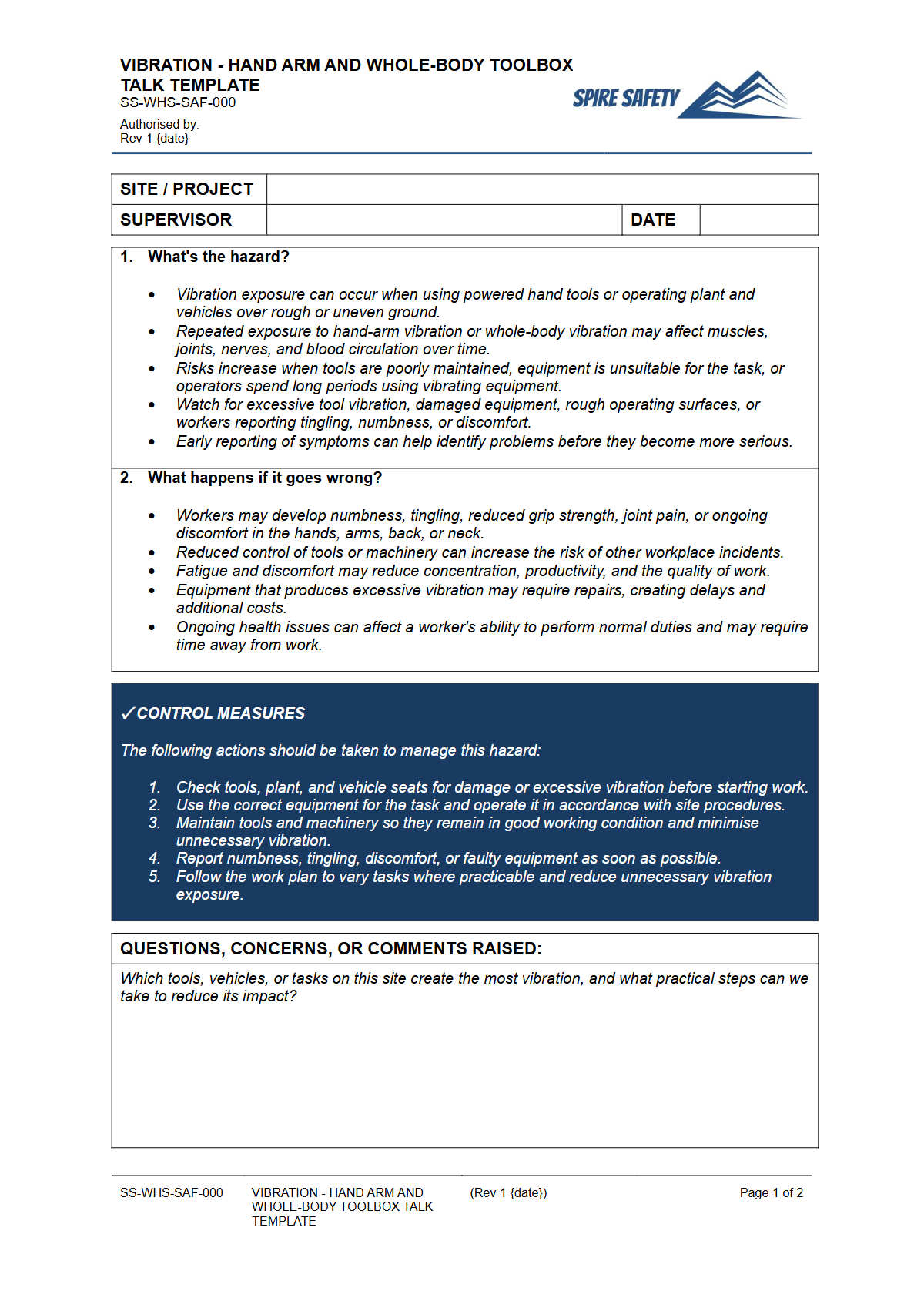
A template for your next toolbox talk on hand-arm and whole-body vibration. Educate your team on risks and controls effectively.
Vibration - Hand Arm and Whole Body Toolbox Talk Template
DOCX • 139 KB + PDF
Updated Oct 2026
No signup required
Purpose of this document
This free WHS resource provides a structured template for a Vibration - Hand Arm and Whole Body Toolbox Talk. Its primary purpose is to assist Persons Conducting a Business or Undertaking (PCBUs) and WHS professionals in communicating critical information about vibration hazards and their management to workers.
Understanding and controlling exposure to hand-arm vibration (HAV) and whole-body vibration (WBV) is crucial for preventing serious health issues, including musculoskeletal disorders and neurological damage. This template helps facilitate discussions on identifying vibration sources, assessing risks, and implementing effective control measures aligned with Australian WHS practice.
By utilising this template, organisations can enhance worker awareness regarding the health effects of vibration, promote safe work practices, and ensure that control measures are understood and applied correctly. It serves as a foundational tool for regular safety meetings, reinforcing the commitment to a safe and healthy work environment and supporting the continuous improvement of your WHS management systems.
Video walkthrough
How to use this Toolbox Talk
This Vibration - Hand Arm and Whole Body Toolbox Talk Template is provided in an editable DOCX format, making it easy to adapt to your specific workplace context. It must be customised to your workplace practices, equipment, and identified risks. We recommend reviewing the content thoroughly and inserting details relevant to your operations, such as specific machinery used, current risk assessments, and implemented control measures.
The PDF version is included for reference and convenience.
During the toolbox talk, encourage open discussion and questions from your team. This fosters a participative safety culture and ensures the information is absorbed and understood.
Document attendance and any key discussion points or actions arising from the talk. Regularly review and update the content to reflect any changes in equipment, processes, or WHS regulations, ensuring your training remains current and effective.
When to use it
This template is ideal for regular WHS meetings, particularly:
- Before commencing tasks involving vibrating tools or machinery.
- During the induction of new workers who will operate vibrating equipment.
- After any incident or near-miss related to vibration exposure.
- As part of ongoing WHS training programs and refreshers.
- When new equipment or processes that introduce vibration hazards are implemented.
- Following the review of WHS compliance auditing finding significant vibration risks.
Who should use it
This resource is designed for a broad range of WHS stakeholders:
- WHS Managers and Officers
- Supervisors and Team Leaders
- Business owners and PCBUs
- Safety Representatives
- Anyone responsible for conducting WHS training or safety briefings.
Common mistakes
Common mistakes to avoid
- Not formally assessing vibration risks for all relevant tasks.
- Relying solely on PPE like anti-vibration gloves without other controls.
- Failing to provide regular health surveillance for exposed workers.
- Not adequately training workers on the correct use of low-vibration equipment.
Legal references
Legal considerations
The following legal requirements may be relevant to this type of work.
- Work Health and Safety Act (Harmonised) — Provides the primary duties for protecting workers and other people from work health and safety risks.
- Work Health and Safety Regulations (Harmonised) — Sets out requirements supporting the management of workplace hazards and risks.
The following codes may be relevant to this type of work.
- Managing WHS Risks Code of Practice — Provides practical guidance on identifying hazards, assessing risks and applying effective controls.
- Work Health and Safety Consultation, Cooperation and Coordination Code of Practice — Provides practical guidance on consulting workers and coordinating with other duty holders.
- Managing the Work Environment and Facilities Code of Practice — Provides practical guidance on safe work environments, workplace facilities and related controls.
Did you know
Vibration Exposure Limits
Daily vibration exposure is typically measured using exposure action values (EAV) and exposure limit values (ELV) to guide risk management and prevent health effects.
HAVS Recognition
Hand-Arm Vibration Syndrome (HAVS) is also sometimes known as 'white finger' due to its effect on blood circulation in the fingers.
FAQ
Frequently asked questions
01What is the difference between hand-arm vibration and whole-body vibration?
02What are the common health risks associated with vibration exposure?
03How can I reduce worker exposure to vibration?
04Does this template supports your compliance efforts with Australian WHS laws regarding vibration?
Share this resource
Vibration - Hand Arm and Whole Body Toolbox Talk Template
Browse Categories
How To Use It
- 1Download and open in Word or PDF.
- 2Replace the placeholders with your business details.
- 3Get it reviewed by a WHS specialist before rollout.
Need it customised?
Our WHS consultants can adapt this template to your site, run a gap analysis, or audit what you already have in place.
Book a Free Consultation WHS consulting servicesor call 1300 156 382