
Visitor Safety Responsibilities Toolbox Talk Template
Download our free Visitor Safety Responsibilities Toolbox Talk Template to discuss visitor WHS requirements and promote a safer workplace in Australia.
Visitor Safety Responsibilities Toolbox Talk Template
DOCX • 141 KB + PDF
Updated Oct 2026
No signup required
Purpose of this document
This Visitor Safety Responsibilities Toolbox Talk Template is designed to facilitate discussions about the WHS responsibilities of visitors to your workplace. Recognising that visitors may not be familiar with your site-specific hazards and controls, this template provides a structured way to communicate essential safety information.
It aims to ensure that all individuals entering your premises understand their role in maintaining a safe environment and adhering to workplace health and safety protocols. By clearly outlining visitor responsibilities, organisations can proactively manage risks and prevent incidents involving non-employees.
This resource acts as a valuable tool for organisations committed to a robust safety culture and aligns with Australian WHS practice regarding the duty of care owed to all persons at a workplace.
Video walkthrough
How to use this Toolbox Talk
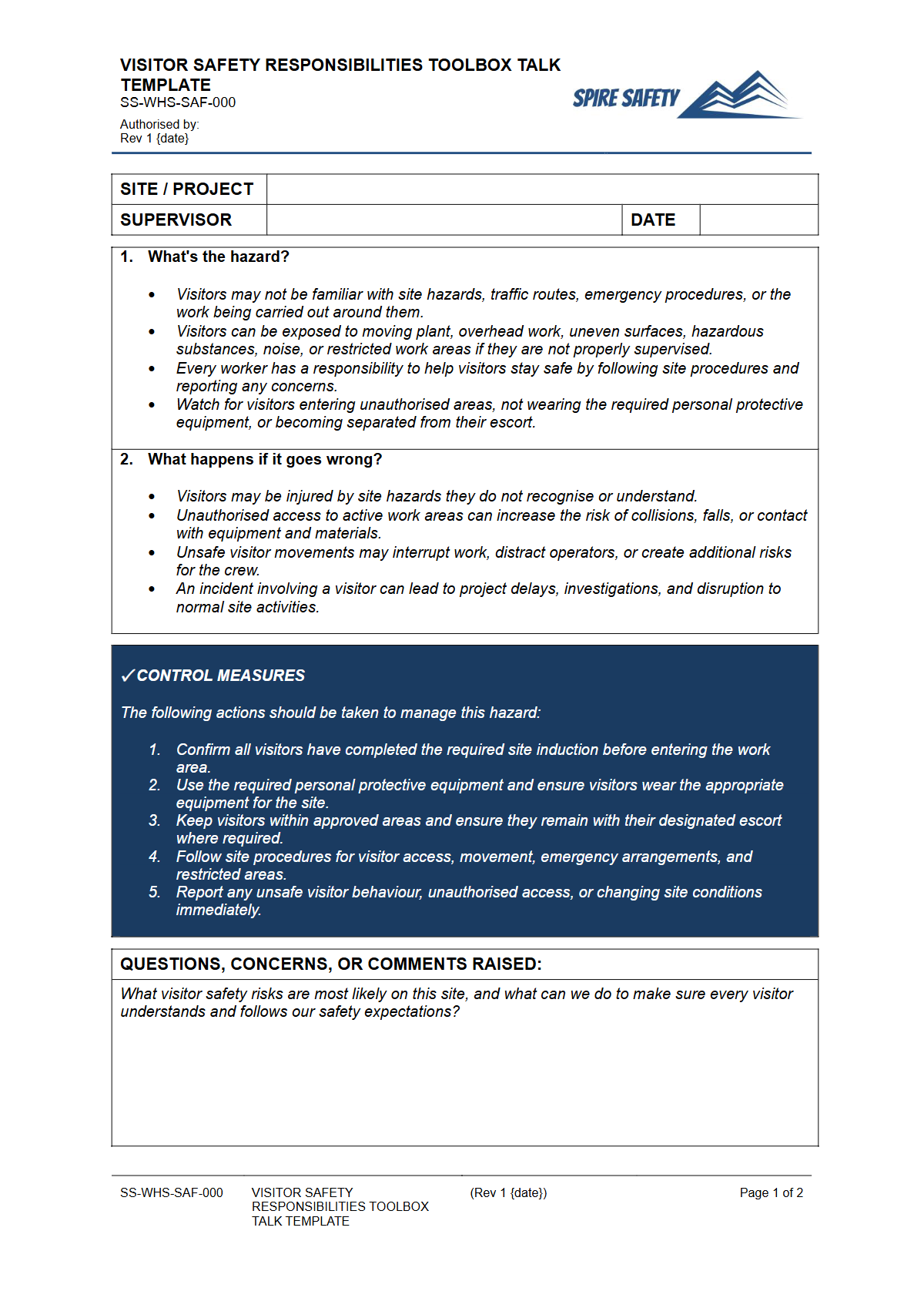
Our free Visitor Safety Responsibilities Toolbox Talk Template is provided in an editable DOCX format, making it easy to adapt to your specific workplace needs. The document includes sections for discussion points, key safety messages, and areas for recording attendance and sign-offs.
To effectively use this template:
- Download the DOCX version of the Visitor Safety Responsibilities Toolbox Talk Template.
- Review the content and customise it to reflect your specific workplace hazards, WHS policies, site rules, and visitor induction processes.
- Ensure that any site-specific personal protective equipment (PPE) requirements are clearly outlined.
- Deliver the talk to relevant personnel, such as supervisors, reception staff, or anyone responsible for visitor management.
- Encourage open discussion and questions from attendees to confirm understanding.
- Retain records of the toolbox talk, including attendee names and dates, as part of your WHS management system documentation.
Important: This template is a starting point. It must be customised to your workplace and its specific hazards, risks, controls, policies, and procedures. We do not provide legal advice; customise this document and seek expert advice as necessary. For comprehensive support in developing a safety management system, consider our WHS management systems consulting services.
When to use it
This Visitor Safety Responsibilities Toolbox Talk should be used in situations where visitors regularly access your workplace, or before a planned visit by a large group. It is particularly useful:
- As part of a visitor induction process for contractors, delivery drivers, clients, or other non-employees.
- Following any incidents or near misses involving visitors that highlight a need for clearer communication.
- When there are changes to site access procedures, specific hazards, or WHS policies that impact visitors.
- As a refresher for staff who regularly interact with or host visitors.
- As a proactive measure to reinforce safety awareness amongst all personnel regarding visitor management.
Who should use it
This Visitor Safety Responsibilities Toolbox Talk Template is a valuable resource for:
- WHS Managers and Officers: To ensure consistent safety messaging for visitors across the organisation.
- Supervisors and Team Leaders: Responsible for inducting visitors or overseeing work areas where visitors may be present.
- Reception and Administration Staff: Often the first point of contact for visitors and responsible for initial safety briefings.
- Project Managers: Especially on construction sites or at project launches where diverse groups of visitors may attend.
- Any Employee Hosting a Visitor: To understand their role in ensuring the visitor's safety and disseminating key information.
Using this template helps ensure that everyone involved in managing or interacting with visitors understands their obligations under Australian WHS law. For further assistance in managing WHS risks, explore the diverse range of free WHS resources library available on our website or consider engaging our expert WHS consulting services.
Common mistakes
Common mistakes to avoid
- Assuming visitors inherently understand your site's specific hazards.
- Not providing clear, concise, and accessible safety information to all visitors.
- Failing to enforce visitor safety rules consistently.
- Not documenting visitor inductions or safety briefings.
Legal references
Legal considerations
The following legal requirements may be relevant to this type of work.
- Work Health and Safety Act (Harmonised) — Provides the primary duties for protecting workers and other people from work health and safety risks.
- Work Health and Safety Regulations (Harmonised) — Sets out requirements supporting the management of workplace hazards and risks.
The following codes may be relevant to this type of work.
- Managing WHS Risks Code of Practice — Provides practical guidance on identifying hazards, assessing risks and applying effective controls.
- Work Health and Safety Consultation, Cooperation and Coordination Code of Practice — Provides practical guidance on consulting workers and coordinating with other duty holders.
- Managing the Work Environment and Facilities Code of Practice — Provides practical guidance on safe work environments, workplace facilities and related controls.
Did you know
Visitor vs. Worker Liability
While visitors have responsibilities, the PCBU (Person Conducting a Business or Undertaking) holds the primary duty of care to ensure, so far as is reasonably practicable, the health and safety of all persons at the workplace, including visitors.
Averaging 200 Fatalities Annually
Work-related fatalities in Australia average around 200 per year, underscoring the critical importance of effective WHS management for everyone on site, including visitors. (Source: Safe Work Australia)
FAQ
Frequently asked questions
01What is a visitor's WHS responsibility in Australia?
02Does my business need a visitor induction?
03How often should visitor safety procedures be reviewed?
04Can I prevent a visitor from entering if they don't follow safety rules?
Share this resource
Visitor Safety Responsibilities Toolbox Talk Template
Browse Categories
How To Use It
- 1Download and open in Word or PDF.
- 2Replace the placeholders with your business details.
- 3Get it reviewed by a WHS specialist before rollout.
Need it customised?
Our WHS consultants can adapt this template to your site, run a gap analysis, or audit what you already have in place.
Book a Free Consultation WHS consulting servicesor call 1300 156 382