
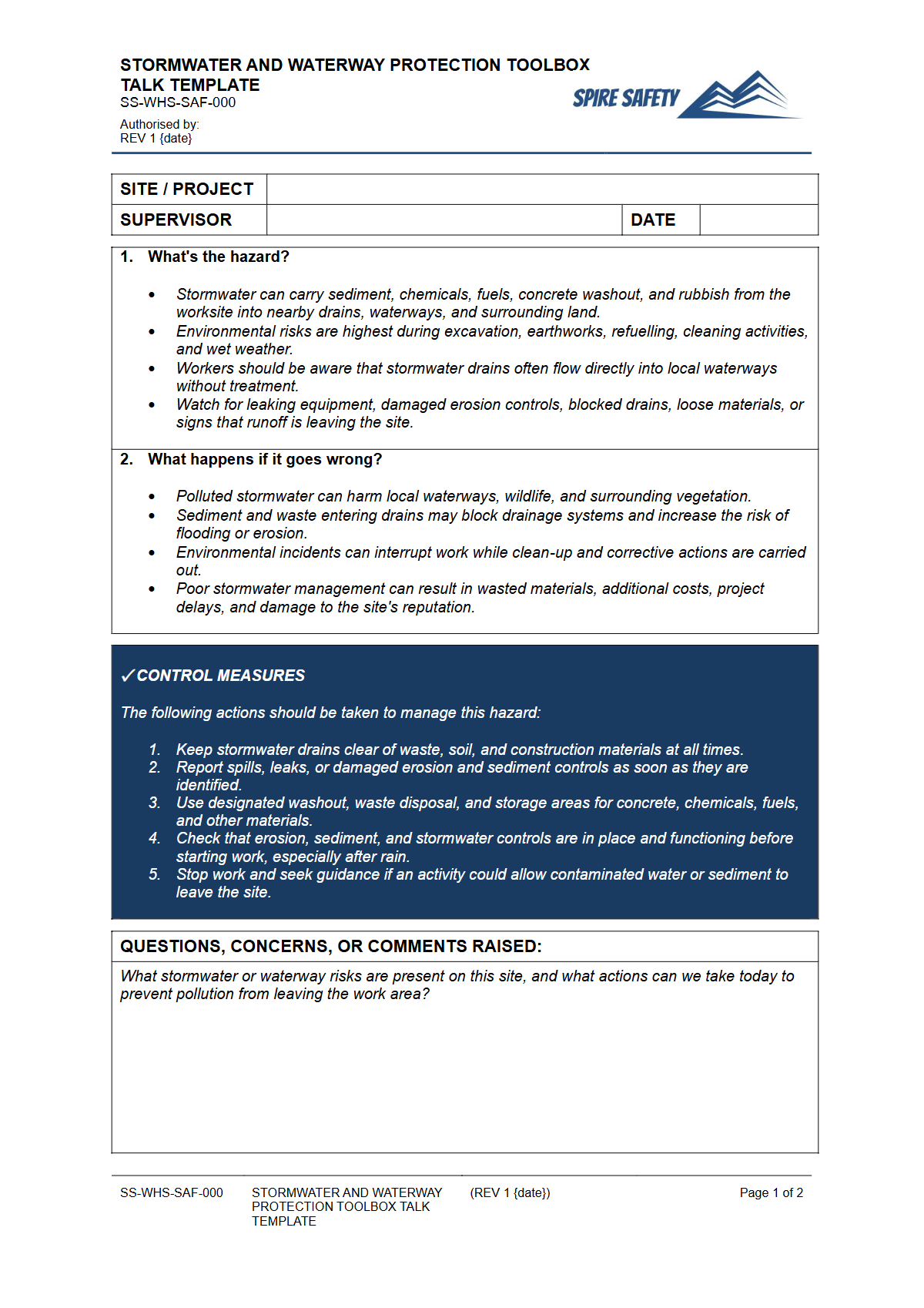
Stormwater and Waterway Protection Toolbox Talk Template
This free Stormwater and Waterway Protection Toolbox Talk template helps your team understand environmental responsibilities on site. Download now.
Stormwater and Waterway Protection Toolbox Talk Template
DOCX • 142 KB + PDF
Updated Oct 2026
No signup required
Purpose of this document
The “Stormwater and Waterway Protection Toolbox Talk Template” is a structured guide designed to facilitate discussions with your team about the importance of preventing pollution in stormwater and local waterways during works. This resource helps reinforce good environmental practices and reminds workers of their responsibilities under Australian environmental and WHS legislation, particularly concerning the impact of site activities on the natural environment.
While not a definitive legal document, it serves as a valuable educational tool to promote awareness and proactive measures to protect water quality.
Using this template ensures that critical environmental protection topics are covered consistently across your projects. It aids in mitigating risks associated with accidental discharges, sediment runoff, and chemical spills that can contaminate waterways.
By regularly discussing these issues, organisations can foster a culture of environmental responsibility, reduce potential fines, and maintain positive community relations. This Toolbox Talk topic focuses on practical strategies and controls that can be implemented on site to safeguard Australia's precious water resources.
Video walkthrough
How to use this Toolbox Talk
This Stormwater and Waterway Protection Toolbox Talk template is provided as a downloadable file (DOCX and PDF) for your convenience. The DOCX version is fully editable, allowing you to tailor the content specifically to your project's unique environmental risks, site-specific conditions, and the nature of the work being performed.
Before conducting the Toolbox Talk, ensure you have reviewed and updated the template with relevant details, including site plans, specific controls for drains or waterways, and any project-specific environmental management plan requirements. You must customise this template to your workplace's specific risks and operations to ensure its effectiveness.
Deliver the Toolbox Talk in a clear, engaging manner, encouraging open discussion and questions from your team. Use visual aids where appropriate, such as site maps showing proximity to waterways, photographs of correct control measures, or examples of potential environmental hazards.
Document attendance and key discussion points to maintain a record of your organisation’s commitment to environmental awareness and WHS compliance. Regular WHS compliance auditing can help ensure these practices are consistently applied.
When to use it
This Stormwater and Waterway Protection Toolbox Talk template should be used:
- Before commencing any new project or work activity that could potentially impact stormwater or waterways.
- As a refresher before undertaking specific tasks known to carry a high risk of environmental contamination (e.g., excavation near drains, chemical handling, concrete pours).
- Following an environmental incident or near-miss, to reinforce lessons learned and prevent reoccurrence.
- Periodically, as part of your regular WHS program, to maintain a high level of environmental awareness among your workers.
- When new workers join the team or when existing workers are assigned to new tasks that involve environmental considerations.
Who should use it
This template is primarily designed for:
- Site Supervisors and Managers: To lead discussions and ensure their teams understand and implement site environmental controls.
- WHS Officers and Coordinators: To integrate environmental awareness into broader WHS management systems and training programs.
- Project Managers: To ensure environmental protection is a key consideration throughout project planning and execution.
- Environmental Officers: To support their efforts in educating workers and maintaining environmental compliance.
- Team Leaders and Forepersons: To deliver practical, on-the-ground instruction and guidance to their crews.
Ultimately, all workers who may impact stormwater or waterways through their daily activities should participate in and understand the content of this Toolbox Talk. Visit the Spire Safety free WHS resources library for more valuable tools.
Common mistakes
Common mistakes to avoid
- Failing to install or maintain sediment fences and erosion controls.
- Stockpiling materials (soil, chemicals) too close to drains or waterways.
- Washing hands or equipment directly into stormwater drains.
- Not training all workers on environmental responsibilities and spill response procedures.
Legal references
Legal considerations
The following legal requirements may be relevant to this type of work.
- Work Health and Safety Act (Harmonised) — Provides the primary duties for protecting workers and other people from work health and safety risks.
- Work Health and Safety Regulations (Harmonised) — Sets out requirements supporting the management of workplace hazards and risks.
The following codes may be relevant to this type of work.
- Managing WHS Risks Code of Practice — Provides practical guidance on identifying hazards, assessing risks and applying effective controls.
- Work Health and Safety Consultation, Cooperation and Coordination Code of Practice — Provides practical guidance on consulting workers and coordinating with other duty holders.
- Managing the Work Environment and Facilities Code of Practice — Provides practical guidance on safe work environments, workplace facilities and related controls.
Did you know
Impact of Sediment
Did you know that sediment runoff from construction sites is one of the largest pollutants of Australian urban waterways, smothering aquatic habitats and reducing water quality?
Fines for Pollution
Organisations can face significant penalties and fines under Australian environmental legislation for polluting waterways, highlighting the importance of preventative measures.
FAQ
Frequently asked questions
01What is stormwater pollution?
02Why is waterway protection important for businesses?
03How often should a Stormwater Protection Toolbox Talk be conducted?
04Does this template ensure full WHS compliance?
Share this resource
Stormwater and Waterway Protection Toolbox Talk Template
Browse Categories
How To Use It
- 1Download and open in Word or PDF.
- 2Replace the placeholders with your business details.
- 3Get it reviewed by a WHS specialist before rollout.
Need it customised?
Our WHS consultants can adapt this template to your site, run a gap analysis, or audit what you already have in place.
Book a Free Consultation WHS consulting servicesor call 1300 156 382