
School Maintenance Safety Toolbox Talk Template
Streamline WHS discussions with our School Maintenance Safety Toolbox Talk Template. A practical starting point for essential safety briefings.
School Maintenance Safety Toolbox Talk Template
DOCX • 138 KB + PDF
Updated Oct 2026
No signup required
Purpose of this document
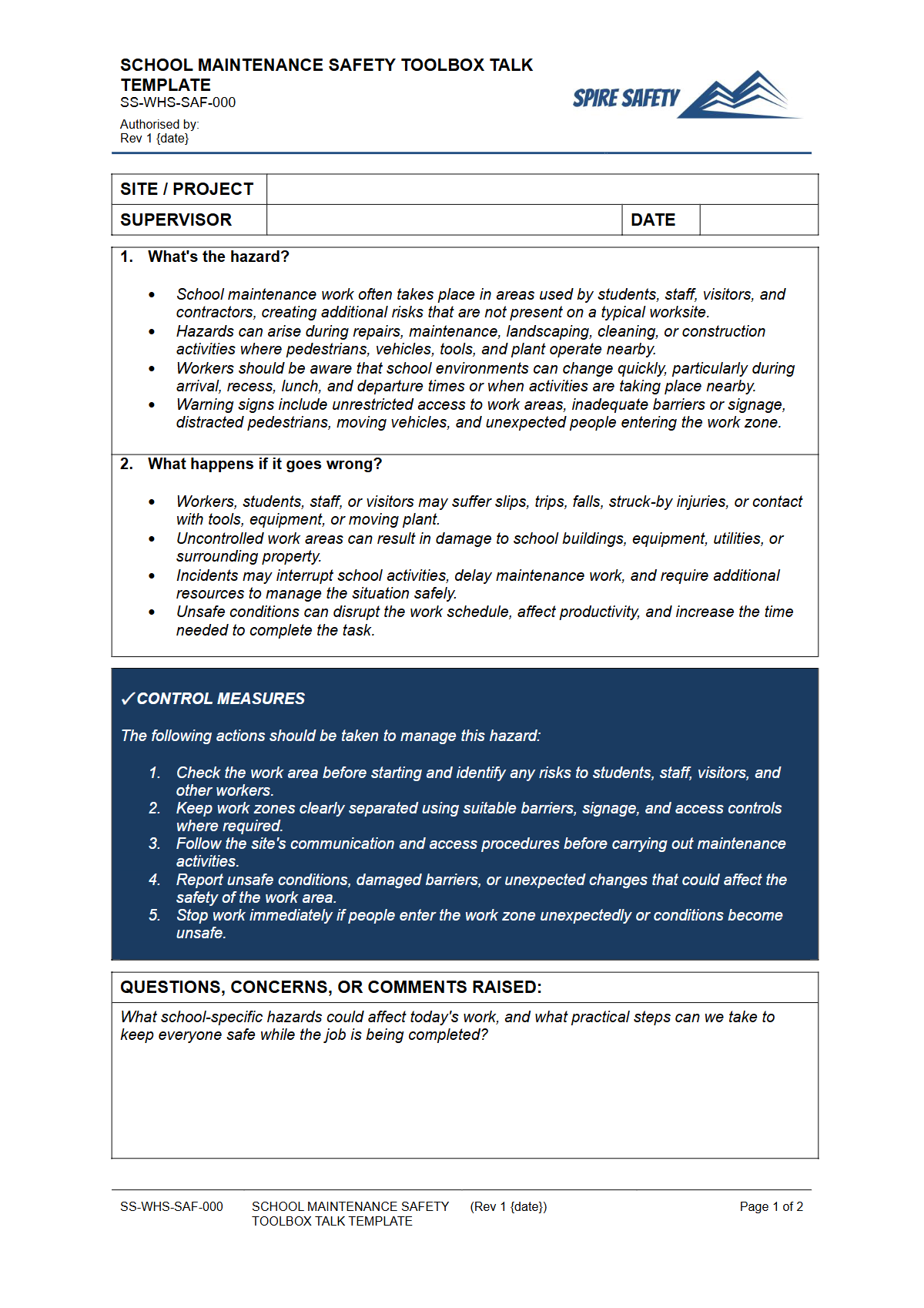
This School Maintenance Safety Toolbox Talk Template provides a structured starting point for facilitating essential safety discussions within educational facilities. Maintenance work in schools often presents unique hazards due to the diverse environments (classrooms, workshops, playgrounds, plant rooms) and the presence of students and staff.
This template helps organisations recognise common risks, from working at height and electrical safety to hazardous chemicals and manual tasks, and promotes proactive risk management.
Regular toolbox talks are a cornerstone of effective WHS management, fostering a culture of safety and ensuring that all personnel involved in maintenance operations are aware of their responsibilities and the site-specific hazards they may encounter. This template is designed to assist in communicating critical safety information, encouraging open dialogue, and reinforcing safe work behaviours.
Video walkthrough
How to use this Toolbox Talk
This free WHS resource is provided in DOCX format for easy customisation. To use it effectively, download the template and tailor it to the specific context of your school and the particular maintenance task being undertaken. Key sections to customise include:
- Site-specific hazards: Identify and detail the unique risks associated with your school's physical environment and specific maintenance projects (e.g., asbestos presence, live electrical circuits, uneven terrain, working near children).
- Control measures: Outline the specific preventative and protective measures implemented to mitigate identified hazards. This includes engineering controls, administrative controls, and the required personal protective equipment (PPE).
- Emergency procedures: Review and communicate relevant emergency protocols, such as evacuation routes, first aid locations, and contact numbers.
- Consultation: Use the template as a basis for genuine discussion. Encourage workers to share their experiences, identify unaddressed hazards, and propose solutions. This collaborative approach enhances safety outcomes and aligns with good WHS practice.
Remember, this is a template. It must be customised to your specific workplace, tasks, and legal obligations to be effective and relevant.
When to use it
This School Maintenance Safety Toolbox Talk Template is ideal for use:
- Before commencing any new maintenance project or task within a school environment.
- As part of regular, scheduled safety meetings for maintenance teams.
- Following an incident or near-miss, to reinforce safety procedures and discuss lessons learned.
- When introducing new equipment, materials, or work methods.
- As a refresher training session, particularly for seasonal or temporary staff involved in school upkeep.
- During the induction of new maintenance personnel to establish WHS expectations from the outset.
Who should use it
This School Maintenance Safety Toolbox Talk Template is specifically designed for:
- School principals and administration overseeing maintenance activities.
- Maintenance managers and team leaders responsible for planning and supervising work.
- Facilities managers and property supervisors in educational settings.
- WHS officers and representatives guiding safety discussions.
- Contractors and their supervisors undertaking maintenance work on school premises.
- Anyone facilitating safety briefings for personnel involved in maintenance operations within schools. This resource supports organisations in implementing robust WHS management systems tailored to the education sector.
Common mistakes
Common mistakes to avoid
- Not customising the template for specific tasks or site conditions.
- Treating the toolbox talk as a 'tick-box' exercise rather than a genuine discussion.
- Failing to review and update topics based on incidents, near misses, or changes in work practices.
- Not ensuring all attendees understand the information, especially those with language barriers.
Legal references
Legal considerations
The following legal requirements may be relevant to this type of work.
- Work Health and Safety Act (Harmonised) — Provides the primary duties for protecting workers and other people from work health and safety risks.
- Work Health and Safety Regulations (Harmonised) — Sets out requirements supporting the management of workplace hazards and risks.
The following codes may be relevant to this type of work.
- Managing WHS Risks Code of Practice — Provides practical guidance on identifying hazards, assessing risks and applying effective controls.
- Work Health and Safety Consultation, Cooperation and Coordination Code of Practice — Provides practical guidance on consulting workers and coordinating with other duty holders.
- Managing the Work Environment and Facilities Code of Practice — Provides practical guidance on safe work environments, workplace facilities and related controls.
Did you know
Slips, Trips, and Falls
According to Safe Work Australia data, slips, trips, and falls are a leading cause of injury in many workplaces, including educational facilities. Regular maintenance and hazard identification are key to prevention.
Importance of Consultation
Effective WHS consultation, where workers are actively engaged in identifying hazards and developing control measures, can significantly improve safety outcomes and reduce workplace injuries.
FAQ
Frequently asked questions
01What is a 'Toolbox Talk'?
02Why are toolbox talks important for school maintenance?
03Can this template be used for contractors working at schools?
04Does this template cover all WHS regulations?
Share this resource
School Maintenance Safety Toolbox Talk Template
Browse Categories
How To Use It
- 1Download and open in Word or PDF.
- 2Replace the placeholders with your business details.
- 3Get it reviewed by a WHS specialist before rollout.
Need it customised?
Our WHS consultants can adapt this template to your site, run a gap analysis, or audit what you already have in place.
Book a Free Consultation WHS consulting servicesor call 1300 156 382
Related templates
- Sharps and Needlestick Awareness Toolbox Talk Template
- Silica Dust Awareness Toolbox Talk Template
- Site Security and Unauthorised Access Toolbox Talk Template
- Situational Awareness Toolbox Talk Template
- Slips Trips and Falls Toolbox Talk Template
- SS-WHS-SAF-000 Complacency and Routine Task Risk Toolbox Talk Template