
Sharps and Needlestick Awareness Toolbox Talk Template
Download our free Sharps and Needlestick Awareness Toolbox Talk Template. A structured resource to manage risks in your workplace. Get your copy today!
Sharps and Needlestick Awareness Toolbox Talk Template
DOCX • 139 KB + PDF
Updated Oct 2026
No signup required
Purpose of this document
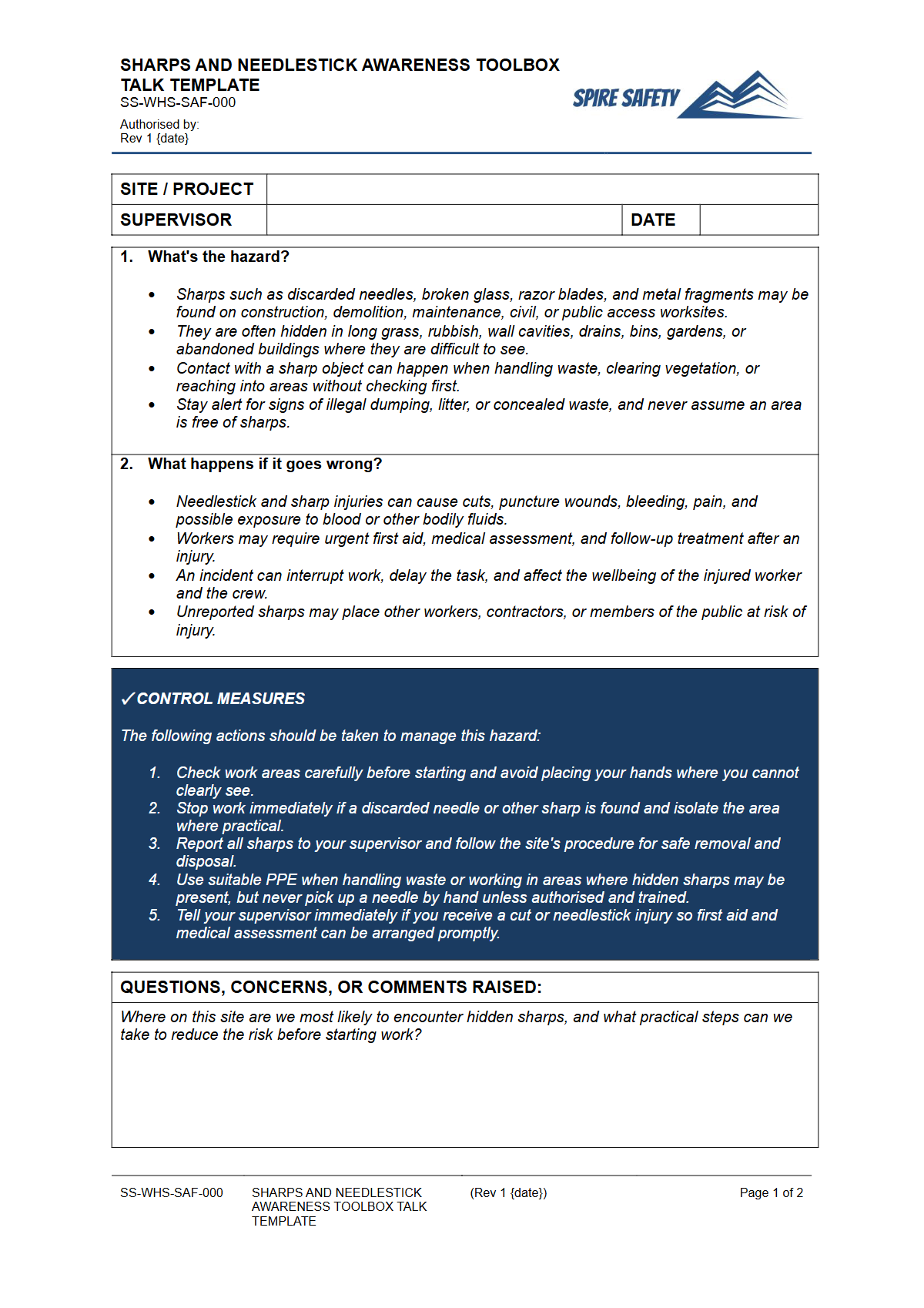
This Sharps and Needlestick Awareness Toolbox Talk Template is designed to assist persons conducting a business or undertaking (PCBUs) and their WHS managers in conducting essential discussions with workers regarding the hazards associated with sharps and needlestick injuries. Sharps include not only needles but also broken glass, scalpel blades, and other pointed or edged instruments that can penetrate the skin.
These injuries can pose significant health risks, including exposure to bloodborne pathogens such. Implementing effective control measures and fostering a strong safety culture are paramount.
This Toolbox Talk provides a framework to educate workers on identifying potential sharps hazards, understanding safe handling practices, proper disposal methods, and immediate response procedures in the event of an injury. It aims to minimise the occurrence of such incidents and promote a safer working environment across various industries where sharps may be present, such as healthcare, construction, cleaning, and waste management.
Using a structured approach through a Toolbox Talk helps facilitate regular, short, and focused discussions on specific WHS topics. This template is aligned with Australian WHS practices, encouraging proactive risk management and continuous improvement in workplace safety.
Video walkthrough
How to use this Toolbox Talk
Our Sharps and Needlestick Awareness Toolbox Talk Template is provided in an editable DOCX format, making it easy to adapt to your specific workplace context. Begin by reviewing the entire document and identifying sections that require customisation.
This includes adding details about specific sharps present in your workplace, outlining site-specific disposal procedures, and detailing contact information for emergency response or first aid personnel.
When conducting the Toolbox Talk, ensure all relevant workers are present and engaged. Use the provided discussion points as prompts to encourage active participation and questions.
Emphasise practical demonstrations where appropriate, such as showing correct disposal bin usage or PPE application. Document attendance and any actions agreed upon during the talk, including responsibilities and deadlines for follow-up activities.
Regularly revisit this topic, especially after incidents or changes in work procedures, to reinforce safe behaviours.
Please note: This template is a starting point. It must be customised to your workplace's specific risks, procedures, and legal obligations to be effective. While based on the model WHS framework, it does not supports your compliance efforts, as compliance depends on your organisation's unique application and adherence to WHS legislation.
When to use it
This Sharps and Needlestick Awareness Toolbox Talk should be used regularly as part of your ongoing WHS program. It is particularly important to conduct this Toolbox Talk:
- During new worker inductions, especially for those who will be handling or working near sharps.
- At the commencement of new projects or tasks where sharps hazards may be introduced or change.
- After any sharps-related incident or near-miss, to reinforce safety measures and learn from the event.
- As part of routine safety meetings or at least quarterly, to maintain awareness and reinforce safe practices.
- When new equipment, tools, or procedures involving sharps are introduced into the workplace.
- Following any changes to WHS legislation or industry best practices related to sharps handling and disposal.
- Before high-risk activities where sharps exposure is a known risk.
Who should use it
This Sharps and Needlestick Awareness Toolbox Talk Template is intended for:
- WHS Managers and Coordinators: To facilitate structured safety discussions and ensure consistent messaging.
- Supervisors and Team Leaders: Who are directly responsible for guiding their teams and conducting local safety briefings.
- Safety Representatives: To raise awareness and contribute to a safer work environment.
- Persons Conducting a Business or Undertaking (PCBUs): To demonstrate a commitment to WHS and fulfill their primary duty of care.
- Workers: As participants in the discussion, ensuring they understand their responsibilities and contribute to hazard identification.
- Anyone involved in WHS management systems: As part of continuous improvement and risk mitigation efforts. For broader support, consider exploring WHS management systems consulting.
Common mistakes
Common mistakes to avoid
- Not adequately training all staff who may encounter sharps.
- Using inappropriate disposal containers or overfilling them.
- Recapping needles by hand, which significantly increases injury risk.
- Neglecting to report sharps incidents or near-misses, hindering effective learning and prevention.
Legal references
Legal considerations
The following legal requirements may be relevant to this type of work.
- Work Health and Safety Act (Harmonised) — Provides the primary duties for protecting workers and other people from work health and safety risks.
- Work Health and Safety Regulations (Harmonised) — Sets out requirements supporting the management of workplace hazards and risks.
The following codes may be relevant to this type of work.
- Managing WHS Risks Code of Practice — Provides practical guidance on identifying hazards, assessing risks and applying effective controls.
- Work Health and Safety Consultation, Cooperation and Coordination Code of Practice — Provides practical guidance on consulting workers and coordinating with other duty holders.
- Managing the Work Environment and Facilities Code of Practice — Provides practical guidance on safe work environments, workplace facilities and related controls.
Did you know
Globally, millions of needlestick injuries occur annually.
The World Health Organisation (WHO) estimates that millions of healthcare workers alone sustain needlestick injuries each year, highlighting the pervasive nature of this risk globally.
FAQ
Frequently asked questions
01What is considered a 'sharp' in a workplace context?
02Why are Toolbox Talks essential for sharps awareness?
03Where can I find more free WHS resources for my business?
04How often should we revise our sharps safety procedures?
Share this resource
Sharps and Needlestick Awareness Toolbox Talk Template
Browse Categories
How To Use It
- 1Download and open in Word or PDF.
- 2Replace the placeholders with your business details.
- 3Get it reviewed by a WHS specialist before rollout.
Need it customised?
Our WHS consultants can adapt this template to your site, run a gap analysis, or audit what you already have in place.
Book a Free Consultation WHS consulting servicesor call 1300 156 382
Related templates
- Silica Dust Awareness Toolbox Talk Template
- Site Security and Unauthorised Access Toolbox Talk Template
- Situational Awareness Toolbox Talk Template
- Slips Trips and Falls Toolbox Talk Template
- SS-WHS-SAF-000 Complacency and Routine Task Risk Toolbox Talk Template
- SS-WHS-SAF-000 Hand and Finger Injury Prevention Toolbox Talk Template