
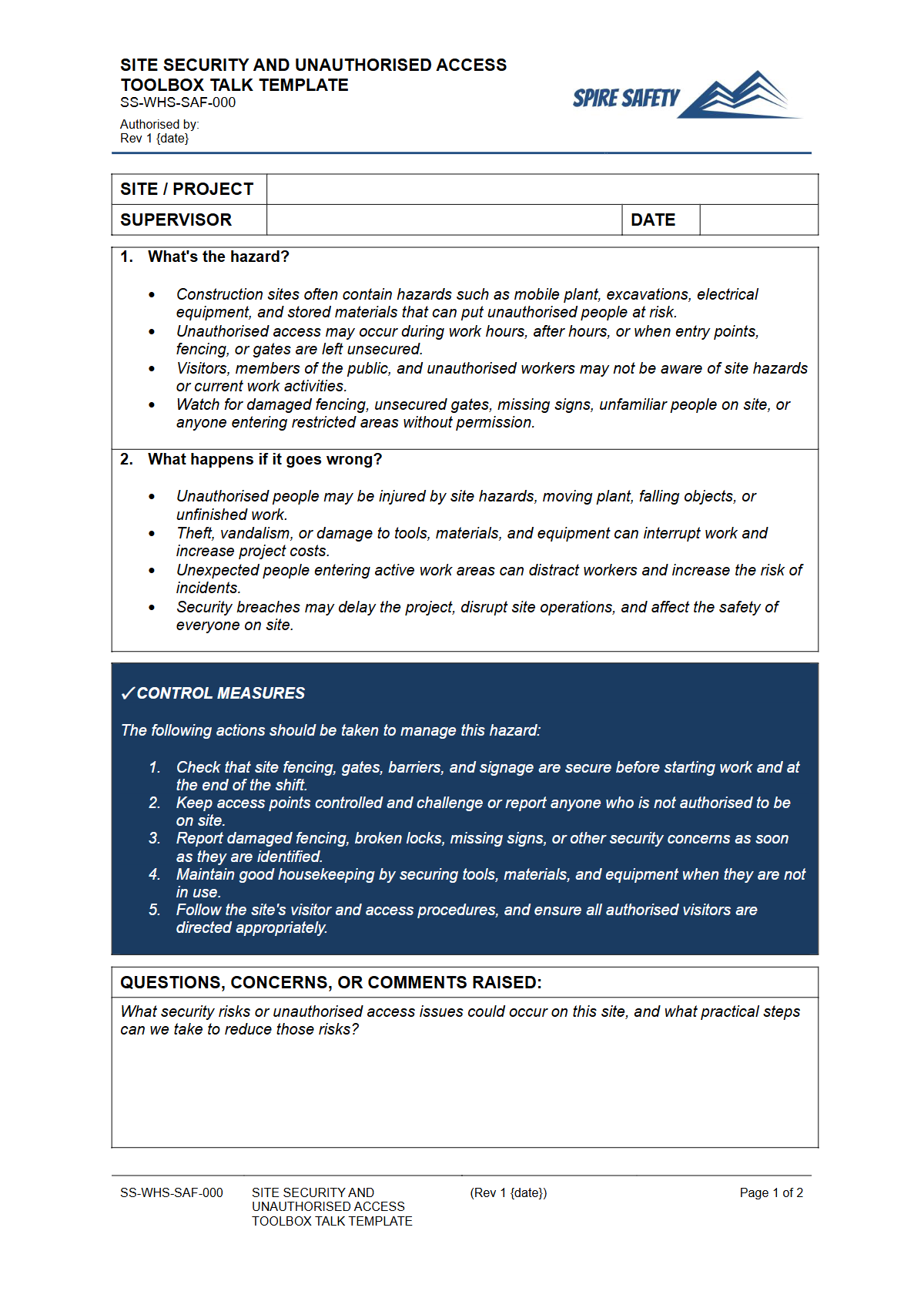
Site Security and Unauthorised Access Toolbox Talk Template
Download your free Site Security and Unauthorised Access Toolbox Talk Template. A structured starting point for your next safety discussion.
Site Security and Unauthorised Access Toolbox Talk Template
DOCX • 141 KB + PDF
Updated Oct 2026
No signup required
Purpose of this document
This free WHS resource provides a foundational Site Security and Unauthorised Access Toolbox Talk Template designed to help organisations brief their teams on the critical importance of maintaining secure work environments. Unauthorised access to worksites, whether construction, industrial, or office, poses significant risks including theft, vandalism, injury to intruders, and disruption to operations.
Properly managing site security is integral to fulfilling WHS duties and protecting all persons.
This Toolbox Talk focuses on identifying common security vulnerabilities, implementing effective control measures, and fostering a culture of vigilance among workers. It outlines key responsibilities for all personnel in recognising and reporting security breaches or suspicious activities.
Regular communication through Toolbox Talks is a practical way to reinforce safe work practices and keep security awareness at the forefront, contributing to a safer and more productive workplace directly aligned with Australian WHS practice.
Video walkthrough
How to use this Toolbox Talk
This Site Security and Unauthorised Access Toolbox Talk Template is provided in an editable DOCX format, along with a PDF version for easy reference. Please note: This template is a structured starting point.
You must customise it to your workplace's specific conditions, hazards, and control measures before use. Add your company logo, specific site rules, emergency contacts, and examples relevant to your operations.
Discuss the content with your team, encouraging participation and questions to ensure understanding and engagement. Following the discussion, ensure all attendees sign off to confirm their participation and comprehension of the information presented.
When to use it
This Toolbox Talk is ideal for initial site inductions, introducing new projects, or as a regular refresher during pre-start meetings. It is particularly relevant after any security incident, near-miss, or change in site conditions, personnel, or security protocols.
Conduct this Toolbox Talk whenever there's a perceived increase in risk due to external factors, or to reinforce safe behaviour and promote continuous improvement in your WHS management systems.
Who should use it
This Toolbox Talk is suitable for supervisors, team leaders, project managers, and WHS officers responsible for conducting safety briefings. It is designed to be delivered to all workers, contractors, visitors, and anyone performing work on your site who needs to understand their role in maintaining site security and preventing unauthorised access.
Workers involved in WHS consulting can also adapt this resource for client use.
Common mistakes
Common mistakes to avoid
- Assuming everyone knows security protocols without formal training.
- Failing to update security measures after a near-miss or incident.
- Not involving workers in identifying potential security vulnerabilities.
- Over-relying on technology (CCTV, alarms) without adequate human patrols or response plans.
Legal references
Legal considerations
The following legal requirements may be relevant to this type of work.
- Work Health and Safety Act (Harmonised) — Provides the primary duties for protecting workers and other people from work health and safety risks.
- Work Health and Safety Regulations (Harmonised) — Sets out requirements supporting the management of workplace hazards and risks.
The following codes may be relevant to this type of work.
- Managing WHS Risks Code of Practice — Provides practical guidance on identifying hazards, assessing risks and applying effective controls.
- Work Health and Safety Consultation, Cooperation and Coordination Code of Practice — Provides practical guidance on consulting workers and coordinating with other duty holders.
- Managing the Work Environment and Facilities Code of Practice — Provides practical guidance on safe work environments, workplace facilities and related controls.
Did you know
Impact of Unauthorised Access
Unauthorised access can lead to equipment theft, property damage, serious injuries to intruders, and significant project delays, increasing overall operational costs.
Legal Duty for Site Security
Under Australian WHS legislation, Persons Conducting a Business or Undertaking (PCBUs) have a duty to ensure, so far as is reasonably practicable, the health and safety of all persons on the site, which includes preventing unauthorised access.
FAQ
Frequently asked questions
01What is the primary goal of a Site Security Toolbox Talk?
02How often should site security be discussed in Toolbox Talks?
03What are common examples of unauthorised access to a worksite?
04What are the immediate steps workers should take if they spot an intruder?
Share this resource
Site Security and Unauthorised Access Toolbox Talk Template
Browse Categories
How To Use It
- 1Download and open in Word or PDF.
- 2Replace the placeholders with your business details.
- 3Get it reviewed by a WHS specialist before rollout.
Need it customised?
Our WHS consultants can adapt this template to your site, run a gap analysis, or audit what you already have in place.
Book a Free Consultation WHS consulting servicesor call 1300 156 382
Related templates
- Situational Awareness Toolbox Talk Template
- Slips Trips and Falls Toolbox Talk Template
- SS-WHS-SAF-000 Complacency and Routine Task Risk Toolbox Talk Template
- SS-WHS-SAF-000 Hand and Finger Injury Prevention Toolbox Talk Template
- Steel Erection Safety Toolbox Talk Template
- Stormwater and Waterway Protection Toolbox Talk Template