
Silica Dust Awareness Toolbox Talk Template
Download a free Silica Dust Awareness Toolbox Talk Template to help educate your team on crystalline silica risks and controls. Get your copy today!
Silica Dust Awareness Toolbox Talk Template
DOCX • 140 KB + PDF
Updated Oct 2026
No signup required
Purpose of this document
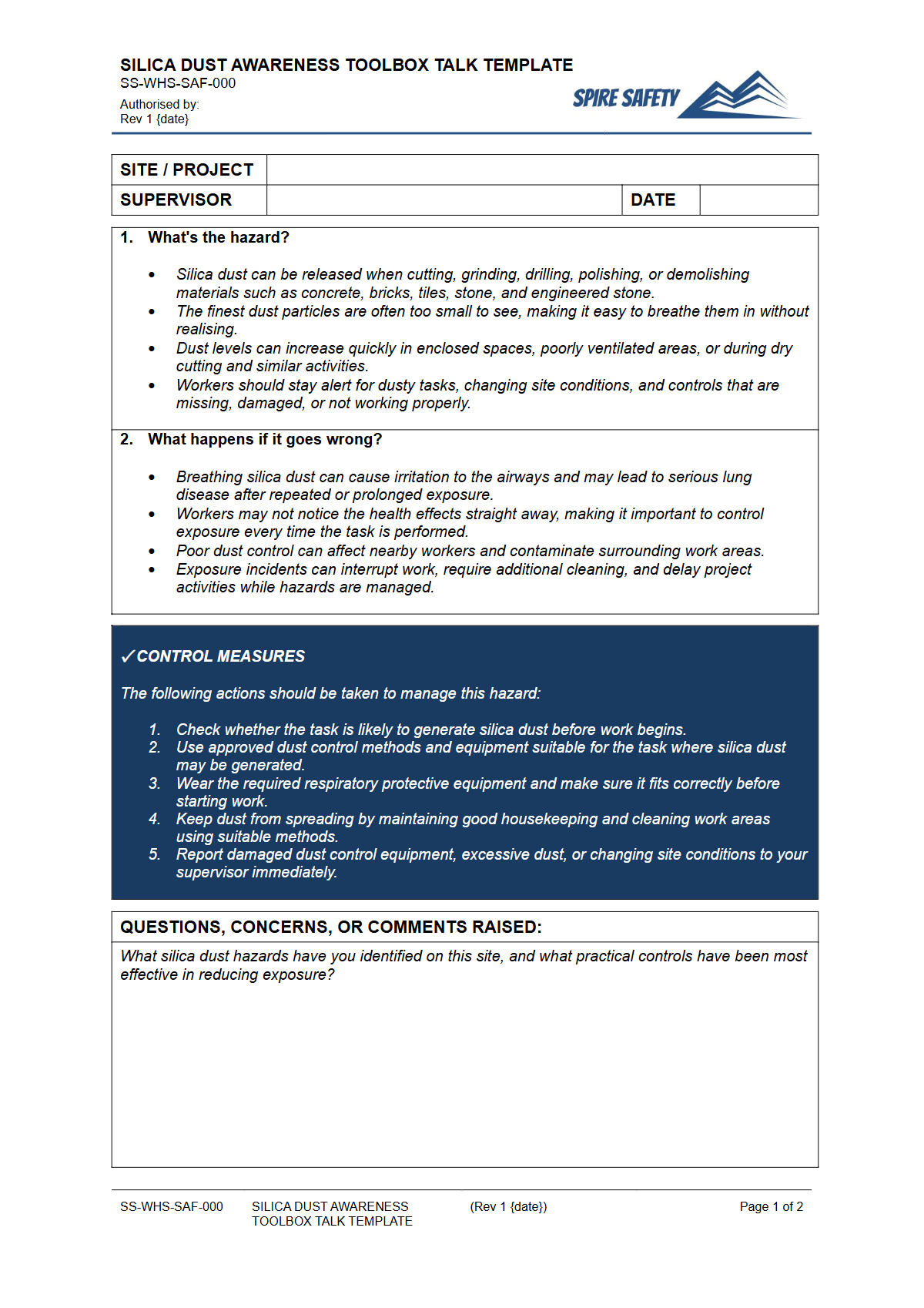
This Silica Dust Awareness Toolbox Talk Template is designed to facilitate discussions about the hazards associated with respirable crystalline silica (RCS) in your workplace. It provides a structured format to inform workers about the risks of silica dust exposure, common work activities that generate RCS, and the control measures necessary to protect their health.
Utilising this template can help reinforce safe work practices and encourage a proactive approach to managing airborne contaminants, aligning with Australian WHS practice. It serves as a valuable educational tool, promoting a safer working environment and contributing to the overall effectiveness of your WHS management systems.
Video walkthrough
How to use this Toolbox Talk
This Toolbox Talk template offers a foundational structure for conducting a safety briefing on silica dust awareness. To ensure its effectiveness, you must customise it to the specific tasks, environments, and control measures present in your workplace. Tailor the content to reflect the actual silica-generating activities undertaken by your team, the specific engineering controls in place (e.g., local exhaust ventilation, water suppression), administrative controls (e.g., job rotation, no-go zones), and the particular personal protective equipment (PPE) required.
You should also include details about your organisation's procedures for monitoring exposure, health surveillance, and incident reporting relating to silica. Remember to document who attended the talk, the date it was conducted, and any issues raised or actions decided upon.
For more comprehensive support, consider our WHS consulting services.
When to use it
This Silica Dust Awareness Toolbox Talk Template is ideal for use during regular safety meetings, project kick-offs for tasks involving silica-generating materials, or refresher training sessions. It should be conducted whenever new workers join a team that might be exposed to silica, or when new equipment, processes, or materials that could generate RCS are introduced.
Periodic use helps maintain a consistent level of awareness regarding silica hazards and keeps control measures at the forefront of workers' minds. It's particularly relevant before commencing any construction work or tasks involving cutting, grinding, drilling, or sanding materials like concrete, stone, brick, or other silica-containing substances.
Who should use it
Supervisors, team leaders, safety officers, and WHS managers are the primary users of this template. Anyone responsible for communicating WHS information to a team of workers who may encounter silica dust in their daily activities will find this resource beneficial.
It is designed to empower those in leadership roles to effectively convey critical safety information, fostering a culture of safety and promoting a shared understanding of occupational health risks. This template is suitable for diverse industries including construction, mining, manufacturing, and any sector where crystalline silica is present in materials being processed or disturbed. Find more useful resources in our free WHS resources library.
Common mistakes
Common mistakes to avoid
- Failing to identify all processes that generate silica dust.
- Not providing adequate respiratory protective equipment (RPE) or ensuring its correct fit and use.
- Neglecting regular maintenance and inspection of engineering controls like dust extraction systems.
- Inadequate worker training on the risks of silica and the correct use of control measures.
Legal references
Legal considerations
The following legal requirements may be relevant to this type of work.
- Work Health and Safety Act (Harmonised) — Provides the primary duties for protecting workers and other people from work health and safety risks.
- Work Health and Safety Regulations (Harmonised) — Sets out requirements supporting the management of workplace hazards and risks.
The following codes may be relevant to this type of work.
- Managing WHS Risks Code of Practice — Provides practical guidance on identifying hazards, assessing risks and applying effective controls.
- Work Health and Safety Consultation, Cooperation and Coordination Code of Practice — Provides practical guidance on consulting workers and coordinating with other duty holders.
- Managing the Work Environment and Facilities Code of Practice — Provides practical guidance on safe work environments, workplace facilities and related controls.
Did you know
Silica Dust & Construction
It's estimated that over 600,000 Australian workers are exposed to silica dust each year, with a significant proportion working in construction-related industries.
Silicosis is Preventable
While silicosis is a serious, irreversible lung disease, it is entirely preventable through effective hazard identification and the implementation of appropriate control measures.
FAQ
Frequently asked questions
01What is respirable crystalline silica (RCS)?
02What health risks are associated with silica dust exposure?
03How can I assess silica dust exposure risks in my workplace?
04What are common control measures for silica dust?
Share this resource
Silica Dust Awareness Toolbox Talk Template
Browse Categories
How To Use It
- 1Download and open in Word or PDF.
- 2Replace the placeholders with your business details.
- 3Get it reviewed by a WHS specialist before rollout.
Need it customised?
Our WHS consultants can adapt this template to your site, run a gap analysis, or audit what you already have in place.
Book a Free Consultation WHS consulting servicesor call 1300 156 382
Related templates
- Site Security and Unauthorised Access Toolbox Talk Template
- Situational Awareness Toolbox Talk Template
- Slips Trips and Falls Toolbox Talk Template
- SS-WHS-SAF-000 Complacency and Routine Task Risk Toolbox Talk Template
- SS-WHS-SAF-000 Hand and Finger Injury Prevention Toolbox Talk Template
- Steel Erection Safety Toolbox Talk Template