
Scaffolding Safety Toolbox Talk Template
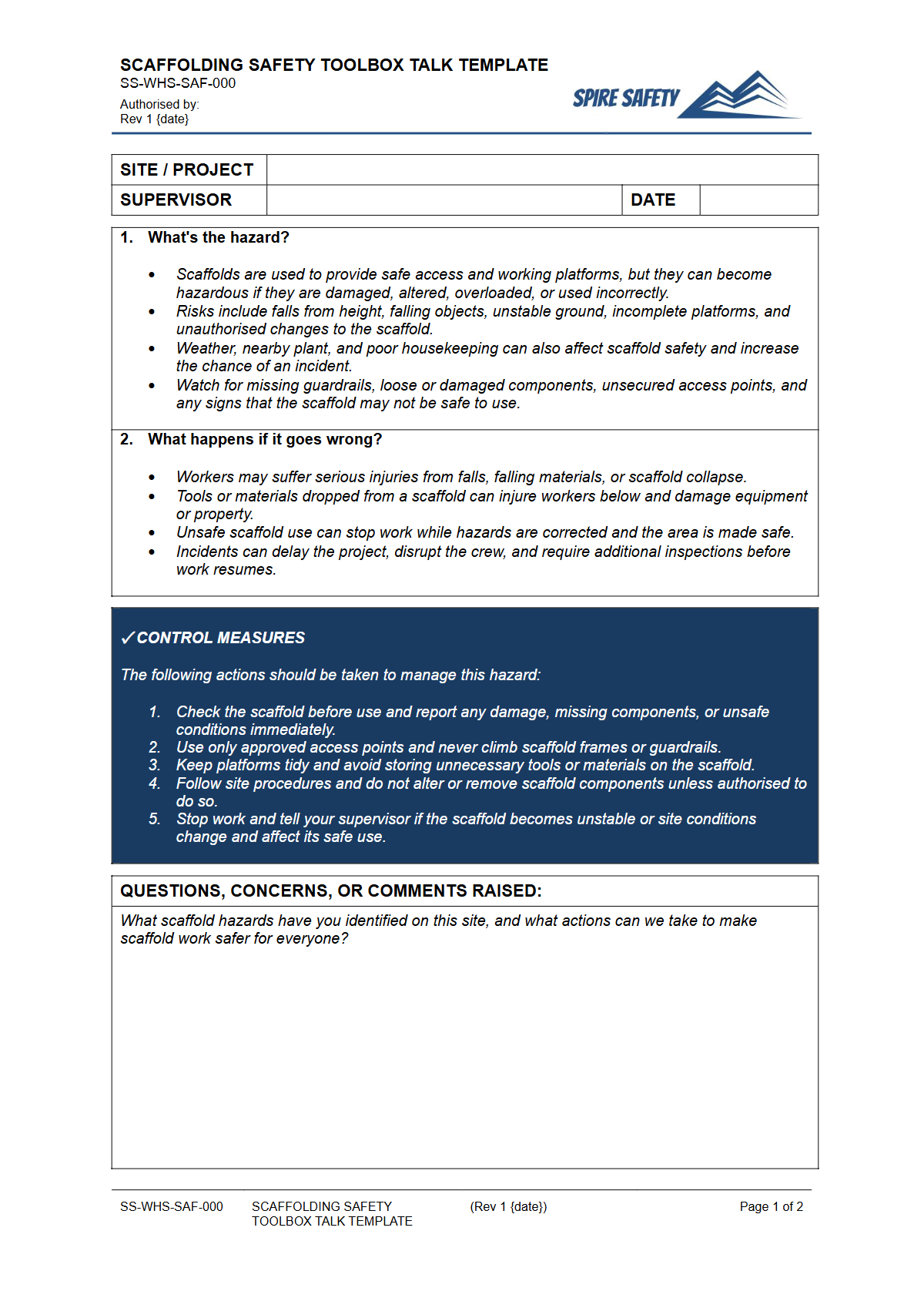
Download our free Scaffolding Safety Toolbox Talk template. A structured starting point for discussing critical WHS issues with your team. Get yours now!
Scaffolding Safety Toolbox Talk Template
DOCX • 140 KB + PDF
Updated Oct 2026
No signup required
Purpose of this document
Our free Scaffolding Safety Toolbox Talk template provides a structured starting point for conducting essential workplace safety discussions. This resource helps you facilitate consistent and effective communication about the inherent risks associated with scaffolding work, and the control measures required to manage them.
It’s designed to promote a proactive safety culture and ensure that all workers involved in or near scaffolding activities understand their responsibilities and the critical safety procedures.
Regular toolbox talks, like those facilitated by this template, are a key component of effective WHS management systems. They serve as a practical tool for reinforcing safety messages, discussing recent incidents or near misses, and addressing any emerging hazards specific to your work site.
Video walkthrough
How to use this Toolbox Talk
To effectively use this Scaffolding Safety Toolbox Talk template, download the DOCX file and adapt it to your specific workplace conditions and project requirements. Remember, this is a general template, and it must be customised to your workplace and project to be effective and relevant. We cannot make specific claims about its compliance with all WHS laws in your jurisdiction as that depends on your customisations and implementations.
- Customise Content: Tailor the discussion points to reflect the particular types of scaffolding used on site, specific site hazards (e.g., overhead power lines, uneven ground), and the control measures in place.
- Engage Workers: Encourage active participation from all attendees. Ask open-ended questions to check understanding and invite workers to share their experiences and observations.
- Document Attendance: Ensure all workers attending the talk sign off, acknowledging their participation and understanding of the discussed safety points.
- Follow-Up Actions: Detail any actions agreed upon during the talk, assign responsibilities, and set completion dates.
- Integrate with Training: Use this template as a reinforcement tool alongside formal training for working safely at heights and around scaffolding.
When to use it
This Scaffolding Safety Toolbox Talk template is ideal for use:
- Before commencing any new project involving scaffolding to refresh team knowledge.
- When new workers join the team who will be working with or near scaffolding.
- Following any scaffolding-related incident, near miss, or hazard report.
- As part of routine safety meetings to maintain a high level of awareness regarding scaffolding safety.
- Whenever there are changes to scaffolding types, construction methods, or site conditions that could impact scaffolding safety.
Who should use it
This Scaffolding Safety Toolbox Talk resource is primarily intended for:
- Site Supervisors and Forepersons: To lead discussions and ensure their teams are fully aware of scaffolding safety protocols.
- WHS Officers and Managers: As part of their broader WHS management strategy and for conducting regular safety briefings.
- Project Managers: To ensure that scaffolding safety is a priority across all project phases.
- Any Worker Involved in Scaffolding: Including scaffolders, workers who use scaffolding, and those working in proximity to scaffold structures, to foster their active participation in safety.
- PCBU Representatives: To demonstrate a commitment to worker safety and meet obligations for providing information and instruction.
Common mistakes
Common mistakes to avoid
- Not customising the toolbox talk to specific site conditions or scaffolding types.
- Failing to encourage worker participation, leading to passive information delivery.
- Skipping documentation of attendance and key discussion points.
- Not following up on identified actions or unresolved safety concerns.
Legal references
Legal considerations
The following legal requirements may be relevant to this type of work.
- Work Health and Safety Act (Harmonised) — Provides the primary duties for protecting workers and other people from work health and safety risks.
- Work Health and Safety Regulations (Harmonised) — Sets out requirements supporting the management of workplace hazards and risks.
The following codes may be relevant to this type of work.
- Managing WHS Risks Code of Practice — Provides practical guidance on identifying hazards, assessing risks and applying effective controls.
- Work Health and Safety Consultation, Cooperation and Coordination Code of Practice — Provides practical guidance on consulting workers and coordinating with other duty holders.
- Managing the Work Environment and Facilities Code of Practice — Provides practical guidance on safe work environments, workplace facilities and related controls.
Did you know
Working at Heights
Falls from heights, including those from scaffolding, are a leading cause of serious injury and fatality in construction. Proper planning and control measures are crucial.
Scaffolding Codes
All scaffolding should be erected, altered, and dismantled in accordance with relevant Australian Standards and the Safe Work Australia Code of Practice – Managing the Risk of Falls at Workplaces.
FAQ
Frequently asked questions
01What is a Scaffolding Safety Toolbox Talk?
02How often should Scaffolding Toolbox Talks be held?
03Are Toolbox Talks legally required in Australia?
04Where can I find more free WHS resources?
Share this resource
Scaffolding Safety Toolbox Talk Template
Browse Categories
How To Use It
- 1Download and open in Word or PDF.
- 2Replace the placeholders with your business details.
- 3Get it reviewed by a WHS specialist before rollout.
Need it customised?
Our WHS consultants can adapt this template to your site, run a gap analysis, or audit what you already have in place.
Book a Free Consultation WHS consulting servicesor call 1300 156 382