
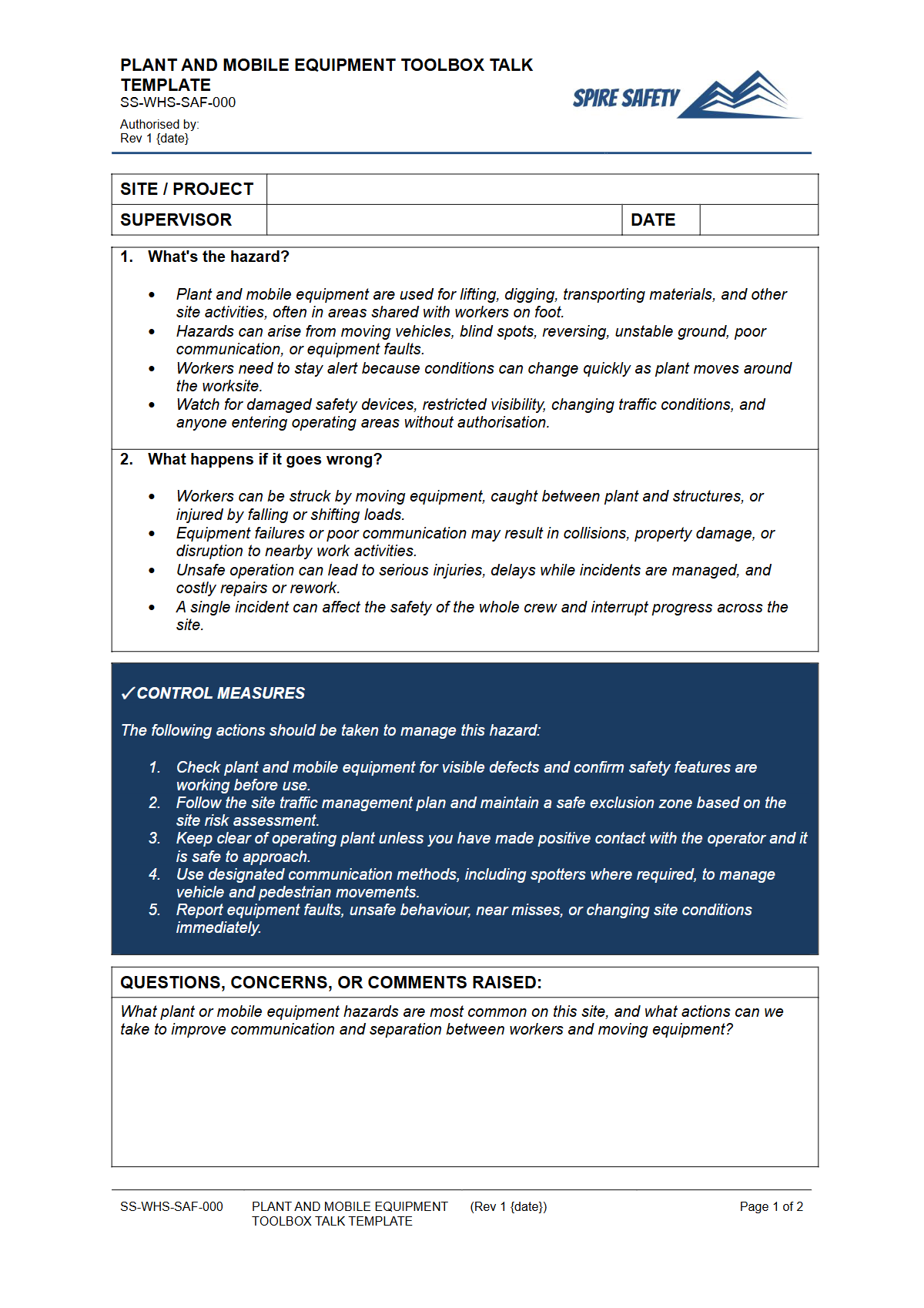
Plant and Mobile Equipment Toolbox Talk Template
Download our free Plant and Mobile Equipment Toolbox Talk Template for Australian workplaces. A structured starting point for critical safety discussions.
Plant and Mobile Equipment Toolbox Talk Template
DOCX • 141 KB + PDF
Updated Oct 2026
No signup required
Purpose of this document
This Plant and Mobile Equipment Toolbox Talk Template provides a structured starting-point for facilitating essential safety discussions in Australian workplaces. Plant and mobile equipment are significant hazard sources, and regular communication is crucial for preventing incidents.
This template is designed to help persons conducting a business or undertaking (PCBUs) and their supervisors conduct effective toolbox talks, promoting a proactive safety culture around these high-risk activities.
Using this resource helps ensure workers recognise and control hazards associated with various types of plant and mobile equipment. It supports the ongoing communication and training required under Australian WHS laws, helping to embed safe work practices into daily operations.
This template is aligned with Australian WHS practice and based on the model WHS framework, offering a practical tool for hazard identification, risk assessment, and control measure implementation.
Video walkthrough
How to use this Toolbox Talk
Our free Plant and Mobile Equipment Toolbox Talk Template is provided in an editable DOCX format for easy customisation. To use it effectively, download the template and tailor it to the specific plant, equipment, and operational risks present in your workplace.
This involves adding details pertinent to your machinery, work environment, and the tasks being performed. For example, if you operate forklifts, include specific information about pedestrian exclusion zones or load handling unique to your site.
Remember, this template must be customised to your workplace's specific risks, equipment, and operational procedures to be effective. It serves as a foundation, not a ready-to-use final document.
Prior to conducting the talk, review the content and prepare any visual aids or demonstrations that would enhance understanding. Facilitate an open discussion, encouraging workers to share their experiences and ask questions.
Document attendance and key discussion points, reflecting your commitment to ongoing WHS. For more comprehensive support in managing WHS risks, consider exploring our WHS consulting services.
When to use it
This Plant and Mobile Equipment Toolbox Talk Template should be used regularly, especially before commencing tasks involving plant and mobile equipment, or when introducing new equipment, processes, or personnel. It's also suitable after incidents or near misses involving plant, or when changes to WHS legislation or codes of practice occur that impact your operations.
Routine use helps maintain vigilance and reinforces good safety habits. Consider scheduling these talks as part of your regular WHS management system.
Who should use it
This template is primarily for supervisors, team leaders, and WHS officers responsible for overseeing work involving plant and mobile equipment. It's also highly beneficial for small to medium-sized businesses that may not have dedicated WHS personnel but still need to conduct professional and effective safety briefings.
Workers also benefit from participating, as it directly addresses their safety and encourages active engagement in hazard control. Our WHS management systems expertise can help integrate such tools effectively into your overall safety strategy.
Common mistakes
Common mistakes to avoid
- Not customising the template to specific workplace risks and equipment.
- Treating the toolbox talk as a 'tick-the-box' exercise rather than an interactive discussion.
- Failing to document attendance, discussion points, and actions agreed upon.
- Not following up on actions or concerns raised during the talk.
Legal references
Legal considerations
The following legal requirements may be relevant to this type of work.
- Work Health and Safety Act (Harmonised) — Provides the primary duties for protecting workers and other people from work health and safety risks.
- Work Health and Safety Regulations (Harmonised) — Sets out requirements supporting the management of workplace hazards and risks.
The following codes may be relevant to this type of work.
- Managing WHS Risks Code of Practice — Provides practical guidance on identifying hazards, assessing risks and applying effective controls.
- Work Health and Safety Consultation, Cooperation and Coordination Code of Practice — Provides practical guidance on consulting workers and coordinating with other duty holders.
- Managing the Work Environment and Facilities Code of Practice — Provides practical guidance on safe work environments, workplace facilities and related controls.
Did you know
Major source of incidents
Safe Work Australia reports that incidents involving plant and structures are consistently among the top causes of work-related fatalities and serious injuries in Australia, highlighting the critical need for effective control measures.
Operator Competency
It's a legal requirement that anyone operating plant is competent to do so, meaning they have the necessary skills, knowledge, and experience, often evidenced by specific licences or training.
FAQ
Frequently asked questions
01What is plant and mobile equipment in a WHS context?
02Why are toolbox talks important for plant and mobile equipment?
03How often should plant and mobile equipment toolbox talks be conducted?
04Does this template ensure WHS legal compliance?
Share this resource
Plant and Mobile Equipment Toolbox Talk Template
Browse Categories
How To Use It
- 1Download and open in Word or PDF.
- 2Replace the placeholders with your business details.
- 3Get it reviewed by a WHS specialist before rollout.
Need it customised?
Our WHS consultants can adapt this template to your site, run a gap analysis, or audit what you already have in place.
Book a Free Consultation WHS consulting servicesor call 1300 156 382