
Plant Guarding and Isolation Toolbox Talk Template
Download our free Plant Guarding and Isolation Toolbox Talk template, designed to assist Australian workplaces in managing plant risks. Get your DOCX today!
Plant Guarding and Isolation Toolbox Talk Template
DOCX • 137 KB + PDF
Updated Oct 2026
No signup required
Purpose of this document
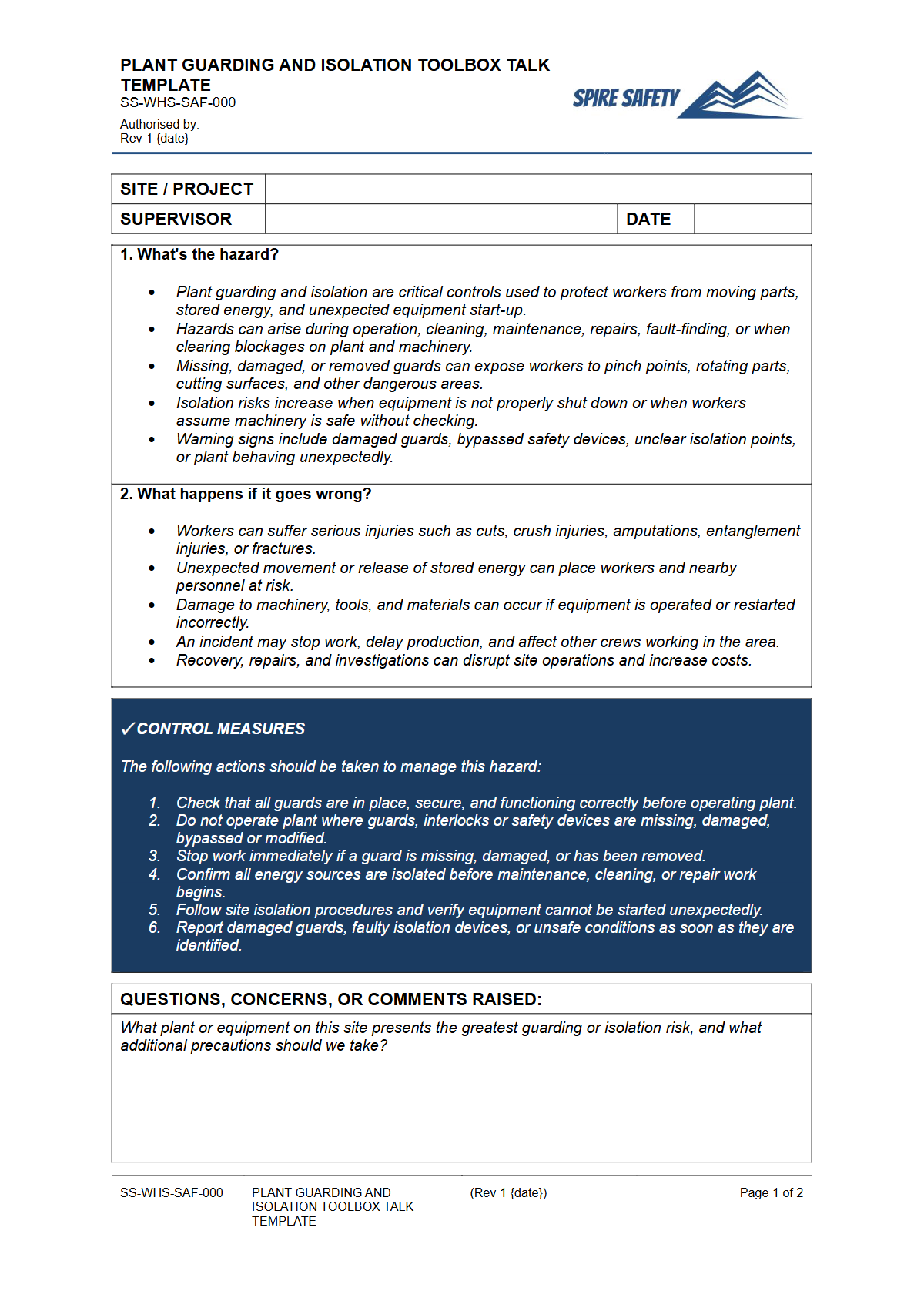
This Plant Guarding and Isolation Toolbox Talk Template provides a structured framework for conducting essential discussions on plant safety within your workplace. In Australia, plant operation is a significant source of WHS hazards. This template aims to facilitate regular, proactive conversations about the critical controls required to prevent injuries and maintain a safe working environment when operating or maintaining machinery.
Effective plant guarding prevents access to dangerous moving parts, while robust isolation procedures ensure plant is de-energised and cannot be inadvertently started during maintenance or cleaning. This template helps workers understand their responsibilities, recognise potential hazards, and reinforce safe work practices consistent with Australian WHS principles.
Video walkthrough
How to use this Toolbox Talk
This Plant Guarding and Isolation Toolbox Talk Template is provided in an editable DOCX format for easy customisation. To effectively use this resource, download the template and tailor it specifically to the types of plant and machinery present at your worksite. You must customise this template to your workplace's specific hazards, plant, and control measures before use to ensure its relevance and effectiveness. Incorporate your organisation's specific procedures for guarding and isolation, including lockout/tagout protocols, and reference any relevant safe work procedures or operating manuals.
Encourage open discussion during the toolbox talk. This is an opportunity for workers to ask questions, share experiences, and contribute to identifying and improving safety measures. Document attendance and any actions agreed upon during the talk. Consider integrating these discussions into your broader WHS management systems to ensure consistency and ongoing improvement.
When to use it
This Plant Guarding and Isolation Toolbox Talk Template should be used regularly, especially:
Before commencing work involving new plant or machinery.
When new workers are inducted or transferred to roles involving plant operation.
Following any incidents, near misses, or identified uncontrolled hazards related to plant guarding or isolation.
As part of routine safety meetings to reinforce existing safe work procedures.
After significant changes to plant, work processes, or WHS legislation.
Periodically to refresh worker knowledge and engagement on critical safety topics.
Who should use it
This toolbox talk template is a valuable tool for:
Supervisors and team leaders responsible for facilitating safety discussions.
WHS managers and officers overseeing plant safety programs.
Workers involved in the operation, maintenance, or cleaning of plant and machinery.
Training coordinators delivering WHS instruction.
Anyone involved in developing or implementing WHS procedures related to plant hazards.
By effectively using this template, all personnel can contribute to a safer working environment and ensure that critical plant guarding and isolation requirements are understood and practised consistently across the organisation. For more helpful resources, visit our free WHS resources library.
Common mistakes
Common mistakes to avoid
- Not customising the template to specific workplace plant and hazards.
- Treating toolbox talks as a 'tick-box' exercise rather than an interactive discussion.
- Failing to follow up on actions or concerns raised during the talk.
- Not documenting attendance or key outcomes of the toolbox talk.
Legal references
Legal considerations
The following legal requirements may be relevant to this type of work.
- Work Health and Safety Act (Harmonised) — Provides the primary duties for protecting workers and other people from work health and safety risks.
- Work Health and Safety Regulations (Harmonised) — Sets out requirements supporting the management of workplace hazards and risks.
The following codes may be relevant to this type of work.
- Managing WHS Risks Code of Practice — Provides practical guidance on identifying hazards, assessing risks and applying effective controls.
- Work Health and Safety Consultation, Cooperation and Coordination Code of Practice — Provides practical guidance on consulting workers and coordinating with other duty holders.
- Managing the Work Environment and Facilities Code of Practice — Provides practical guidance on safe work environments, workplace facilities and related controls.
Did you know
Hierarchy of Controls for Plant
The WHS Regulations mandate applying the hierarchy of control measures to manage plant risks, with elimination and substitution preferred over engineering controls like guarding, and administrative controls and PPE as the least effective.
Energy Sources for Isolation
When isolating plant, consider all energy sources, including electrical, hydraulic, pneumatic, mechanical, thermal, chemical, and gravitational, and ensure each is safely de-energised and secured.
FAQ
Frequently asked questions
01What is the primary purpose of plant guarding?
02What is isolation in the context of plant safety?
03How often should toolbox talks on plant safety be held?
04Does this template guarantee WHS compliance?
Share this resource
Plant Guarding and Isolation Toolbox Talk Template
Browse Categories
How To Use It
- 1Download and open in Word or PDF.
- 2Replace the placeholders with your business details.
- 3Get it reviewed by a WHS specialist before rollout.
Need it customised?
Our WHS consultants can adapt this template to your site, run a gap analysis, or audit what you already have in place.
Book a Free Consultation WHS consulting servicesor call 1300 156 382