
Plumbing Safety Toolbox Talk Template
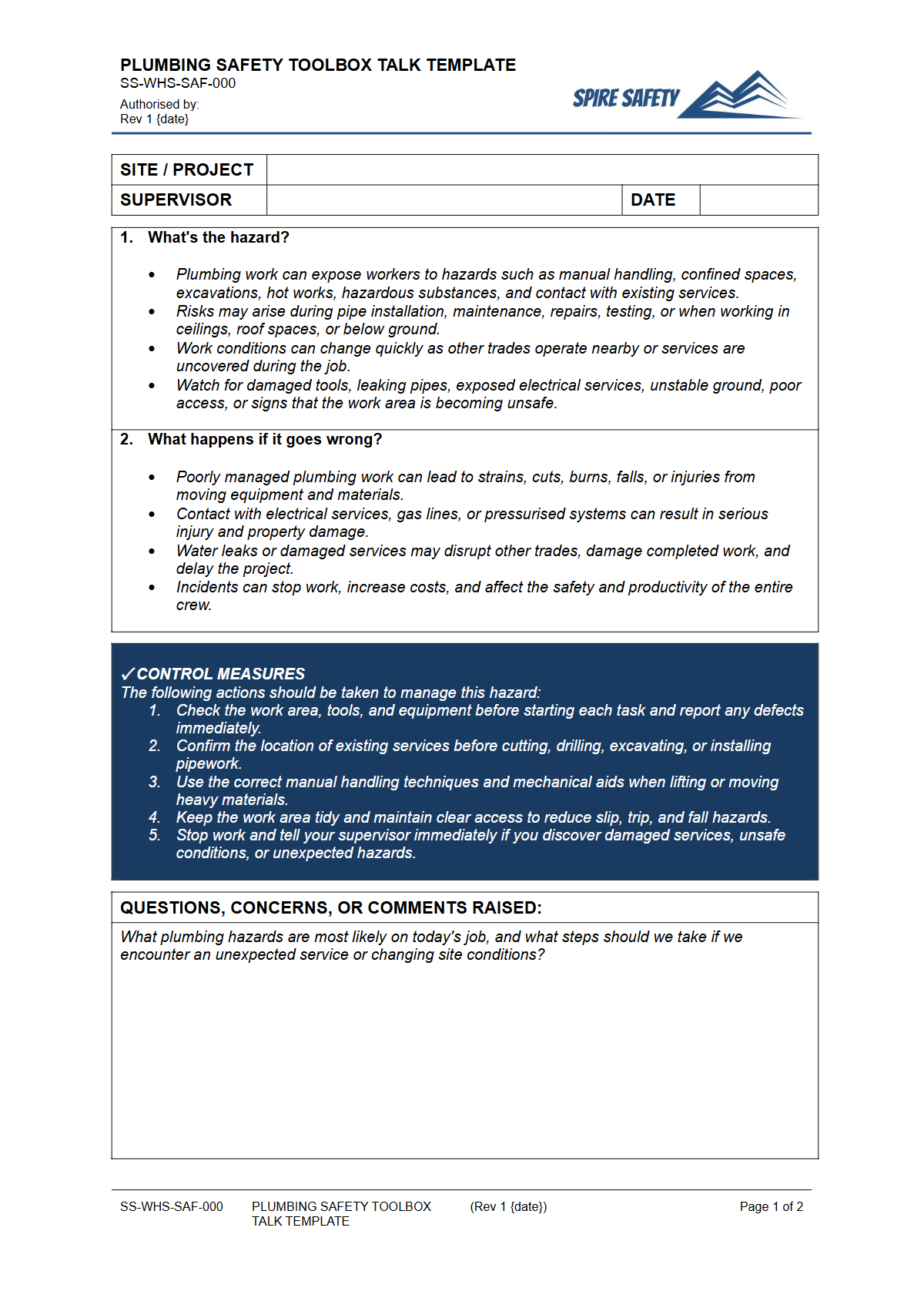
Download our free Plumbing Safety Toolbox Talk Template. A structured starting point to discuss critical WHS topics with your plumbing team.
Plumbing Safety Toolbox Talk Template
DOCX • 141 KB + PDF
Updated Oct 2026
No signup required
Purpose of this document
This Plumbing Safety Toolbox Talk Template provides a structured framework for conducting brief, focused safety discussions with your plumbing team. It's designed to help address common hazards and risks specific to plumbing work, fostering a proactive safety culture on site.
Regular toolbox talks are a vital component of effective WHS management systems, ensuring that safety remains top-of-mind for all workers. This template is aligned with Australian WHS practice, offering a practical tool to facilitate consistent safety messaging and hazard awareness among plumbers and related trades.
Video walkthrough
How to use this Toolbox Talk
Our Plumbing Safety Toolbox Talk Template is a versatile tool for team leaders and supervisors. Download the DOCX file to easily customise the content to suit your specific work environment and current projects.
You'll find sections for discussion points, hazard identification, risk controls, and space to record attendees and actions. Remember, this is a template; it must be customised to your workplace and its unique risks and activities. Always encourage open dialogue and feedback from your team to make the toolbox talk meaningful and relevant to their daily tasks.
The PDF version is provided for convenient viewing and printing once customised.
When to use it
This Toolbox Talk template is ideal for use at the start of a shift, before commencing a new task, or when introducing new equipment or procedures. It can also be effectively utilised after an incident or near-miss to reinforce learning and prevent recurrence.
Regular, short safety discussions are more impactful than infrequent, long sessions. Integrate these talks into your routine to maintain a consistent focus on safety and well-being for all workers within the plumbing industry.
Who should use it
This resource is primarily intended for plumbing business owners, supervisors, team leaders, and WHS officers responsible for conducting on-site safety briefings. Any individual tasked with communicating WHS information to a team of plumbers and associated trades will find this template beneficial.
It provides a reliable structure for delivering consistent, relevant safety messages, improving overall risk awareness and safe working behaviours. Consider exploring our free WHS resources library for additional templates and guidance to support your WHS efforts.
Common mistakes
Common mistakes to avoid
- Not customising the Toolbox Talk to specific site conditions or tasks.
- Failing to encourage worker participation and feedback during the session.
- Using the template as a 'tick and flick' exercise without genuine discussion.
- Not documenting attendance or actions taken as a result of the talk.
Legal references
Legal considerations
The following legal requirements may be relevant to this type of work.
- Work Health and Safety Act (Harmonised) — Provides the primary duties for protecting workers and other people from work health and safety risks.
- Work Health and Safety Regulations (Harmonised) — Sets out requirements supporting the management of workplace hazards and risks.
The following codes may be relevant to this type of work.
- Managing WHS Risks Code of Practice — Provides practical guidance on identifying hazards, assessing risks and applying effective controls.
- Work Health and Safety Consultation, Cooperation and Coordination Code of Practice — Provides practical guidance on consulting workers and coordinating with other duty holders.
- Managing the Work Environment and Facilities Code of Practice — Provides practical guidance on safe work environments, workplace facilities and related controls.
Did you know
Hearing Protection
Prolonged exposure to noise from plumbing tools like pipe cutters and grinders can lead to permanent hearing damage if adequate protection is not used.
Asbestos Risk
Plumbers frequently encounter asbestos-containing materials in older buildings, particularly in pipes, insulation, and roofing, necessitating strict control measures.
FAQ
Frequently asked questions
01What is a Toolbox Talk?
02How long should a Plumbing Safety Toolbox Talk be?
03Can this template be used for other trades?
04Is this template a substitute for formal WHS training?
Share this resource
Plumbing Safety Toolbox Talk Template
Browse Categories
How To Use It
- 1Download and open in Word or PDF.
- 2Replace the placeholders with your business details.
- 3Get it reviewed by a WHS specialist before rollout.
Need it customised?
Our WHS consultants can adapt this template to your site, run a gap analysis, or audit what you already have in place.
Book a Free Consultation WHS consulting servicesor call 1300 156 382