
New and Young Worker Safety Toolbox Talk Template
A free, customisable New and Young Worker Safety Toolbox Talk Template to help integrate new employees safely into your workplace. Download today!
New and Young Worker Safety Toolbox Talk Template
DOCX • 141 KB + PDF
Updated Oct 2026
No signup required
Purpose of this document
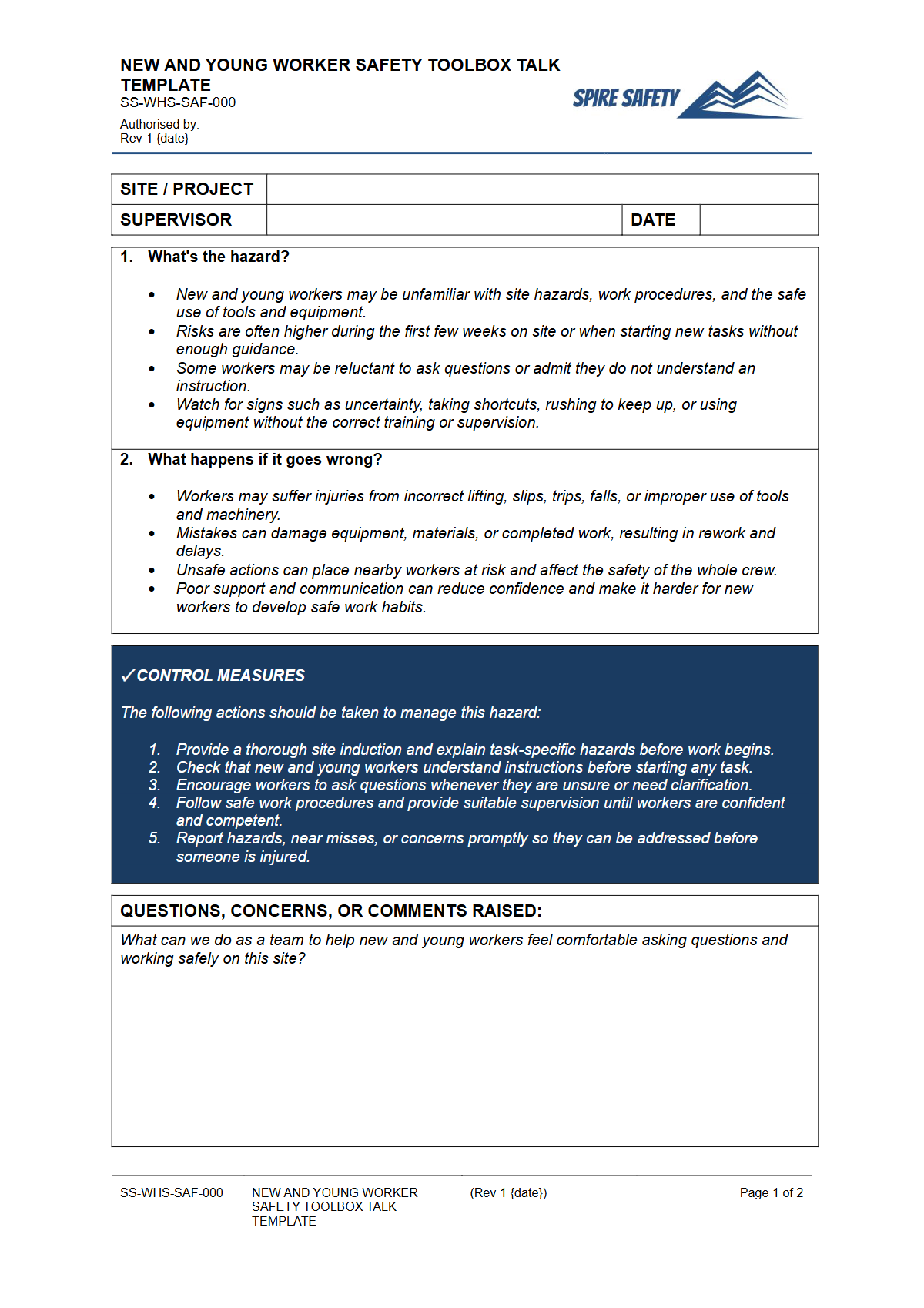
This New and Young Worker Safety Toolbox Talk Template provides a structured starting point for discussions on critical safety considerations for new and young employees in your workplace. It's designed to help organisations integrate new team members safely, ensuring they understand workplace hazards, control measures, and their WHS responsibilities from day one.
Addressing the specific needs of new and young workers is crucial, as they may have less experience, be unfamiliar with workplace processes, or be hesitant to ask questions, potentially increasing their risk of injury. This template facilitates a proactive approach to WHS, establishing a foundation for a safe working environment and aligning with Australian WHS practice.
The template covers essential topics such as induction processes, hazard identification, risk assessment basics, safe work procedures, emergency protocols, and the importance of reporting incidents and near misses. It also encourages open communication, reminding supervisors and experienced workers of their role in mentoring and supporting new hires.
Effective WHS management systems depend on clear communication and consistent training, and this toolbox talk serves as an integral part of that system.
Video walkthrough
How to use this Toolbox Talk
This Toolbox Talk Template for New and Young Worker Safety is provided in an editable DOCX format, allowing for complete customisation to your specific workplace. Important: This template must be customised to your workplace’s specific hazards, risks, controls, policies, and procedures. It is not a generic, off-the-shelf solution but a framework to guide your WHS discussions.
Download the document and review it thoughtfully. Add details relevant to your industry, specific job roles, machinery, chemicals, and any unique site conditions.
Include examples of common hazards or incidents relevant to your operations to make the discussion more relatable and impactful.
During the toolbox talk, encourage active participation from all attendees. Facilitate an open dialogue where new and young workers feel comfortable asking questions and sharing observations.
Use real-world examples and practical demonstrations where appropriate. Document attendance and key discussion points, ensuring any actions arising from the talk are assigned and followed up.
For ongoing WHS improvement, consider how this template fits into your broader WHS management systems strategy.
When to use it
This New and Young Worker Safety Toolbox Talk should be used primarily:
- As part of the initial induction process for all new employees, regardless of age or experience.
- When onboarding young workers (e.g., apprentices, trainees, casuals under 25) who may require additional guidance and supervision.
- Before new workers commence tasks or duties with which they are unfamiliar.
- As a refresher training session for supervisors and mentors responsible for overseeing new or young workers.
- Following any incident or near-miss involving a new or young worker, to reinforce safety messages and identify areas for improvement.
- Periodically, as part of an ongoing WHS communication strategy, especially when new hazards are introduced or work processes change.
Who should use it
This Toolbox Talk template is an invaluable resource for:
- Supervisors and Team Leaders: Responsible for the direct oversight and induction of new and young workers.
- WHS Managers and Officers: To ensure consistent WHS messaging and compliance across the organisation. For comprehensive support, consider WHS consulting services Spire Safety offers.
- Human Resources Professionals: As part of their onboarding toolkit to ensure WHS is integrated into the new employee experience.
- Business Owners and Senior Management: To demonstrate a commitment to WHS leadership and worker safety, fostering a positive safety culture.
- Experienced Workers: To review their role in mentoring and guiding new colleagues.
By effectively utilising this template, organisations can significantly enhance the safety of their new and young workforce, reduce incidents, and build a stronger safety culture, complementing efforts towards certifications such as ISO 45001 certification. Explore our free WHS resources library for more useful templates.
Common mistakes
Common mistakes to avoid
- Not customising the Toolbox Talk to specific workplace hazards.
- Presenting the talk as a lecture rather than an interactive discussion.
- Failing to follow up on questions or concerns raised during the session.
- Not documenting attendance and discussion points.
Legal references
Legal considerations
The following legal requirements may be relevant to this type of work.
- Work Health and Safety Act (Harmonised) — Provides the primary duties for protecting workers and other people from work health and safety risks.
- Work Health and Safety Regulations (Harmonised) — Sets out requirements supporting the management of workplace hazards and risks.
The following codes may be relevant to this type of work.
- Managing WHS Risks Code of Practice — Provides practical guidance on identifying hazards, assessing risks and applying effective controls.
- Work Health and Safety Consultation, Cooperation and Coordination Code of Practice — Provides practical guidance on consulting workers and coordinating with other duty holders.
- Managing the Work Environment and Facilities Code of Practice — Provides practical guidance on safe work environments, workplace facilities and related controls.
Did you know
Young Worker Statistics
Workers under 25 years old generally account for a disproportionately high percentage of workplace injuries compared to their representation in the workforce.
Effective Communication
Clear, concise communication, tailored to the audience, is one of the most effective control measures for managing WHS risks, particularly for new and young workers.
FAQ
Frequently asked questions
01Why are new and young workers at higher risk of injury?
02How often should new worker safety be discussed?
03Can this template be used for contractors?
04What is a 'Toolbox Talk'?
Share this resource
New and Young Worker Safety Toolbox Talk Template
Browse Categories
How To Use It
- 1Download and open in Word or PDF.
- 2Replace the placeholders with your business details.
- 3Get it reviewed by a WHS specialist before rollout.
Need it customised?
Our WHS consultants can adapt this template to your site, run a gap analysis, or audit what you already have in place.
Book a Free Consultation WHS consulting servicesor call 1300 156 382