
Lockout Tagout (LOTO) Toolbox Talk Template
Download our free Lockout Tagout (LOTO) Toolbox Talk Template. A clear, customisable resource to enhance workplace safety discussions. Get your copy today!
Lockout Tagout (LOTO) Toolbox Talk Template
DOCX • 137 KB + PDF
Updated Oct 2026
No signup required
Purpose of this document
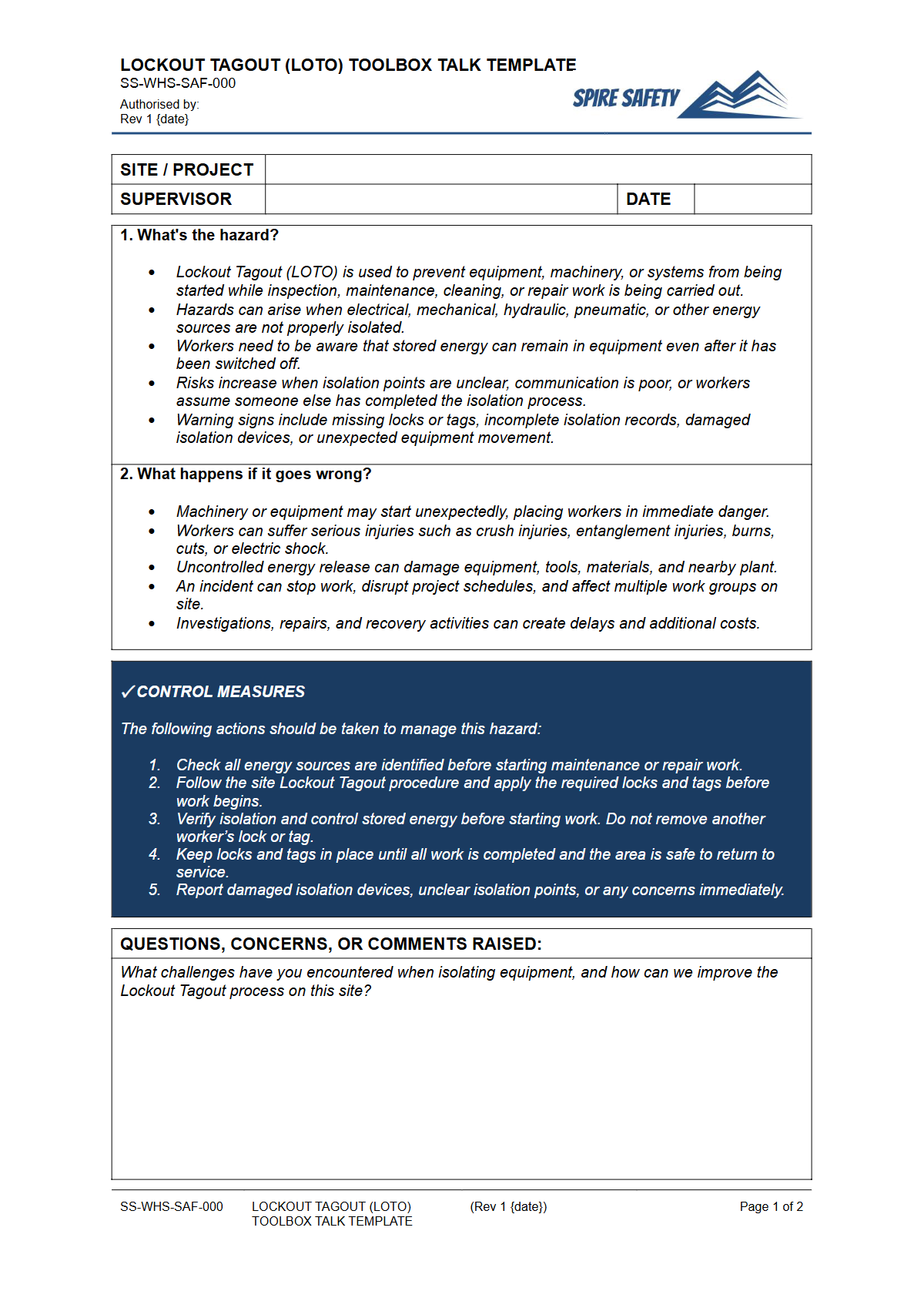
This Lockout Tagout (LOTO) Toolbox Talk Template is designed to facilitate crucial safety discussions concerning the isolation of energy sources in your workplace. Effective LOTO procedures are fundamental to preventing injuries and fatalities when maintaining, servicing, or repairing machinery and equipment. This template helps ensure that all workers understand the risks associated with unexpected start-up or release of stored energy, and the critical steps required to safely de-energise and lock out equipment. It covers the identification of energy sources, the application of LOTO devices, verification steps, and post-service procedures.
By regularly conducting toolbox talks using a structured Lockout Tagout (LOTO) Toolbox Talk Template, organisations can reinforce the importance of safe work practices, promote a strong safety culture, and meet their obligations under WHS legislation. It's a vital tool for preventing serious incidents and ensuring that every worker returns home safely at the end of their shift.
Video walkthrough
How to use this Toolbox Talk
Our free Lockout Tagout (LOTO) Toolbox Talk Template is provided in both DOCX and PDF formats for your convenience. The DOCX version is fully editable, allowing you to tailor the content to your specific workplace environment, machinery, and WHS procedures. We encourage you to review the template, insert details relevant to your site-specific LOTO requirements, and add any unique hazards or control measures pertinent to your operations. This template must be customised to your workplace and its specific LOTO procedures.
Before the toolbox talk, distribute copies to attendees or display it prominently. During the session, lead a discussion, encouraging active participation from all workers. Use the template as a guide to cover key points, answer questions, and reinforce understanding. Document attendance and any actions arising from the discussion. Regular reviews and updates to your LOTO procedures, informed by these toolbox talks, are part of effective WHS management systems.
When to use it
This Lockout Tagout (LOTO) Toolbox Talk Template should be used regularly as part of your ongoing WHS program. It is particularly essential:
Before commencing work on new or unfamiliar machinery requiring energy isolation.
Following any incident or near-miss related to unexpected machinery start-up or energy release.
When introducing new LOTO devices, procedures, or equipment.
During worker inductions or refresher training for those involved in maintenance, servicing, or operating plant.
As part of routine safety meetings to maintain awareness and reinforce safe work practices.
When reviewing or updating your organisation's LOTO policies and procedures.
Consistent application helps embed critical safety behaviours and knowledge among your workforce.
Who should use it
This Lockout Tagout (LOTO) Toolbox Talk Template is suitable for a wide range of personnel across various industries. It is primarily intended for:
Team Leaders, Supervisors, and Managers: To lead and facilitate effective toolbox talks with their teams.
Safety Officers and WHS Managers: To integrate into their ongoing safety training and awareness programs.
Maintenance Technicians and Tradespeople: As a refresher and to ensure consistent application of LOTO procedures during their work.
Operators of Plant and Equipment: To understand why LOTO is critical and what to expect when machines are being serviced.
New Employees: As part of their induction training, particularly if their roles involve working with or near machinery requiring energy isolation.
Ultimately, anyone responsible for or involved in energy isolation procedures or working on/near machinery that requires LOTO will benefit from the discussions facilitated by this template. You can find more helpful resources in our free WHS resources library.
Common mistakes
Common mistakes to avoid
- Not verifying that energised equipment has been properly isolated and de-energised before commencing work.
- Bypassing LOTO procedures due to perceived time pressures or 'known' safe workarounds.
- Failing to adequately train all workers involved in LOTO on specific site procedures and equipment.
- Using LOTO devices that are easily defeated or not suitable for the type of energy being isolated.
Legal references
Legal considerations
The following legal requirements may be relevant to this type of work.
- Work Health and Safety Act (Harmonised) — Provides the primary duties for protecting workers and other people from work health and safety risks.
- Work Health and Safety Regulations (Harmonised) — Sets out requirements supporting the management of workplace hazards and risks.
The following codes may be relevant to this type of work.
- Managing WHS Risks Code of Practice — Provides practical guidance on identifying hazards, assessing risks and applying effective controls.
- Work Health and Safety Consultation, Cooperation and Coordination Code of Practice — Provides practical guidance on consulting workers and coordinating with other duty holders.
- Managing the Work Environment and Facilities Code of Practice — Provides practical guidance on safe work environments, workplace facilities and related controls.
Did you know
Hierarchy of Controls
LOTO falls under 'Engineering Controls' and 'Administrative Controls' in the hierarchy, targeting the elimination or reduction of hazards at the source or through safe work procedures. It's a robust control measure, but eliminating the hazard entirely (e.g., automated processes) is always preferred if possible.
FAQ
Frequently asked questions
01What specifically is Lockout Tagout (LOTO)?
02Why is LOTO so critical in Australian workplaces?
03What are the common types of energy sources requiring LOTO?
04Who is responsible for implementing LOTO procedures in a workplace?
Share this resource
Lockout Tagout (LOTO) Toolbox Talk Template
Browse Categories
How To Use It
- 1Download and open in Word or PDF.
- 2Replace the placeholders with your business details.
- 3Get it reviewed by a WHS specialist before rollout.
Need it customised?
Our WHS consultants can adapt this template to your site, run a gap analysis, or audit what you already have in place.
Book a Free Consultation WHS consulting servicesor call 1300 156 382