
Mobile Plant and Pedestrian Interaction Toolbox Talk Template
Download this free Mobile Plant and Pedestrian Interaction Toolbox Talk Template to improve safety in your workplace and prevent incidents.
Mobile Plant and Pedestrian Interaction Toolbox Talk Template
DOCX • 137 KB + PDF
Updated Oct 2026
No signup required
Purpose of this document
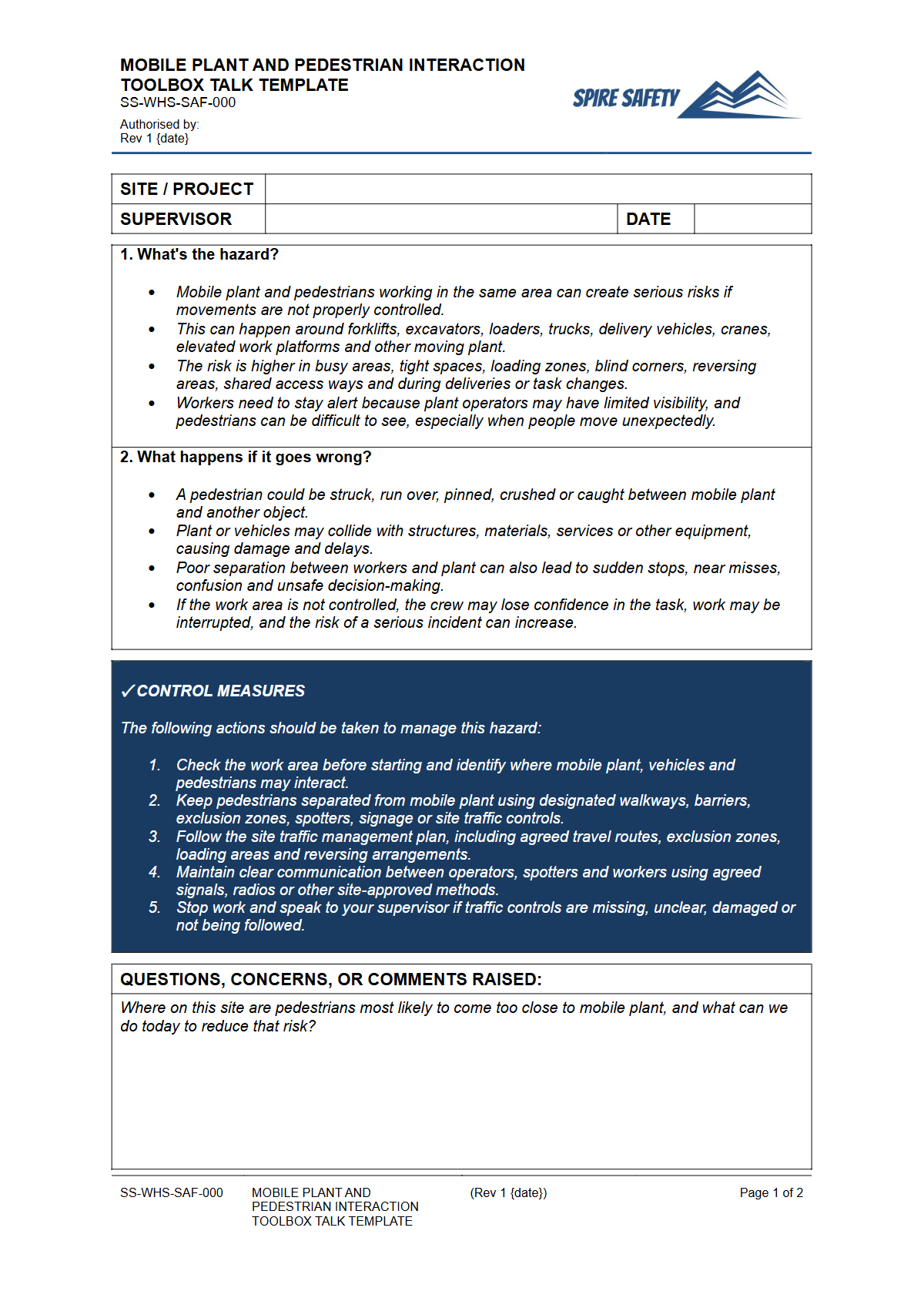
This Mobile Plant and Pedestrian Interaction Toolbox Talk Template provides a structured framework for facilitating discussions with your team about the critical risks associated with mobile plant and pedestrian interactions in the workplace. It aims to raise awareness, reinforce safe work practices, and encourage open dialogue to identify and mitigate hazards effectively.
The resource is designed to help organisations comply with WHS obligations by providing a tool for regular communication and training on an essential safety topic. Effective communication regarding shared spaces and potential hazards is crucial for preventing incidents and ensuring a safer working environment for everyone.
Video walkthrough
How to use this Toolbox Talk
This Mobile Plant and Pedestrian Interaction Toolbox Talk Template is a starting point for your safety discussions. You must customise it to reflect the specific mobile plant, pedestrian activities, site layout, and control measures present in your workplace. Integrate real-world examples from your site, including near misses or incidents, to make the discussion more relevant.
Prior to the talk, conduct a site-specific risk assessment to identify all potential interaction points and prevailing hazards. Use this information to tailor the discussion points, control measures, and questions within the template. Encourage active participation from all attendees, fostering an environment where workers feel comfortable raising concerns or suggesting improvements. Document attendance and key discussion points for your records. Consider incorporating this toolbox talk as part of your broader WHS management systems.
When to use it
This Toolbox Talk Template should be used regularly, especially when:
New mobile plant is introduced to the worksite.
New workers or contractors commence work involving mobile plant or working in areas with mobile plant.
There are changes to the worksite layout or traffic management plans.
Incidents or near misses involving mobile plant and pedestrians occur.
Refresher training is required to reinforce safe work practices.
As part of routine safety meetings to maintain a high level of hazard awareness.
Who should use it
This Mobile Plant and Pedestrian Interaction Toolbox Talk Template is suitable for:
Site supervisors and team leaders responsible for conducting safety briefings.
WHS officers and managers overseeing safety compliance and training.
Workers operating mobile plant or working in proximity to mobile plant.
Management seeking to reinforce a proactive safety culture within the organisation.
Organisations striving to enhance their WHS compliance auditing efforts and minimise risks.
Any individual or team involved in operations where mobile plant and pedestrian movement co-exist.
Common mistakes
Common mistakes to avoid
- Not customising the toolbox talk to specific site conditions.
- Failing to encourage active participation and feedback from workers.
- Not documenting attendance or key discussion outcomes.
- Infrequent or inconsistent delivery of toolbox talks on this critical topic.
Legal references
Legal considerations
The following legal requirements may be relevant to this type of work.
- Work Health and Safety Act (Harmonised) — Provides the primary duties for protecting workers and other people from work health and safety risks.
- Work Health and Safety Regulations (Harmonised) — Sets out requirements supporting the management of workplace hazards and risks.
The following codes may be relevant to this type of work.
- Managing WHS Risks Code of Practice — Provides practical guidance on identifying hazards, assessing risks and applying effective controls.
- Work Health and Safety Consultation, Cooperation and Coordination Code of Practice — Provides practical guidance on consulting workers and coordinating with other duty holders.
- Managing the Work Environment and Facilities Code of Practice — Provides practical guidance on safe work environments, workplace facilities and related controls.
Did you know
Separation is Key
One of the most effective control measures for managing mobile plant and pedestrian interaction risks is physical separation of pedestrians from plant traffic, wherever reasonably practicable.
High Visibility
Wearing high-visibility clothing significantly improves a pedestrian's chances of being seen by mobile plant operators, especially in low light or complex environments.
FAQ
Frequently asked questions
01What is a mobile plant?
02Why is a Toolbox Talk important for mobile plant and pedestrian interaction?
03What are common control measures for mobile plant and pedestrian interaction?
04Where can I find more free WHS resources?
Share this resource
Mobile Plant and Pedestrian Interaction Toolbox Talk Template
Browse Categories
How To Use It
- 1Download and open in Word or PDF.
- 2Replace the placeholders with your business details.
- 3Get it reviewed by a WHS specialist before rollout.
Need it customised?
Our WHS consultants can adapt this template to your site, run a gap analysis, or audit what you already have in place.
Book a Free Consultation WHS consulting servicesor call 1300 156 382