
Hydration and Nutrition on Site Toolbox Talk Template
Ensure worker well-being with our Hydration and Nutrition on Site Toolbox Talk Template. A vital tool for maintaining health on Australian work sites.
Hydration and Nutrition on Site Toolbox Talk Template
DOCX • 145 KB + PDF
Updated Oct 2026
No signup required
Purpose of this document
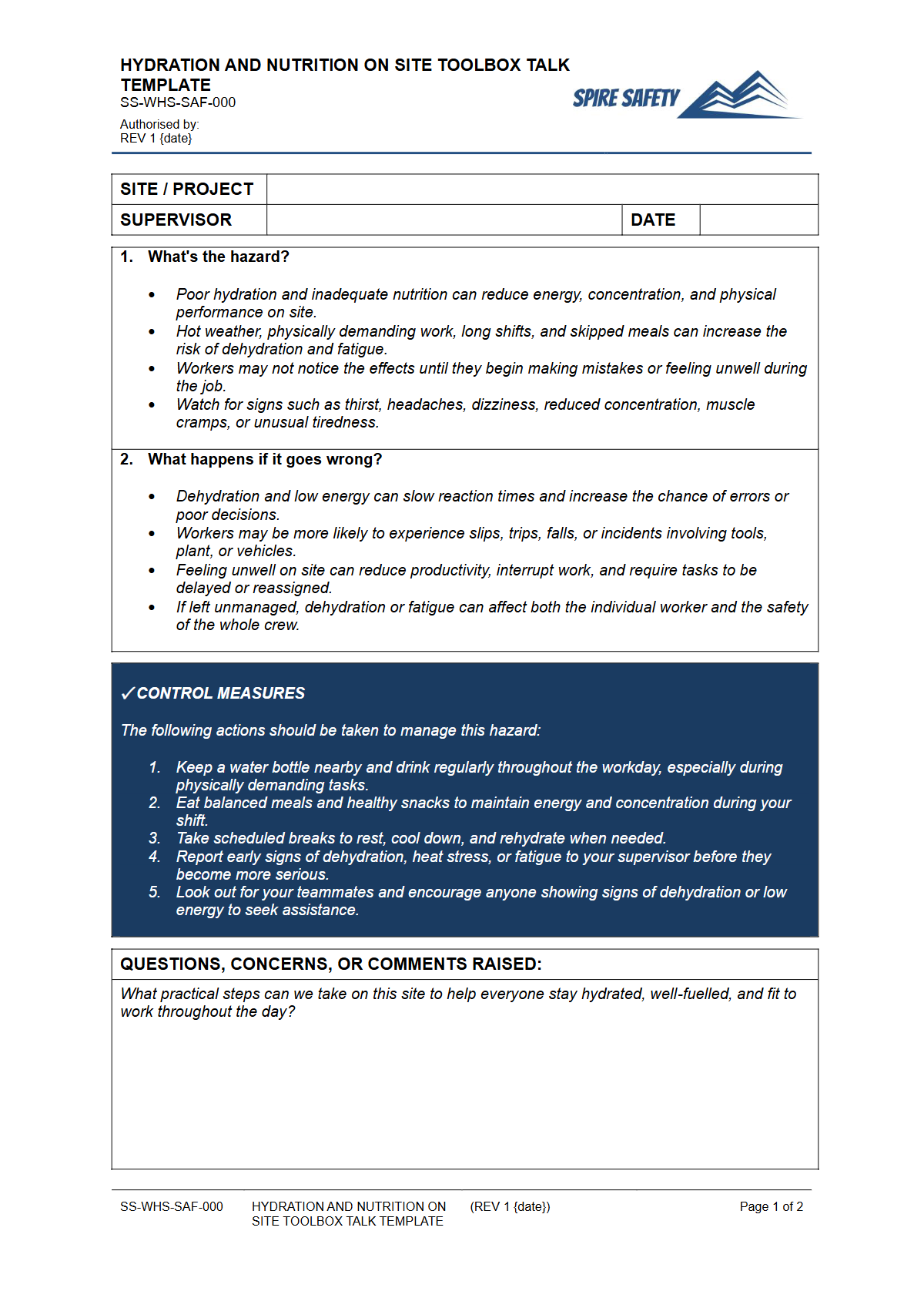
This Hydration and Nutrition on Site Toolbox Talk Template provides a structured discussion guide for supervisors and safety officers to address the critical importance of proper hydration and nutrition in the workplace. Particularly relevant for Australian conditions, where heat stress and demanding physical labour are common, this template aims to raise awareness among workers about the risks associated with poor dietary habits and dehydration.
It covers the health impacts, recognising symptoms, and implementing simple strategies to maintain energy levels and reduce fatigue on site.
Video walkthrough
How to use this Toolbox Talk
Our Hydration and Nutrition on Site Toolbox Talk Template is a comprehensive starting point designed for easy customisation. Download the DOCX file, review the content, and tailor it to reflect the specific hazards, work conditions, and policies present at your work site.
Add details about your organisation's provisions for water refilling stations, shaded break areas, or specific lunch arrangements. Incorporate real-world examples relevant to your team's experiences.
Facilitate an open discussion, encouraging workers to share their own tips and concerns. This template must be customised to your workplace and its specific risks to be effective.
When to use it
This Toolbox Talk is ideal for various situations. It can be conducted as part of induction for new workers, especially those commencing work in warmer months or on physically demanding projects.
Regular refreshers are beneficial throughout the year, particularly before anticipated periods of high heat or increased workload. It's also suitable for addressing observed issues such as worker fatigue, reduced productivity, or reported instances of heat-related illness. Integrating this discussion into your regular safety meetings reinforces a proactive approach to worker well-being and is a key component of effective WHS management systems.
Who should use it
Supervisors, team leaders, safety officers, and WHS managers are the primary users of this template. Anyone responsible for conducting site inductions or leading health and safety discussions will find it a valuable resource.
It is designed for workplaces across various industries, including construction, manufacturing, agriculture, and outdoor service industries, where workers are exposed to environmental stressors or perform strenuous tasks. The principles discussed are universally applicable for promoting a healthier workforce.
For further assistance in developing bespoke WHS resources, consider our WHS consulting services.
Common mistakes
Common mistakes to avoid
- Not drinking water until you feel thirsty, which means you're already dehydrated.
- Relying on sugary drinks or caffeine as primary hydration sources.
- Skipping meals or eating unhealthy, heavy foods that cause energy crashes.
- Not taking adequate breaks to rehydrate and refuel, especially in hot conditions.
Legal references
Legal considerations
The following legal requirements may be relevant to this type of work.
- Work Health and Safety Act (Harmonised) — Provides the primary duties for protecting workers and other people from work health and safety risks.
- Work Health and Safety Regulations (Harmonised) — Sets out requirements supporting the management of workplace hazards and risks.
The following codes may be relevant to this type of work.
- Managing WHS Risks Code of Practice — Provides practical guidance on identifying hazards, assessing risks and applying effective controls.
- Work Health and Safety Consultation, Cooperation and Coordination Code of Practice — Provides practical guidance on consulting workers and coordinating with other duty holders.
- Managing the Work Environment and Facilities Code of Practice — Provides practical guidance on safe work environments, workplace facilities and related controls.
Did you know
Impact of 1% Dehydration
Even a 1% drop in body fluid can impair physical performance and reduce mental alertness, making accurate work and critical decision-making more challenging.
Salt Loss in Sweat
When working in hot conditions, you don't just lose water; you also lose essential electrolytes like sodium. Replenishing these is vital for maintaining fluid balance and preventing muscle cramps.
FAQ
Frequently asked questions
01Why is hydration so important on a work site?
02What are the common signs of dehydration I should look out for in myself or colleagues?
03How can I practically improve my nutrition while working on site?
04Does my organisation have a responsibility to provide water on site?
Share this resource
Hydration and Nutrition on Site Toolbox Talk Template
Browse Categories
How To Use It
- 1Download and open in Word or PDF.
- 2Replace the placeholders with your business details.
- 3Get it reviewed by a WHS specialist before rollout.
Need it customised?
Our WHS consultants can adapt this template to your site, run a gap analysis, or audit what you already have in place.
Book a Free Consultation WHS consulting servicesor call 1300 156 382