
Healthy Backs - Posture and Lifting Toolbox Talk Template
Download your free "Healthy Backs - Posture and Lifting Toolbox Talk Template". A practical guide for workplace safety discussions.
Healthy Backs - Posture and Lifting Toolbox Talk Template
DOCX • 142 KB + PDF
Updated Oct 2026
No signup required
Purpose of this document
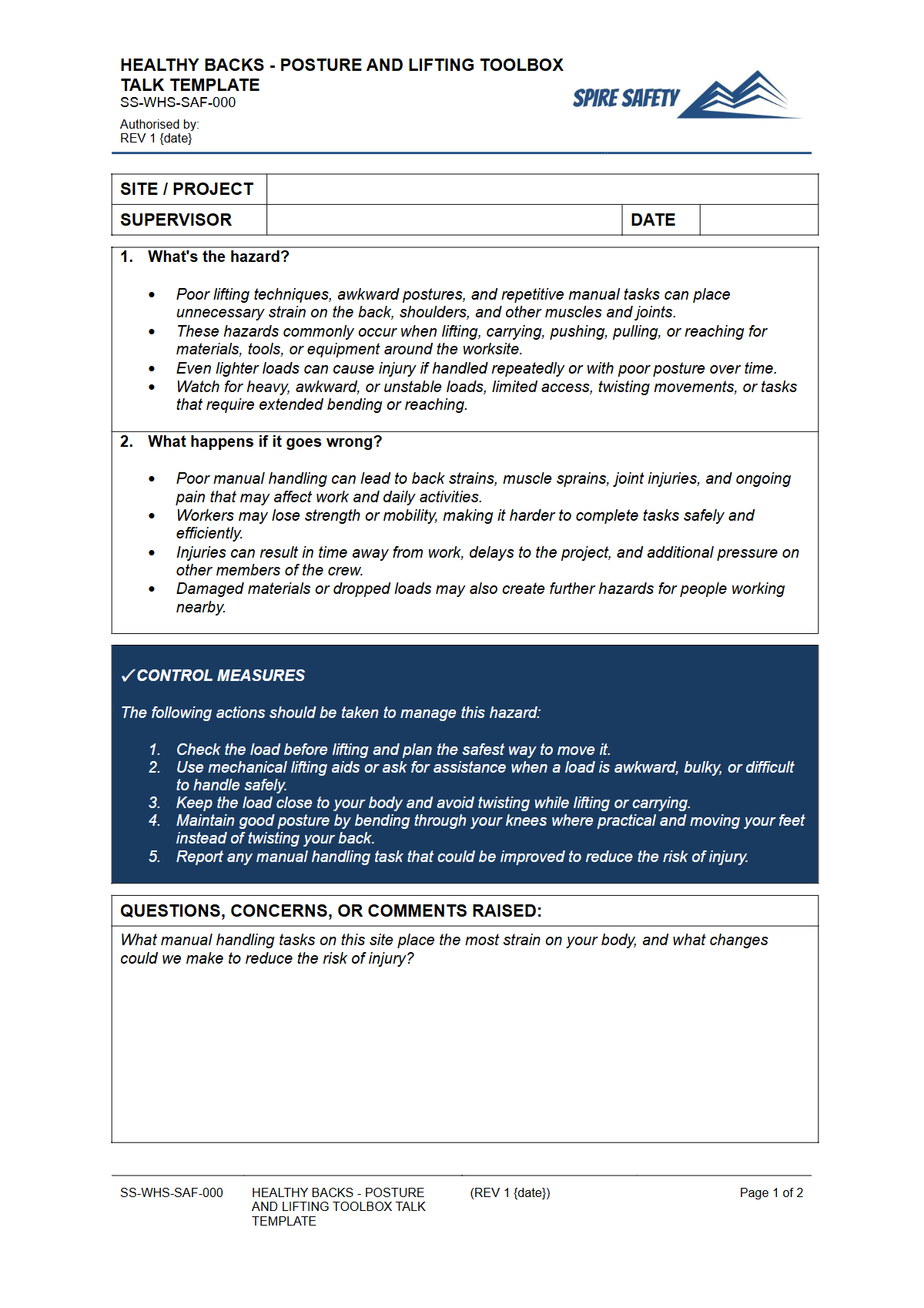
This "Healthy Backs - Posture and Lifting Toolbox Talk Template" is designed to provide Australian workplaces with a structured starting point for discussions about preventing musculoskeletal injuries, specifically those related to manual tasks, poor posture, and incorrect lifting techniques. Organisations can use this template to cover essential information relevant to maintaining worker health and safety, promoting good ergonomic practices, and understanding the risks associated with hazardous manual tasks.
By regularly addressing these topics, organisations can foster an environment where workers are aware of potential hazards and understand the practical steps to mitigate them. This proactive approach supports a culture of safety and contributes to overall worker wellbeing, helping to reduce incidents of back pain, strains, and other injuries common in various work settings.
Video walkthrough
How to use this Toolbox Talk
Our "Healthy Backs - Posture and Lifting Toolbox Talk Template" is provided in an editable DOCX format for your convenience. To use this template effectively, download it and customise it to reflect your specific workplace environment, tasks, and worker demographics.
It is crucial to include details relevant to the actual manual tasks performed, the equipment used, and the specific control measures implemented at your site. Remember, this template is a general guide; it must be customised to your workplace to be truly effective and aligned with Australian WHS practice.
Consider adding site-specific examples of safe lifting practices, demonstrations of correct posture for common tasks, and details of any ergonomic aids or equipment available to your workers. Supplementing the discussion with visual aids or practical exercises can significantly enhance engagement and retention of information.
When to use it
This Toolbox Talk template is ideal for regular safety briefings, particularly:
- At the start of new projects or tasks involving manual handling.
- After any incidents or near misses related to back injuries or strains.
- As part of induction training for new workers.
- During scheduled safety meetings (e.g., quarterly, annually).
- When new equipment or work processes are introduced that may impact manual handling techniques.
- As a refresher to reinforce good ergonomic behaviours and lifting practices.
Regular communication about safe work practices is a cornerstone of effective WHS management systems, ensuring that safety remains a top priority for all workers.
Who should use it
This resource is valuable for a range of individuals and roles responsible for workplace health and safety in Australia, including:
- Workplace supervisors and team leaders.
- Safety officers and WHS managers.
- Health and safety representatives.
- Business owners and employers.
- Anyone conducting site inductions or safety briefings.
It provides a structured framework for facilitating discussions and delivering consistent WHS messaging across different teams and departments. For those seeking to further enhance their safety protocols, exploring WHS consulting services can provide tailored guidance and support.
Common mistakes
Common mistakes to avoid
- Not customising the template to specific workplace tasks and risks.
- Delivering the talk as a lecture rather than an interactive discussion.
- Failing to follow up on identified hazards or proposed control measures.
- Not providing practical demonstrations of safe lifting techniques.
Legal references
Legal considerations
The following legal requirements may be relevant to this type of work.
- Work Health and Safety Act (Harmonised) — Provides the primary duties for protecting workers and other people from work health and safety risks.
- Work Health and Safety Regulations (Harmonised) — Sets out requirements supporting the management of workplace hazards and risks.
The following codes may be relevant to this type of work.
- Managing WHS Risks Code of Practice — Provides practical guidance on identifying hazards, assessing risks and applying effective controls.
- Work Health and Safety Consultation, Cooperation and Coordination Code of Practice — Provides practical guidance on consulting workers and coordinating with other duty holders.
- Managing the Work Environment and Facilities Code of Practice — Provides practical guidance on safe work environments, workplace facilities and related controls.
Did you know
Manual Tasks are a Leading Hazard
Hazardous manual tasks are a significant cause of injuries in Australian workplaces, accounting for a large proportion of musculoskeletal disorder (MSD) claims.
Prevention is Key
Implementing proper training and ergonomic assessments can significantly reduce the risk of back injuries, leading to a healthier and more productive workforce.
FAQ
Frequently asked questions
01What is the primary goal of a 'Healthy Backs' Toolbox Talk?
02How often should I conduct a Toolbox Talk on posture and lifting?
03Can this template help reduce workers' compensation claims?
04Are there other related resources available?
Share this resource
Healthy Backs - Posture and Lifting Toolbox Talk Template
Browse Categories
How To Use It
- 1Download and open in Word or PDF.
- 2Replace the placeholders with your business details.
- 3Get it reviewed by a WHS specialist before rollout.
Need it customised?
Our WHS consultants can adapt this template to your site, run a gap analysis, or audit what you already have in place.
Book a Free Consultation WHS consulting servicesor call 1300 156 382