
General Toolbox Talk Template Template
Streamline your workplace safety discussions with our free General Toolbox Talk Template. A structured starting point for effective WHS briefings. Download now!
General Toolbox Talk Template Template
DOCX • 142 KB + PDF
Updated Oct 2026
No signup required
Purpose of this document
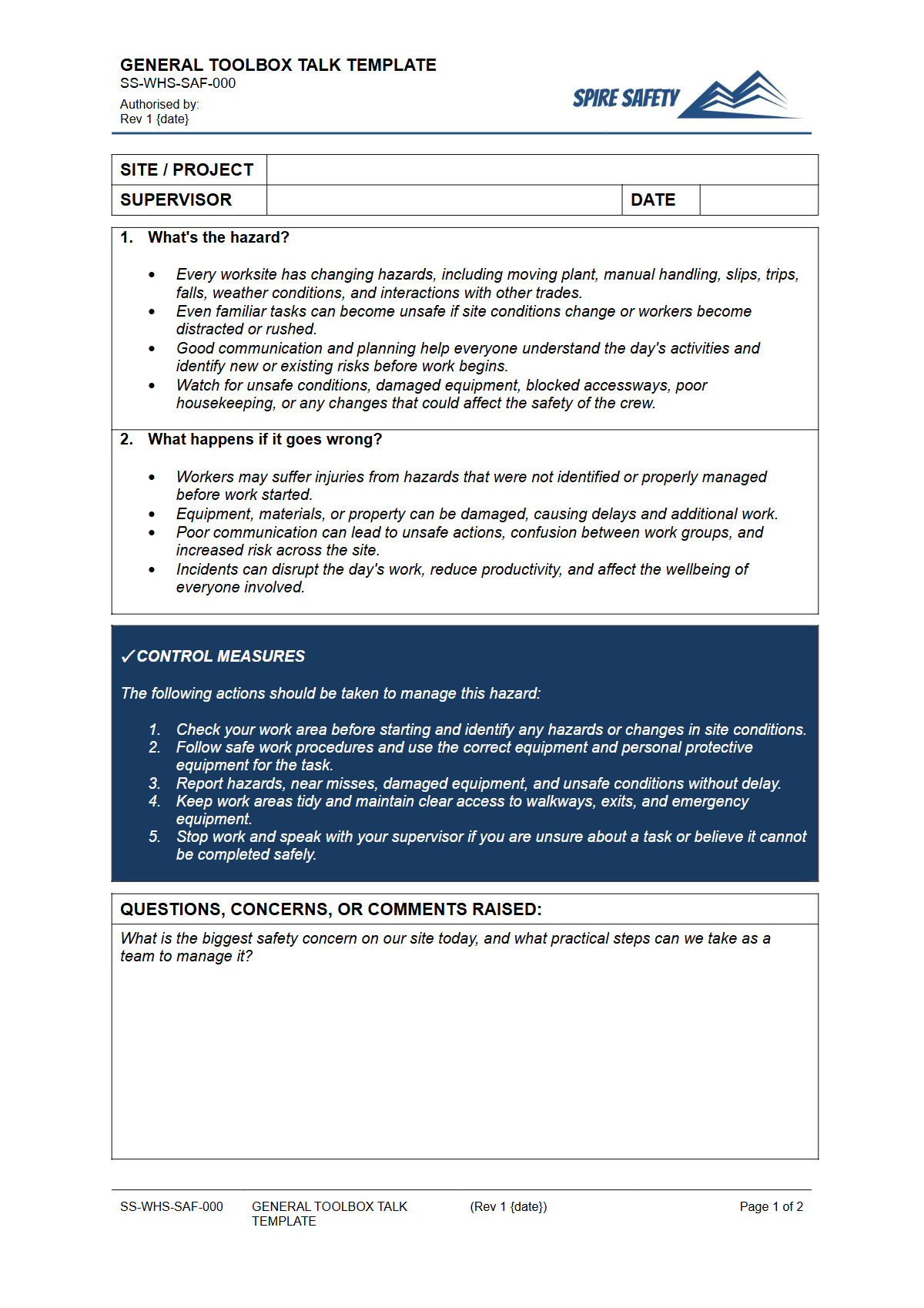
This General Toolbox Talk Template provides a structured framework for conducting workplace safety discussions. It’s designed to help organisations facilitate regular conversations about work health and safety (WHS) among workers, supervisors, and management.
By standardising the format of your toolbox talks, this template assists in ensuring key WHS topics are addressed consistently, promoting proactive risk management and a culture of safety.
Regular toolbox talks are a cornerstone of effective WHS management systems. They offer an informal yet effective way to communicate safety information, discuss hazards and controls, and gather worker feedback on safety matters. This template recognises the importance of these routine safety briefings in preventing incidents and improving overall workplace safety performance.
Video walkthrough
How to use this Toolbox Talk
This General Toolbox Talk Template is a starting point, not a finished product ready for immediate use. It must be customised to your specific workplace, its unique hazards, operations, and legislative requirements.
- Download and Adapt: Access the template in DOCX format. Tailor the content to reflect the specific WHS topics relevant to your team or project. This might include recent incidents, new equipment, changes in work procedures, or identified hazards.
- Fill in Details: Complete sections for the topic, date, attendees, and presenter. Clearly state the objective of each toolbox talk.
- Add Specific Content: Populate the ‘Key Discussion Points’ and ‘Actions & Responsibilities’ sections with information directly applicable to your current work environment. For example, if discussing manual handling, include details about the specific loads, techniques, and equipment used in your workplace.
- Encourage Participation: The template includes sections for ‘Worker Input & Feedback’. Actively solicit questions, concerns, and suggestions from attendees. This fosters a sense of ownership and encourages proactive safety behaviour.
- Record and Review: Use the template to document attendance, discussion outcomes, and any agreed-upon actions. Regularly reviewing past toolbox talks can help identify recurring issues or areas needing further attention.
- Integrate with broader WHS: Consider how toolbox talks fit within your overall WHS strategy. They can be a valuable input for hazard identification, risk assessment reviews, and the ongoing maintenance of control measures.
When to use it
This General Toolbox Talk Template is suitable for a wide range of situations where regular, informal safety discussions are beneficial:
- Project Start-ups: Before commencing new projects or phases of work, to brief teams on specific project hazards and safety expectations.
- Shift Handover: At the beginning of shifts, to communicate critical safety information, outstanding hazards, or recent incidents from previous shifts.
- Following Incidents/Near Misses: To discuss lessons learned from incidents or near misses, reinforcing safe work practices and preventing recurrence.
- Introduction of New Equipment or Processes: When introducing new plant, equipment, or modifications to work processes, to explain new risks and control measures.
- Regular Interval Meetings: As a standard agenda item in weekly or monthly team meetings to maintain ongoing safety awareness and engagement.
- Addressing Specific Hazards: To focus discussions on particular hazards recognised within the workplace or industry, such as working at heights, electrical safety, or hazardous chemicals.
The frequency and timing should align with your organisation’s WHS policies and the nature of the work being performed.
Who should use it
This General Toolbox Talk Template is designed for anyone responsible for leading or facilitating WHS discussions within a workplace. This includes:
- Supervisors and Team Leaders: Who are on the front lines of managing teams and overseeing daily operations. They are ideally positioned to deliver relevant, timely safety messages.
- Project Managers: For conducting briefings with project teams, particularly on sites or tasks with evolving hazards.
- Safety Officers/WHS Managers: To provide guidance and support to supervisors, ensure consistency in safety messaging, and as a tool for their own presentations.
- Site Managers: For overall site safety communication, especially in construction or industrial settings.
- Workers: While typically led by supervisors, workers can be empowered to contribute topics or even lead sections of a toolbox talk, fostering greater engagement and ownership of safety.
Ultimately, this template supports any individual or team committed to fostering a safer work environment through regular, meaningful safety communication. It is an excellent resource for organisations undergoing ISO 45001 consulting and seeking to formalise their safety communication practices.
Common mistakes
Common mistakes to avoid
- Delivering generic, irrelevant content that doesn't apply to current tasks.
- Making talks one-sided with no opportunity for worker input or questions.
- Failing to document attendance, topics, and actions for future reference.
- Using toolbox talks as a scolding session rather than a constructive discussion.
Legal references
Legal considerations
The following legal requirements may be relevant to this type of work.
- Work Health and Safety Act (Harmonised) — Provides the primary duties for protecting workers and other people from work health and safety risks.
- Work Health and Safety Regulations (Harmonised) — Sets out requirements supporting the management of workplace hazards and risks.
The following codes may be relevant to this type of work.
- Managing WHS Risks Code of Practice — Provides practical guidance on identifying hazards, assessing risks and applying effective controls.
- Work Health and Safety Consultation, Cooperation and Coordination Code of Practice — Provides practical guidance on consulting workers and coordinating with other duty holders.
- Managing the Work Environment and Facilities Code of Practice — Provides practical guidance on safe work environments, workplace facilities and related controls.
Did you know
Boost Worker Engagement
Regular, interactive toolbox talks have been shown to increase worker engagement in safety, leading to a more proactive safety culture and fewer incidents.
Legal Obligation Support
While not explicitly mandated, regular safety discussions like toolbox talks demonstrate an organisation's commitment to providing information, training, and instruction, which supports compliance with WHS duties.
FAQ
Frequently asked questions
01What is a toolbox talk?
02How long should a toolbox talk be?
03Do I need to keep records of toolbox talks?
04What topics can be covered in a General Toolbox Talk Template?
Share this resource
General Toolbox Talk Template Template
Browse Categories
How To Use It
- 1Download and open in Word or PDF.
- 2Replace the placeholders with your business details.
- 3Get it reviewed by a WHS specialist before rollout.
Need it customised?
Our WHS consultants can adapt this template to your site, run a gap analysis, or audit what you already have in place.
Book a Free Consultation WHS consulting servicesor call 1300 156 382