
Free Position Description (Carpenter) Template
Download our free Position Description (Carpenter) template. Clearly define roles, responsibilities, and WHS duties for your carpentry team. Download today.
Free Position Description (Carpenter) Template
DOCX • 138 KB + PDF
Updated Oct 2026
No signup required
Purpose of the Free Position Description (Carpenter) Template
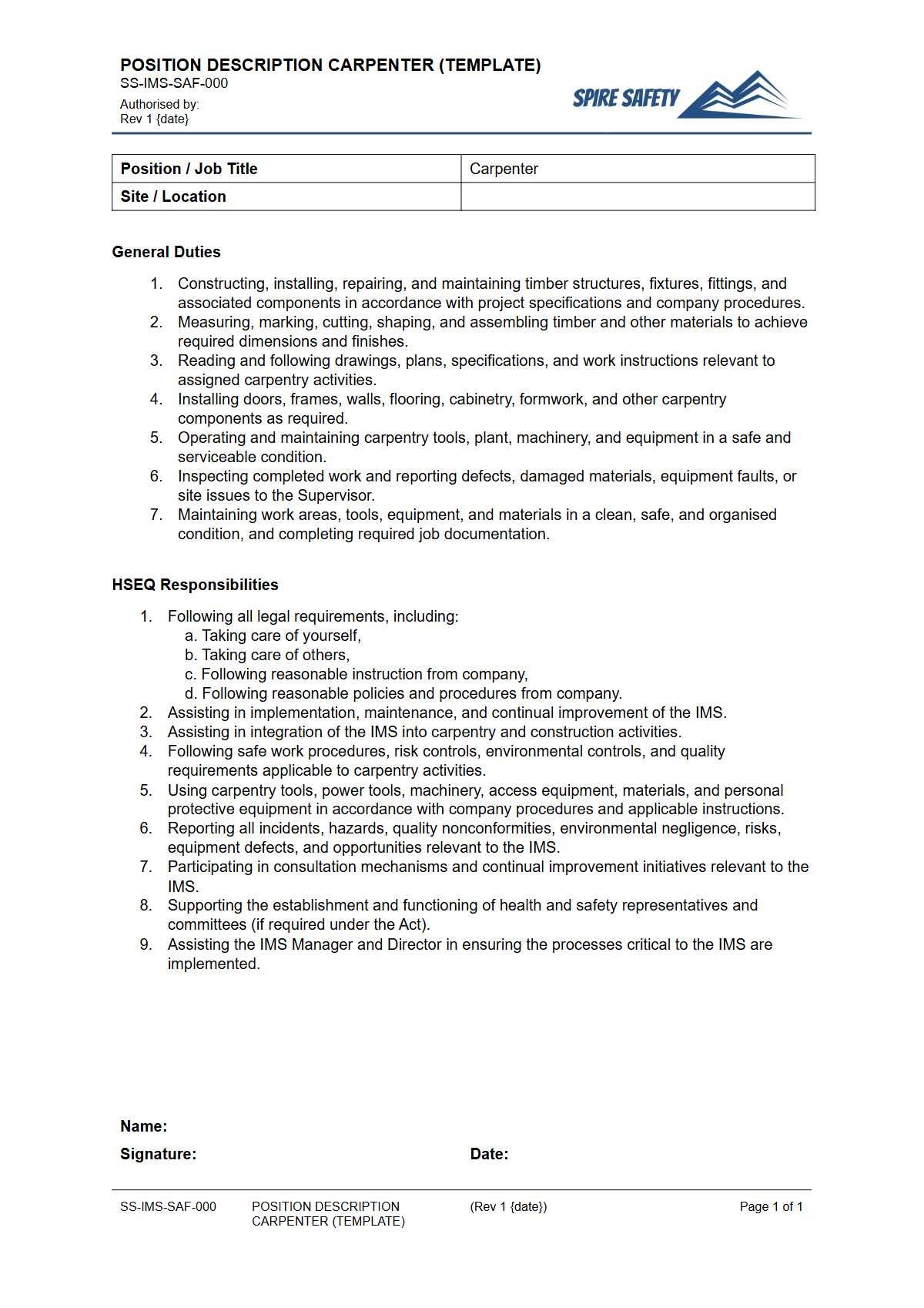
A well-drafted Position Description is a cornerstone of effective people and safety management. This Free Position Description (Carpenter) Template provides a structured starting point for defining the role, responsibilities, and expectations for carpenters within your organisation.
Clearly articulating these details is crucial not only for recruitment and performance management but also for establishing clear lines of accountability for workplace health and safety. For a carpenter, this includes outlining duties related to high-risk tasks, equipment use, and hazard identification.
Using a detailed Position Description helps ensure that both the employer and the employee have a shared understanding of the role's requirements from day one. It serves as a foundational document within your broader safety framework, contributing to a more organised and safer work environment.
Integrating such documents is a key function of effective WHS management systems, ensuring that safety responsibilities are embedded at every level of the organisation.
Defining Key Responsibilities
This template covers essential areas for a carpentry role, including:
- General carpentry tasks (e.g., framework, fit-outs, formwork).
- Interpretation of plans and drawings.
- Safe operation of power tools and equipment.
- Specific WHS duties, such as participating in risk assessments and following Safe Work Method Statements (SWMS).
- Qualifications, licences, and experience required.
- Physical demands and environmental conditions of the role.
How to use the Free Position Description (Carpenter) Template
Our template is designed for ease of use and customisation. Simply download the DOCX file and adapt it to the specific context of your business and the particular carpentry role you are defining.
While the PDF version offers a quick reference, the DOCX version is fully editable to suit your needs.
When completing the template, be specific about the types of projects, materials, tools, and machinery the carpenter will be expected to use. Detail the reporting lines and the level of autonomy in the role.
The more tailored the document is to your operational reality, the more effective it will be.
Important: This template is provided as a guide only. We strongly recommend that you customise this document to reflect the specific requirements, tasks, equipment, and hazards of your workplace.
For organisations aiming for certification or alignment with international standards, further customisation may be required as part of your ISO 45001 consulting journey.
When to use it
A Position Description for a carpenter is a versatile document that should be used at various stages of the employment lifecycle. Key times to use or review this document include:
- Recruitment: Use it to create accurate job advertisements and to guide interview questions.
- Onboarding: Provide it to new hires as part of their induction to clarify expectations from the outset.
- Performance Reviews: Use it as a benchmark for assessing performance and identifying training needs.
- Role Changes: Update the PD whenever the role evolves, such as with the introduction of new technology or responsibilities.
- Safety Audits: Reviewing Position Descriptions can be a valuable part of a safety audit, ensuring roles and WHS responsibilities are clearly defined and understood. Regular reviews are a core component of comprehensive WHS compliance auditing.
Who should use it
This template is beneficial for anyone involved in managing or hiring trade-based personnel in Australia. This includes:
- Business Owners and Directors: Particularly in small to medium-sized construction or trade-based businesses where roles may be less formalised.
- HR Managers and Professionals: For standardising job roles and ensuring consistency in recruitment and management.
- HSE/WHS Managers and Advisors: To ensure that safety responsibilities are clearly defined and integrated into every role.
- Supervisors and Team Leaders: To manage their team members effectively and clarify day-to-day expectations.
If you are uncertain about how to define WHS responsibilities or tailor this document to your specific legal obligations, seeking expert advice is recommended. Professional WHS consulting can provide clarity and help you develop robust documentation that supports your safety goals.
You can also explore our wider free WHS resources library for other helpful templates and guides.
Common mistakes
Common mistakes to avoid
- Using a generic, non-trade-specific PD that misses critical carpentry hazards.
- Forgetting to list essential qualifications, licences (e.g., for EWP or forklift), or tickets.
- Failing to review and update the PD when new tools or work processes are introduced.
- Making the document overly long or complex, which discourages employees from reading it.
Legal references
Legal considerations
The following legal requirements may be relevant to this type of work.
- Work Health and Safety Act (Harmonised) — Provides the primary duties for protecting workers and other people from work health and safety risks.
- Work Health and Safety Regulations (Harmonised) — Sets out requirements supporting the management of workplace hazards and risks.
The following codes may be relevant to this type of work.
- Managing WHS Risks Code of Practice — Provides practical guidance on identifying hazards, assessing risks and applying effective controls.
- Work Health and Safety Consultation, Cooperation and Coordination Code of Practice — Provides practical guidance on consulting workers and coordinating with other duty holders.
- Managing the Work Environment and Facilities Code of Practice — Provides practical guidance on safe work environments, workplace facilities and related controls.
Did you know
Defining 'Competency'
Under WHS regulations, 'competency' isn't just about holding a qualification. It means a worker has the combined skill, knowledge, and experience to perform a task safely without needing direct supervision.
Physical Demands
Clearly listing a role's physical demands in the Position Description helps manage risks related to musculoskeletal disorders, which are a leading cause of workers' compensation claims in the construction industry.
FAQ
Frequently asked questions
01What WHS information is essential in a carpenter's position description?
02Can this template be used for an apprentice carpenter?
03How often should a position description be reviewed?
04Does a position description replace a Safe Work Method Statement (SWMS)?
Share this resource
Free Position Description (Carpenter) Template
Browse Categories
How To Use It
- 1Download and open in Word or PDF.
- 2Replace the placeholders with your business details.
- 3Get it reviewed by a WHS specialist before rollout.
Need it customised?
Our WHS consultants can adapt this template to your site, run a gap analysis, or audit what you already have in place.
Book a Free Consultation WHS consulting servicesor call 1300 156 382
Related templates
- Free Position Description (Chef or Cook) Template
- Free Position Description (Childcare Worker) Template
- Free Position Description (Civil Engineer) Template
- Free Position Description (Cleaner) Template
- Free Position Description (Concreter) Template
- Free Position Description (Construction Manager) Template