
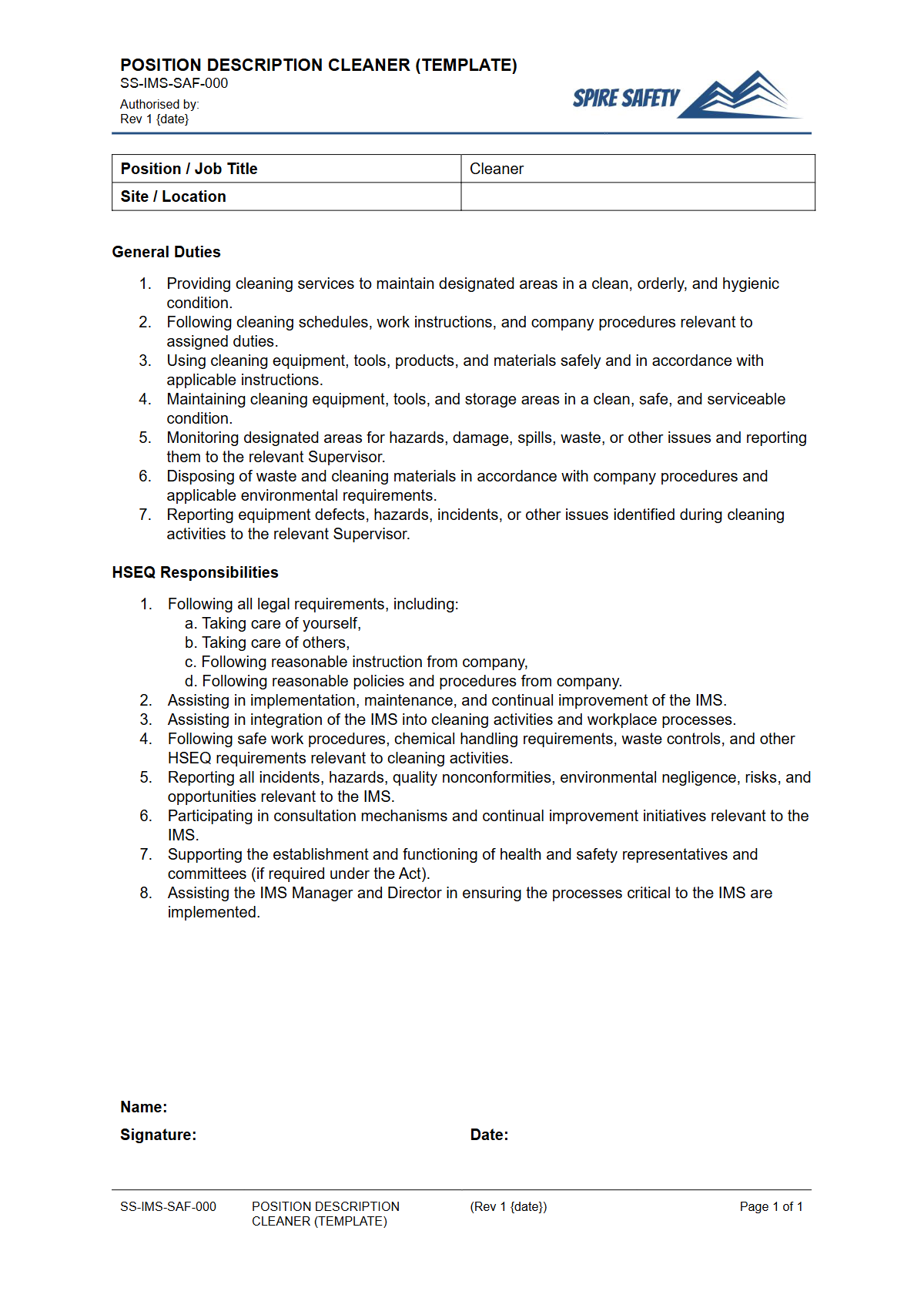
Free Position Description (Cleaner) Template
Download our free Position Description (Cleaner) Template.
Free Position Description (Cleaner) Template
DOCX • 136 KB + PDF
Updated Oct 2026
No signup required
Purpose of the Free Position Description (Cleaner) Template
A well-drafted position description is a critical tool for any organisation. This Free Position Description (Cleaner) Template provides a structured starting point for defining the roles, responsibilities, and performance expectations for your cleaning staff.
It helps ensure that both the employer and the employee have a clear, mutual understanding of the job's requirements from day one. More than just a list of duties, a comprehensive position description is a foundational WHS document.
It clarifies safety-critical tasks, required competencies, and the employee’s obligation to contribute to a safe work environment, helping you meet your primary duty of care.
Using this template helps formalise employment arrangements and sets a benchmark for performance management and training. For cleaners, whose roles often involve physical tasks, hazardous chemicals, and interaction with various workplace hazards, outlining WHS duties is non-negotiable.
It helps integrate safety into the core functions of the role, moving beyond compliance to foster a proactive safety culture. A clear position description also forms an essential part of a comprehensive WHS management system, linking workforce management directly to your organisation's safety objectives.
How to use the Free Position Description (Cleaner) Template
This template is designed for ease of use and customisation. Simply download the DOCX file and adapt it to the unique context of your business and the specific requirements of the cleaning role you are hiring for.
While it is aligned with Australian WHS practice, it serves as a guide, not a final document.
To get the most out of this resource:
- Review and Customise: Go through each section and replace the placeholder text with details relevant to your workplace. Consider the specific environment (e.g., office, medical facility, industrial site), the equipment to be used, and the types of cleaning agents involved.
- Incorporate Site-Specific Hazards: Add details about known hazards and the control measures in place. This includes protocols for manual handling, chemical safety, and using personal protective equipment (PPE).
- Define Reporting Lines: Clearly state who the cleaner reports to for daily tasks and, separately, for WHS matters like incident reporting.
- Consult with Workers: Where possible, consult with existing cleaning staff to ensure the position description accurately reflects the practical realities of the job.
Please note: this template is a starting point. It is essential that you customise it to reflect the specific tasks, equipment, hazards, and control measures relevant to your workplace.
We cannot supports your compliance efforts as this depends on your specific customisation and implementation.
When to use it
A position description for a cleaner is a versatile document that should be used at multiple points in the employment lifecycle. Its primary use is during the recruitment and hiring process to attract suitable candidates and provide clarity on the role's expectations.
It should also be provided to the successful candidate as part of their employment contract and induction package. The document is also invaluable for conducting performance reviews, identifying training needs, and managing any changes to the role's duties over time.
For certain tasks, simply having a position description is not enough. Competency for operating specific equipment must be formally assessed.
For instance, if the role involves using high-pressure water jets, you should also use our Free Pressure Cleaner VOC (Verification of Competency) Template to confirm the worker's ability to operate it safely.
Who should use it
This resource is designed for anyone responsible for managing staff and ensuring workplace safety. This includes:
- Business Owners and Directors: For establishing clear role expectations and meeting their officer duties under WHS law.
- Human Resources (HR) Managers: To streamline recruitment, onboarding, and performance management processes.
- WHS Managers and Advisors: To ensure that safety responsibilities are clearly defined and integrated into every role within the organisation.
- Operations and Facilities Managers: For day-to-day management of cleaning staff and ensuring tasks are performed safely and to standard.
Engaging professional WHS consulting can further help organisations embed these documents into their operational frameworks, ensuring roles are well-defined from both an operational and a safety perspective.
Integrating WHS into a Cleaner's Role
A cleaner's job involves inherent risks, from slips on wet floors to exposure to hazardous chemicals and musculoskeletal injuries from manual tasks. The position description must explicitly address these WHS elements.
Key areas to detail include responsibilities for conducting pre-start equipment checks, correct use and storage of chemicals in line with Safety Data Sheets (SDS), adherence to manual handling procedures, and mandatory use of specified PPE.
The document should also outline the worker's duty to report hazards, incidents, and near misses immediately. This reinforces that safety is a shared responsibility.
For roles involving specialised equipment, it's good practice to link the position description to other safety documents, such as a Pre-Start Checklist for a Drain Cleaner, ensuring a systematic approach to risk management. The effectiveness of these documented responsibilities can be verified through processes like WHS compliance auditing, which checks that procedures are being followed in practice.
For a wider range of templates and checklists to support your safety management system, explore our complete free WHS resources library.
Common mistakes
Common mistakes to avoid
- Using a generic template without customising it for specific site hazards and tasks.
- Forgetting to include specific WHS responsibilities, like using PPE or reporting incidents.
- Failing to review the position description regularly, especially when new chemicals or equipment are introduced.
- Not linking the position description to performance reviews and training needs analysis.
Legal references
Legal considerations
The following legal requirements may be relevant to this type of work.
- Work Health and Safety Act (Harmonised) — Provides the primary duties for protecting workers and other people from work health and safety risks.
- Work Health and Safety Regulations (Harmonised) — Sets out requirements supporting the management of workplace hazards and risks.
The following codes may be relevant to this type of work.
- Managing WHS Risks Code of Practice — Provides practical guidance on identifying hazards, assessing risks and applying effective controls.
- Work Health and Safety Consultation, Cooperation and Coordination Code of Practice — Provides practical guidance on consulting workers and coordinating with other duty holders.
- Managing the Work Environment and Facilities Code of Practice — Provides practical guidance on safe work environments, workplace facilities and related controls.
Did you know
Slips, Trips, and Falls
Slips, trips, and falls are the most common cause of injury in the cleaning industry, accounting for a significant portion of all workers' compensation claims in the sector.
Chemical Safety
According to Safe Work Australia, exposure to hazardous chemicals is a leading risk for cleaners, highlighting the need for proper training on Safety Data Sheets (SDS) and personal protective equipment (PPE).
FAQ
Frequently asked questions
01Why are WHS responsibilities so important in a cleaner's position description?
02Can I use this template for a specialised cleaning role, like a high-rise window cleaner?
03What qualifications should a cleaner have?
04How often should I review a position description?
Share this resource
Free Position Description (Cleaner) Template
Browse Categories
How To Use It
- 1Download and open in Word or PDF.
- 2Replace the placeholders with your business details.
- 3Get it reviewed by a WHS specialist before rollout.
Need it customised?
Our WHS consultants can adapt this template to your site, run a gap analysis, or audit what you already have in place.
Book a Free Consultation WHS consulting servicesor call 1300 156 382
Related templates
- Free Position Description (Concreter) Template
- Free Position Description (Construction Manager) Template
- Free Position Description (Contracts Administrator) Template
- Free Position Description (Crane Operator) Template
- Free Position Description (Earthmoving Plant Operator) Template
- Free Position Description (Electrician) Template