
Free Pre-Start Checklist (Drain Cleaner) Template
Download our free Pre-Start Checklist (Drain Cleaner) Template in DOCX and PDF.
Free Pre-Start Checklist (Drain Cleaner) Template
DOCX • 125 KB + PDF
Updated Oct 2026
No signup required
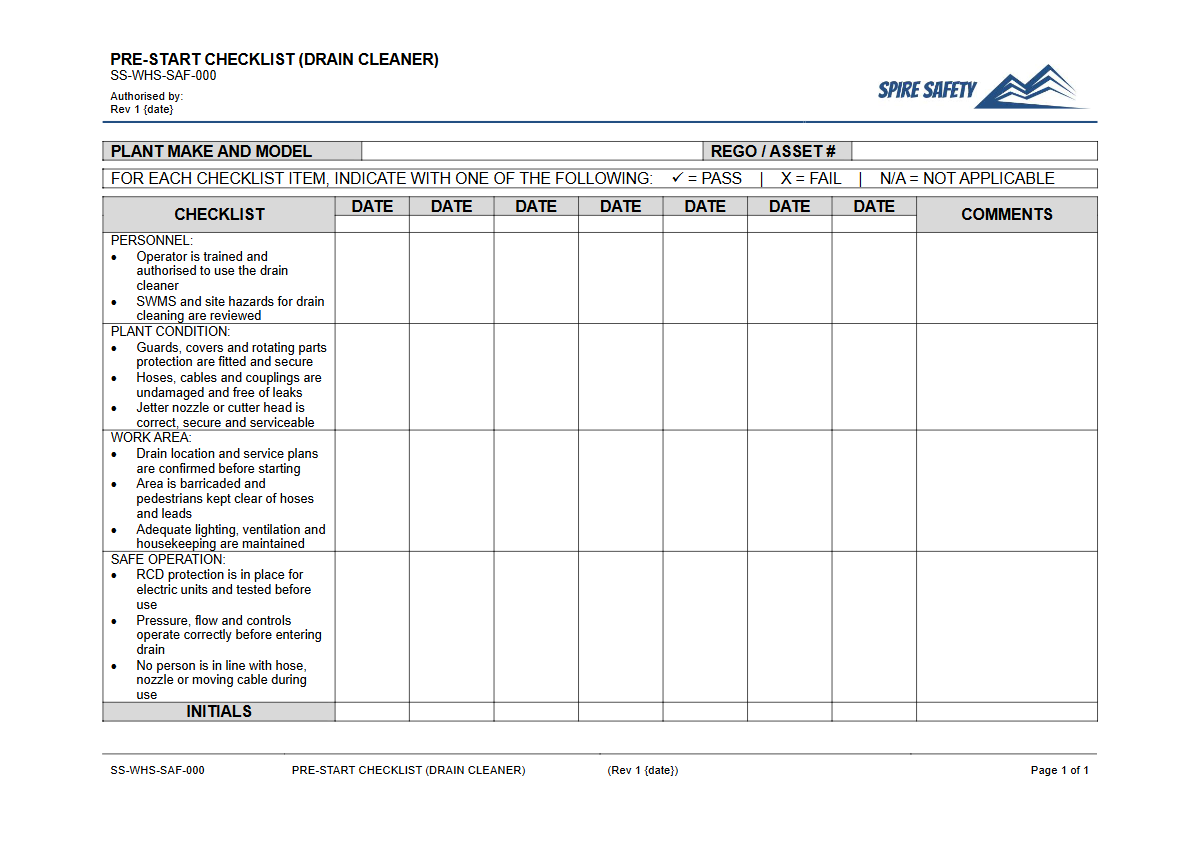
Using high-pressure drain cleaning equipment comes with significant risks if the machinery is not properly maintained and inspected. Our Free Pre-Start Checklist (Drain Cleaner) Template provides a structured framework to help operators conduct thorough, consistent safety checks before each use.
This simple but effective tool helps identify potential faults early, reducing the risk of equipment failure, property damage, and serious injury.
By formalising the inspection process, you create a clear record of due diligence, which is a key component of effective safety management and compliance with Australian WHS legislation.
Video walkthrough
Purpose of the Free Pre-Start Checklist (Drain Cleaner) Template
The primary purpose of this pre-start checklist is to ensure that drain cleaning equipment, such as hydro-jets and electric eels, is in safe working order before operation begins. Regular checks help to systematically identify and control hazards associated with high-pressure systems, rotating parts, and electrical components.
It serves as a daily confirmation that critical safety features are functional and that the equipment has not sustained damage since its last use.
Integrating these checks into your daily routine is a fundamental part of robust WHS management systems. It moves safety from an abstract concept to a practical, repeatable action. This proactive approach helps prevent incidents by catching issues like worn hoses, faulty pressure gauges, damaged electrical cords, or missing guards before they lead to a failure.
Documenting these checks also provides valuable data for maintenance planning and demonstrates a commitment to workplace safety.
How to use the Free Pre-Start Checklist (Drain Cleaner) Template
This template is designed for ease of use. First, download the document in your preferred format (DOCX for easy customisation or PDF for printing).
The next step is critical: you must adapt the checklist to the specific make and model of drain cleaner used in your workplace. Different machines have unique features and failure points, so a generic list is not sufficient.
Important Note: This document is a template that provides a starting point. It is your responsibility to ensure it is customised to reflect the specific equipment, tasks, and risks present in your work environment.
We are not liable for any incidents that may occur from using this template without proper customisation and implementation.
Once customised, the checklist should be completed by the operator before their first use of the equipment on any given day or shift. Supervisors should periodically review completed checklists to ensure they are being filled out correctly and to follow up on any reported defects. Reinforcing this process is essential, which can be supported with our Pre-Start Checks and Plant Maintenance Toolbox Talk Template.
When to use it
A pre-start check should be conducted at the beginning of every shift or before the equipment is used for the first time each day. It is not a weekly or monthly task; its effectiveness lies in its frequency.
This routine ensures that any damage or faults that may have occurred during previous operation, transport, or storage are identified before the machine is put back into service.
Completed checklists should be retained as part of your safety records. These documents are invaluable during safety investigations or when undergoing a WHS compliance auditing process, as they provide tangible evidence of your organisation's proactive risk management practices.
Who should use it
The checklist is designed to be completed by the trained and competent operator of the drain cleaning equipment. These are the individuals most familiar with the machine's day-to-day performance and are best positioned to notice subtle changes or developing faults.
It is crucial that operators are not only trained on how to use the drain cleaner but also on how to properly inspect it.
Supervisors and managers have a role in reviewing the completed forms and ensuring that any identified issues are addressed promptly. A faulty machine must be tagged out and removed from service until it is repaired by a qualified person.
Furthermore, a PCBU must ensure operators are competent to use the equipment; our free Pressure Cleaner VOC (Verification of Competency) Template provides a great framework for this process. For related plumbing and pipe work, you may also find our Verification of Competency (Pipe Threader) Template useful.
By implementing this checklist, you empower your team to take an active role in their own safety and contribute to a stronger safety culture across the organisation. You can explore our entire free WHS resources library for more tools to support your safety initiatives.
Common mistakes
Common mistakes to avoid
- "Pencil-whipping" the checklist without physically inspecting each item.
- Ignoring minor faults like frayed electrical cords or slightly weeping hose fittings.
- Using a generic checklist that doesn't cover the specific safety features of the machine model.
- Failing to immediately tag and remove a faulty machine from service.
Legal references
Legal considerations
The following legal requirements may be relevant to this type of work.
- Work Health and Safety Act (Harmonised) — Provides the primary duties for protecting workers and other people from work health and safety risks.
- Work Health and Safety Regulations (Harmonised) — Sets out requirements supporting the management of workplace hazards and risks.
The following codes may be relevant to this type of work.
- Managing WHS Risks Code of Practice — Provides practical guidance on identifying hazards, assessing risks and applying effective controls.
- Work Health and Safety Consultation, Cooperation and Coordination Code of Practice — Provides practical guidance on consulting workers and coordinating with other duty holders.
- Managing the Work Environment and Facilities Code of Practice — Provides practical guidance on safe work environments, workplace facilities and related controls.
Did you know
High-Pressure Dangers
High-pressure water jetting injuries can penetrate the skin and cause severe internal damage even without an obvious external wound. Any suspected injection injury requires immediate, specialised medical attention.
Maintenance Records
Consistent pre-start check records can help identify recurring faults, informing preventative maintenance schedules and potentially preventing catastrophic equipment failure.
FAQ
Frequently asked questions
01What should a drain cleaner pre-start checklist include?
02Is a daily pre-start check legally required in Australia?
03How often should I inspect a hydro-jet drain cleaner?
04Can this template be used for electric drain eels as well?
Share this resource
Free Pre-Start Checklist (Drain Cleaner) Template
Browse Categories
How To Use It
- 1Download and open in Word or PDF.
- 2Replace the placeholders with your business details.
- 3Get it reviewed by a WHS specialist before rollout.
Need it customised?
Our WHS consultants can adapt this template to your site, run a gap analysis, or audit what you already have in place.
Book a Free Consultation WHS consulting servicesor call 1300 156 382