
Free Pre-Start Checklist (Drop Saw) Template
Download our Free Pre-Start Checklist (Drop Saw) Template (DOCX & PDF) to formalise equipment inspections and manage WHS risks in your workshop.
Free Pre-Start Checklist (Drop Saw) Template
DOCX • 125 KB + PDF
Updated Oct 2026
No signup required
Purpose of the Free Pre-Start Checklist (Drop Saw) Template
Using a Free Pre-Start Checklist (Drop Saw) Template is a critical step in ensuring workshop safety before operating this powerful and potentially hazardous piece of equipment. A drop saw, also known as a mitre saw, presents significant risks including laceration, amputation, and entanglement if not maintained and operated correctly.
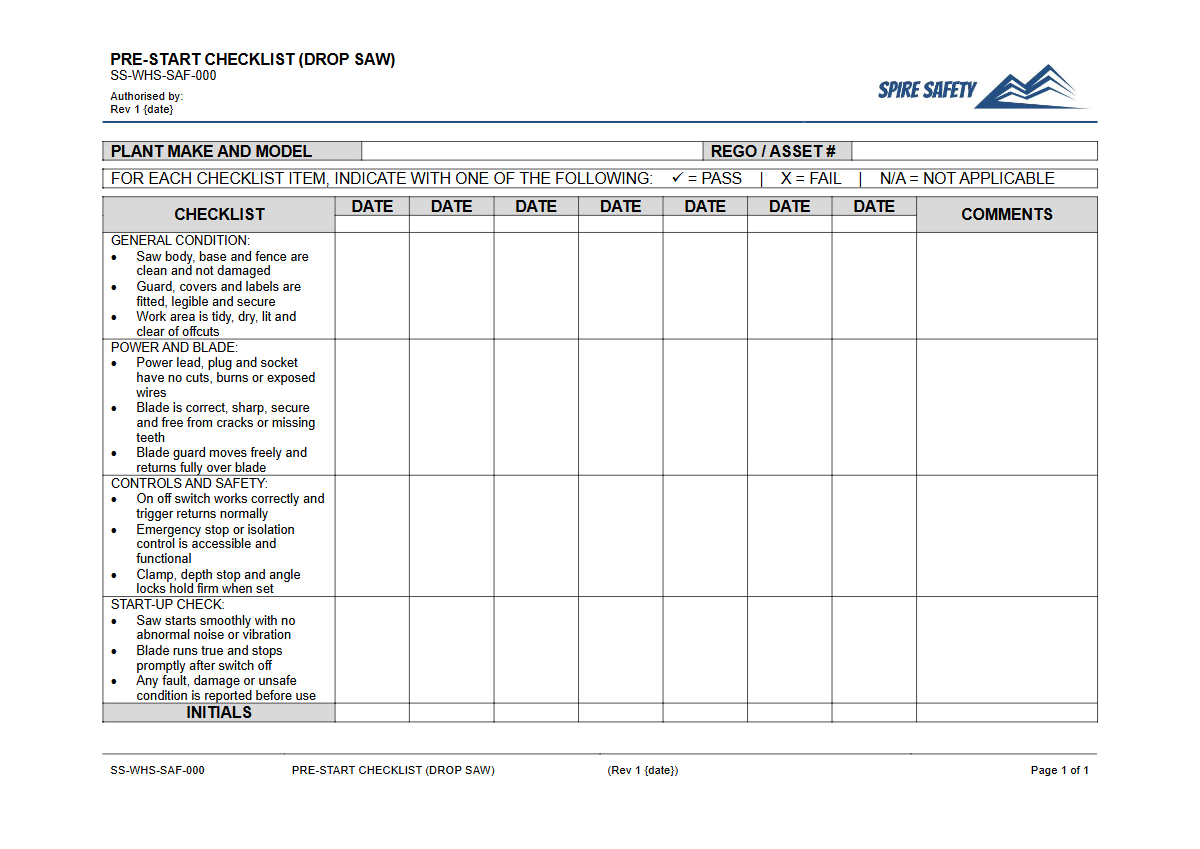
This checklist provides a structured framework for operators to systematically inspect the saw's condition, helping to identify and control risks before they cause an incident. It prompts checks on critical safety components such as the blade guard, blade condition, fences, clamps, and emergency stop controls.
Formalising this process moves safety checks from an informal glance to a documented, repeatable task. It creates a valuable record that demonstrates due diligence in managing plant safety.
Integrating regular, documented checks for all workshop machinery is a cornerstone of effective WHS management systems, helping to build a proactive safety culture within the organisation. Similar structured checks are essential for other high-risk tools, as outlined in our Pre-Start Checklist for a Bench Grinder.
Video walkthrough
How to use the Free Pre-Start Checklist (Drop Saw) Template
This Free Pre-Start Checklist (Drop Saw) Template is provided as a starting point in both DOCX and PDF formats. Download the file and integrate it into your organisation's daily operational procedures.
The DOCX version is fully editable, allowing you to tailor the contents to your specific environment and equipment.
Important: This template must be customised to suit your specific workplace. We have based it on common Australian WHS practices, but every drop saw model, task, and work environment has unique risks.
You should review the checklist against your saw's user manual, the materials being cut, and your own Safe Work Method Statement (SWMS). Add, remove, or modify checklist items to ensure it is fully relevant to your operations.
If you require assistance in adapting safety documentation, consider engaging professional WHS consulting services.
When to use it
A pre-start check should be completed before the drop saw is used for the first time on any given day or shift. It is a brief, focused inspection designed to catch obvious faults or damage that may have occurred since its last use.
This routine is distinct from, and additional to, scheduled periodic maintenance, which involves more detailed technical servicing. The goal of the pre-start is to ensure the equipment is safe for immediate operation, preventing the use of a compromised machine.
Who should use it
The checklist should be completed by the person operating the drop saw. This individual must be trained, competent, and authorised to use the specific model of saw.
Competency includes not only the skill to perform a cut but also a thorough understanding of the machine’s safety features, potential hazards, and emergency procedures. Supervisors and managers also have a responsibility to ensure these checks are being consistently and correctly performed.
This oversight can be verified through workplace inspections and regular WHS compliance auditing to confirm that safety procedures are being followed in practice.
Organisations that use a variety of cutting equipment should implement specific checklists for each type to account for their different risks and operating mechanisms, such as those detailed in our Free Pre-Start Checklist (Floor Saw) Template. By equipping operators with the right tools, you empower them to take ownership of their safety. For more templates and safety documents, browse our complete free WHS resources library.
Common mistakes
Common mistakes to avoid
- Failing to ensure the blade guard retracts and returns smoothly without sticking.
- Using the saw with a dull, damaged, or incorrect type of blade for the material being cut.
- Neglecting to securely clamp or brace the workpiece, leading to kickback or movement during the cut.
- Bypassing safety features or operating the saw with guards removed or tied back.
Legal references
Legal considerations
The following legal requirements may be relevant to this type of work.
- Work Health and Safety Act (Harmonised) — Provides the primary duties for protecting workers and other people from work health and safety risks.
- Work Health and Safety Regulations (Harmonised) — Sets out requirements supporting the management of workplace hazards and risks.
The following codes may be relevant to this type of work.
- Managing WHS Risks Code of Practice — Provides practical guidance on identifying hazards, assessing risks and applying effective controls.
- Work Health and Safety Consultation, Cooperation and Coordination Code of Practice — Provides practical guidance on consulting workers and coordinating with other duty holders.
- Managing the Work Environment and Facilities Code of Practice — Provides practical guidance on safe work environments, workplace facilities and related controls.
Did you know
A Leading Cause of Injury
According to Safe Work Australia, from 2015 to 2019, saws were the tool most frequently involved in serious injury claims related to powered hand tools, machinery, and equipment.
FAQ
Frequently asked questions
01Are pre-start checklists a legal requirement for drop saws in Australia?
02What is the difference between a drop saw and a mitre saw?
03What are the most critical safety risks when using a drop saw?
04How often should a drop saw blade be replaced?
Share this resource
Free Pre-Start Checklist (Drop Saw) Template
Browse Categories
How To Use It
- 1Download and open in Word or PDF.
- 2Replace the placeholders with your business details.
- 3Get it reviewed by a WHS specialist before rollout.
Need it customised?
Our WHS consultants can adapt this template to your site, run a gap analysis, or audit what you already have in place.
Book a Free Consultation WHS consulting servicesor call 1300 156 382