
Free Pre-Start Checklist (Drum Trolley) Template
Download our Free Pre-Start Checklist (Drum Trolley) Template in DOCX & PDF. Formalise your equipment inspections to manage manual handling risks. Download now.
Free Pre-Start Checklist (Drum Trolley) Template
DOCX • 125 KB + PDF
Updated Oct 2026
No signup required
Purpose of the Free Pre-Start Checklist (Drum Trolley) Template
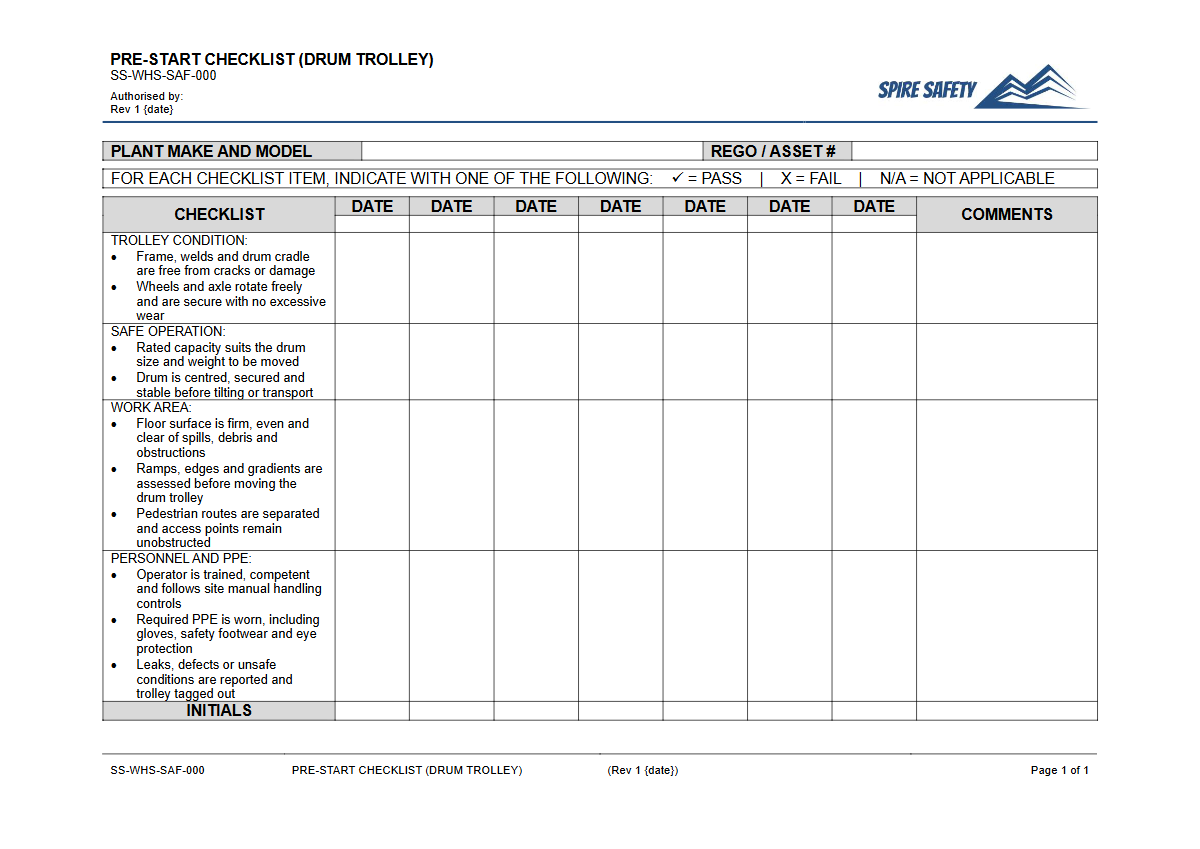
This Free Pre-Start Checklist (Drum Trolley) Template provides a structured starting point for organisations to formalise their equipment inspection process. Using a drum trolley, while seemingly simple, involves significant manual handling risks.
Regular pre-start inspections are a critical control measure to ensure the equipment is safe for use before every shift or task. Implementing this checklist helps identify potential defects in components like wheels, frames, and lifting mechanisms, preventing equipment failure that could lead to injuries, spills, or property damage.
It creates a documented record of due diligence, demonstrating a proactive approach to workplace health and safety.
A consistent inspection routine supports a safer work environment by embedding safety checks into daily operations. This process helps meet duties under WHS legislation, which requires a person conducting a business or undertaking (PCBU) to provide and maintain safe plant.
To further support your manual handling safety protocols, consider downloading our free Hand Trolley SOP (Safe Operating Procedure) template, which outlines safe work practices for similar equipment.
Video walkthrough
How to use the Free Pre-Start Checklist (Drum Trolley) Template
To effectively use this Free Pre-Start Checklist (Drum Trolley) Template, download the DOCX file and adapt it to the specific models of drum trolleys used in your workplace and your operational risks. Key inspection points include the structural integrity of the frame, the condition of the wheels or castors, the functionality of the clamping or lifting mechanism, and the security of handles and grips.
Operators should be trained to complete the checklist thoroughly before their first use of the trolley each day or shift.
The checklist should guide a physical and visual inspection. If any item is marked as 'Unsatisfactory', the trolley must be immediately taken out of service, tagged, and reported for maintenance.
Completed checklists should be filed as part of your safety records. This documentation is valuable for tracking equipment condition over time and can be reviewed during WHS compliance auditing to verify that procedures are being followed.
Important: This template is a guide only. We recommend you customise it to reflect the unique hazards, risks, and specific equipment in your workplace.
When to use a Drum Trolley Pre-Start Checklist
A drum trolley pre-start check should be conducted before the equipment is used for the first time on any given day or shift. It is also advisable to perform a quick visual check before each individual use, especially if multiple operators share the same equipment throughout the day.
The checklist should be integrated as a non-negotiable step for any task involving the movement of 205-litre drums or other heavy cylindrical containers. Regular use of the checklist is a key component of effective WHS management systems, reinforcing a safety-first culture.
Using the checklist becomes even more critical in environments with harsh conditions, such as uneven ground, exposure to chemicals, or high-traffic areas, as these factors can accelerate wear and tear on the equipment. Reinforcing this habit can be achieved through regular safety discussions, such as a Pre-Start Checks and Plant Maintenance Toolbox Talk.
Who should complete the checks?
The pre-start checklist is designed to be completed by the operator—the person who will be using the drum trolley. This places responsibility on the individual directly interacting with the equipment, empowering them to identify and report issues before they escalate.
It is essential that all operators receive adequate training not only on how to use the drum trolley safely but also on how to conduct a thorough pre-start inspection using the checklist. This includes understanding what each checkpoint means and the procedure for reporting faults.
Supervisors and managers have a responsibility to ensure these checks are being completed consistently and correctly. They should periodically review completed checklists and ensure that any reported defects are addressed in a timely manner.
The principles of safe equipment use and operator responsibility are universal across manual handling tasks, as highlighted in resources like the Aged Care Manual Handling Toolbox Talk, which focuses on protecting workers from musculoskeletal injuries. For a wider selection of safety documents, you can browse our free WHS resources library.
Common mistakes
Common mistakes to avoid
- Using a trolley not rated for the weight or size of the drum.
- "Pencil-whipping" the checklist without a proper physical inspection.
- Failing to check the travel path for obstacles, spills, or uneven surfaces before moving the load.
- Continuing to use a trolley with a known defect, such as a wobbly wheel or faulty clamp.
Legal references
Legal considerations
The following legal requirements may be relevant to this type of work.
- Work Health and Safety Act (Harmonised) — Provides the primary duties for protecting workers and other people from work health and safety risks.
- Work Health and Safety Regulations (Harmonised) — Sets out requirements supporting the management of workplace hazards and risks.
The following codes may be relevant to this type of work.
- Managing WHS Risks Code of Practice — Provides practical guidance on identifying hazards, assessing risks and applying effective controls.
- Work Health and Safety Consultation, Cooperation and Coordination Code of Practice — Provides practical guidance on consulting workers and coordinating with other duty holders.
- Managing the Work Environment and Facilities Code of Practice — Provides practical guidance on safe work environments, workplace facilities and related controls.
Did you know
The Weight of a Drum
A standard 205-litre (44-gallon) steel drum of oil can weigh over 200 kilograms, making mechanical aids like drum trolleys essential for safe handling.
Manual Handling Injuries
According to Safe Work Australia, manual handling injuries are a leading cause of serious workers' compensation claims, highlighting the importance of using and maintaining correct equipment.
FAQ
Frequently asked questions
01What are the main hazards associated with using a drum trolley?
02How often should a drum trolley pre-start check be performed?
03Who is responsible for maintaining a drum trolley?
04Can a digital checklist be used instead of this paper template?
Share this resource
Free Pre-Start Checklist (Drum Trolley) Template
Browse Categories
How To Use It
- 1Download and open in Word or PDF.
- 2Replace the placeholders with your business details.
- 3Get it reviewed by a WHS specialist before rollout.
Need it customised?
Our WHS consultants can adapt this template to your site, run a gap analysis, or audit what you already have in place.
Book a Free Consultation WHS consulting servicesor call 1300 156 382