
Free Pre-Start Checklist (Dump Truck) Template
Download our Free Pre-Start Checklist (Dump Truck) Template. This structured DOCX & PDF resource helps formalise daily equipment checks. Improve safety today.
Free Pre-Start Checklist (Dump Truck) Template
DOCX • 125 KB + PDF
Updated Oct 2026
No signup required
Purpose of the Free Pre-Start Checklist (Dump Truck) Template
Operating heavy machinery like dump trucks carries significant WHS risks. A systematic pre-operational check is a fundamental safety control.
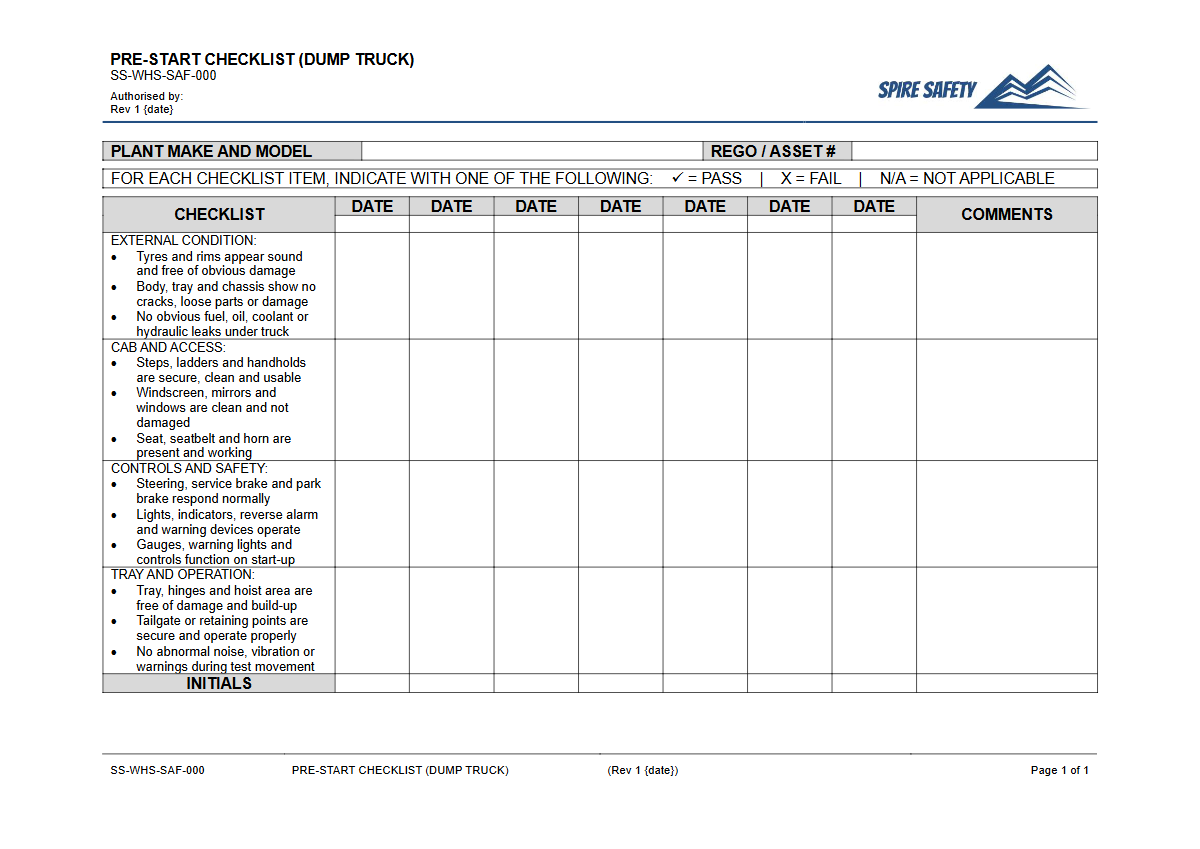
This Free Pre-Start Checklist (Dump Truck) Template provides a structured starting point for operators to inspect their equipment before each use. The primary goal is to identify and report any faults, damage, or wear and tear that could compromise the safe operation of the vehicle.
By formalising this process, organisations can proactively manage risks, prevent incidents, and demonstrate a commitment to plant safety.
Regular checks help ensure critical safety components such as brakes, steering, tyres, lights, and hydraulic systems are in good working order. Using a standardised checklist promotes consistency and thoroughness, reducing the likelihood of operators overlooking potential hazards.
This process is a key part of an effective plant safety program. For similar heavy vehicles, you might also find our Free Pre-Start Checklist (Dump Trailer) Template useful.
Key Objectives of the Checklist
- To verify that the dump truck is safe to operate before starting a shift.
- To create a formal record of equipment condition and inspection activities.
- To facilitate early detection of maintenance needs, preventing minor issues from becoming major failures.
- To ensure operators are actively engaged in assessing the safety of their own equipment.
Video walkthrough
How to use the Free Pre-Start Checklist (Dump Truck) Template
This template is provided in both DOCX and PDF formats for your convenience. The DOCX file is fully editable, allowing you to tailor it to the specific make and model of dump trucks used in your operations, as well as the unique conditions of your worksite.
A generic checklist is a good starting point, but customisation is essential for effectiveness.
Important: Before you use this document, you must customise it to your specific workplace, equipment, and operational risks. We are not responsible for any incidents or compliance issues that may arise from the use of this template.
It is your responsibility to ensure the final document is fit for purpose and addresses all relevant hazards at your site.
Integrate this checklist into your daily operational procedures. Train all operators on how to complete it thoroughly, what each checkpoint means, and the exact process for reporting defects.
Completed checklists should be reviewed by a supervisor and filed as a WHS record. This documentation is a vital part of your safety management system. A well-structured system helps embed practices like pre-start checks into your organisation's culture, forming part of your broader WHS management systems.
When to use it
The dump truck pre-start checklist should be completed by the operator at the beginning of every shift or before the vehicle is used for the first time each day. It is a 'pre-start' check, meaning it must be done while the vehicle is stationary and before any work commences.
If multiple operators use the same truck during a single day, a handover inspection using the checklist is a good practice to ensure continuous safety oversight.
In addition to pre-start checks, some organisations implement post-operational checks to identify any issues that may have developed during the shift. This allows the maintenance team to address problems before the next scheduled use. Regular, documented checks are a key piece of evidence reviewed during safety evaluations, such as those performed in WHS compliance auditing.
Who should use it
This checklist is designed to be used primarily by the dump truck operator. As the person in direct control of the plant, the operator is best placed to conduct a hands-on inspection and notice any changes in the equipment's condition or performance.
Competency is key; operators must be trained not only in operating the truck but also in how to properly inspect it according to the checklist.
Supervisors and managers also have a role. They are responsible for ensuring operators are completing the checks correctly and consistently.
They must also review the completed checklists, sign off on them, and action any reported defects or safety concerns without delay. A robust safety culture depends on clear procedures and accountability at all levels.
Expert WHS consulting can assist in developing these site-specific procedures and training programs.
Beyond dump trucks, maintaining other heavy equipment like those used in forestry also requires diligent pre-start routines. You can adapt the principles from this template or use our specific Pre-Start Checklist (Forwarder) Template as a guide for other machinery.
Maintaining a consistent approach across all plant is a hallmark of a mature safety program, and you can explore more documents in our free WHS resources library to support your efforts.
Common mistakes
Common mistakes to avoid
- Treating the checklist as a "tick-and-flick" paperwork exercise without physically inspecting each item.
- Failing to customise the generic template to match the specific make, model, and configuration of the truck.
- Not having a clear, immediate process for reporting defects and taking the vehicle out of service.
- Inadequate operator training on what to look for during the inspection, beyond just ticking boxes.
Legal references
Legal considerations
The following legal requirements may be relevant to this type of work.
- Work Health and Safety Act (Harmonised) — Provides the primary duties for protecting workers and other people from work health and safety risks.
- Work Health and Safety Regulations (Harmonised) — Sets out requirements supporting the management of workplace hazards and risks.
The following codes may be relevant to this type of work.
- Managing WHS Risks Code of Practice — Provides practical guidance on identifying hazards, assessing risks and applying effective controls.
- Work Health and Safety Consultation, Cooperation and Coordination Code of Practice — Provides practical guidance on consulting workers and coordinating with other duty holders.
- Managing the Work Environment and Facilities Code of Practice — Provides practical guidance on safe work environments, workplace facilities and related controls.
Did you know
Tipping Hazard
A significant number of serious incidents involving dump trucks are rollovers during tipping. This is often caused by unstable or uneven ground, incorrect tyre pressure, or unbalanced loads.
Blind Spots
Large earthmoving equipment like articulated or rigid frame dump trucks can have extensive blind spots, especially to the rear and side. Managing the interaction between plant and people on the ground is a critical risk on any site.
FAQ
Frequently asked questions
01What should be included in a dump truck pre-start checklist?
02How often should a dump truck pre-start check be completed?
03Who is responsible for completing the dump truck pre-start?
04What happens if a defect is found during a pre-start check?
Share this resource
Free Pre-Start Checklist (Dump Truck) Template
Browse Categories
How To Use It
- 1Download and open in Word or PDF.
- 2Replace the placeholders with your business details.
- 3Get it reviewed by a WHS specialist before rollout.
Need it customised?
Our WHS consultants can adapt this template to your site, run a gap analysis, or audit what you already have in place.
Book a Free Consultation WHS consulting servicesor call 1300 156 382