
Free Pre-Start Checklist (Egg Grader) Template
Download our free Pre-Start Checklist (Egg Grader) Template (DOCX & PDF). A structured starting point for formalising your daily equipment safety inspections.
Free Pre-Start Checklist (Egg Grader) Template
DOCX • 125 KB + PDF
Updated Oct 2026
No signup required
Purpose of the Free Pre-Start Checklist (Egg Grader) Template
An egg grader is a critical piece of equipment in any poultry or food processing operation. Its safe and efficient function relies on regular inspections to identify potential faults before they lead to breakdowns, product contamination, or worker injury.
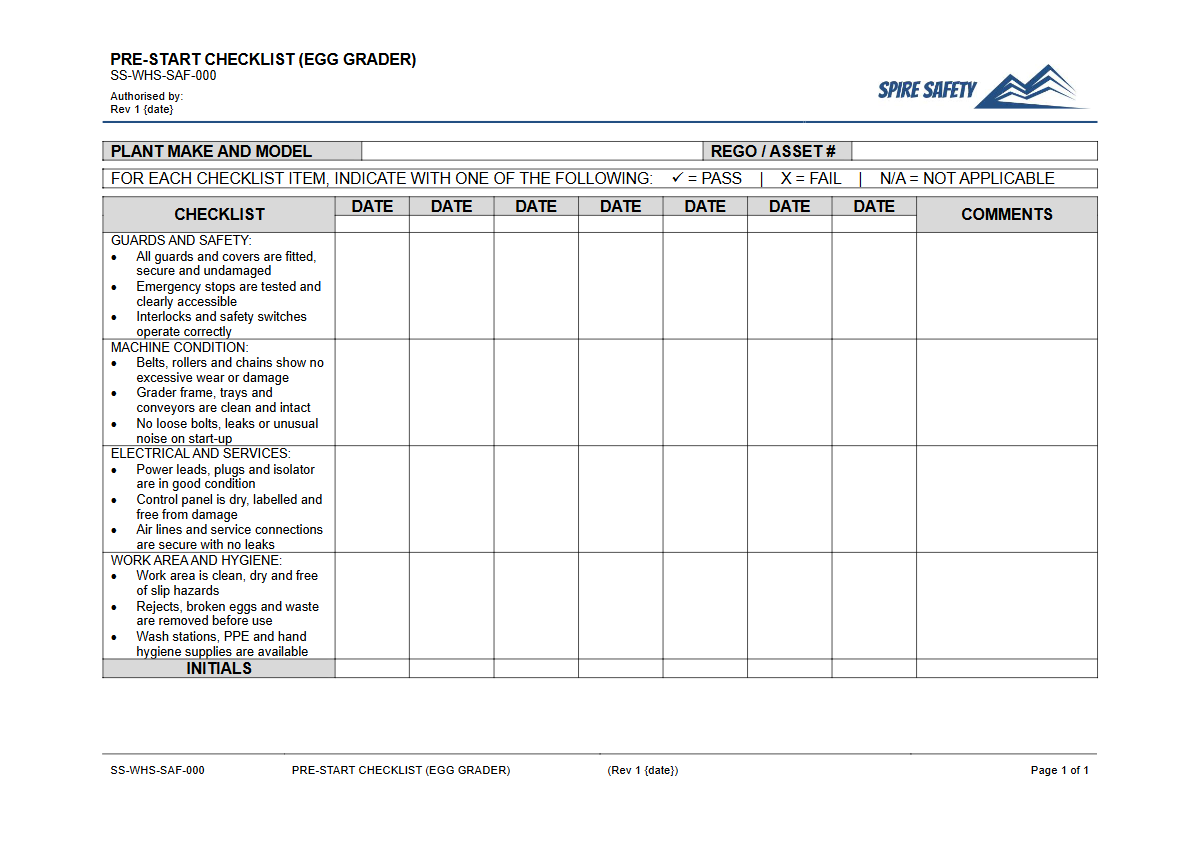
This free Pre-Start Checklist (Egg Grader) Template provides a structured framework for operators to conduct thorough daily checks. Formalising this process helps to identify and address issues with guarding, conveyors, sensors, and cleaning systems, ensuring the equipment remains in a safe and hygienic operational state.
Implementing consistent pre-start checks is a fundamental part of a proactive safety culture. It helps in meeting duties under WHS legislation by systematically managing risks associated with plant.
Integrating such procedures into your broader WHS management systems demonstrates a commitment to workplace safety and operational excellence. Records of these checks also provide valuable data for maintenance scheduling and incident investigations.
Video walkthrough
How to use the Free Pre-Start Checklist (Egg Grader) Template
This template is available as a fully editable DOCX file and a print-ready PDF. After downloading, you can add your company branding and details.
The checklist is designed as a comprehensive starting point, covering common inspection points for egg grading machinery, such as guards, emergency stops, belts, rollers, and cleanliness.
Important: This is a template, not a finished document. It is crucial that you customise it to suit the specific make, model, and configuration of the egg graders used in your workplace.
We have provided a solid foundation, but you must review, add, or remove checks to reflect your unique equipment, operational environment, and risk profile. Different machinery presents different risks; a simple inspection for a pre-start checklist for a coffee grinder will differ significantly from the requirements for complex industrial plant.
When to use it
A pre-start check for an egg grader should be completed by the operator before the start of every shift or before its first use each day. This routine ensures that the equipment is safe to operate from the moment it is switched on.
Regularity is key; what was safe yesterday may not be today due to wear, damage, or cleaning issues. These daily checks can be reinforced through regular workplace safety meetings.
You can use our Pre-Start Checks and Plant Maintenance Toolbox Talk template to facilitate these discussions with your team.
Who should use it
The checklist should be used by trained and competent operators who are familiar with the egg grader's functions and potential hazards. Supervisors and managers also have a role in ensuring the checks are being completed correctly and that any reported issues are actioned promptly.
They are responsible for providing training, reviewing completed records, and fostering a workplace culture where safety checks are taken seriously. The records generated by these checklists are important documents that may be reviewed during internal or external WHS compliance audits.
While this checklist addresses pre-operational safety, other WHS documentation may be required for specific tasks or machinery. For example, high-risk construction work involving certain types of mobile plant requires a specific legal document, such as a Safe Work Method Statement (Concrete Truck Operation) Template, before any work can begin.
Always ensure you are using the correct documentation for your specific operational risks. For more document templates, feel free to browse our complete free WHS resources library.
Common mistakes
Common mistakes to avoid
- Using a generic checklist without customising it for the specific make and model of the egg grader.
- Ticking boxes on the form without physically inspecting each component (pencil-whipping).
- Failing to immediately report, isolate, and tag out faulty equipment identified during the check.
- Not retaining completed checklists as part of the organisation's safety and maintenance records.
Legal references
Legal considerations
The following legal requirements may be relevant to this type of work.
- Work Health and Safety Act (Harmonised) — Provides the primary duties for protecting workers and other people from work health and safety risks.
- Work Health and Safety Regulations (Harmonised) — Sets out requirements supporting the management of workplace hazards and risks.
The following codes may be relevant to this type of work.
- Managing WHS Risks Code of Practice — Provides practical guidance on identifying hazards, assessing risks and applying effective controls.
- Work Health and Safety Consultation, Cooperation and Coordination Code of Practice — Provides practical guidance on consulting workers and coordinating with other duty holders.
- Managing the Work Environment and Facilities Code of Practice — Provides practical guidance on safe work environments, workplace facilities and related controls.
Did you know
Pinch Points
Pinch points on conveyor systems, common on egg graders, are one of the leading causes of serious hand and finger injuries in the food processing industry.
Grading by Weight
In Australia, eggs are graded by weight, not size. A typical egg grader uses a series of precise electronic scales along its conveyor to sort eggs into different weight categories like Jumbo, Extra Large, and Large.
FAQ
Frequently asked questions
01What are the key hazards associated with egg graders?
02How often should an egg grader pre-start check be done?
03Who is responsible for ensuring egg grader pre-start checks are completed?
04Can this template be used to prove WHS compliance?
Share this resource
Free Pre-Start Checklist (Egg Grader) Template
Browse Categories
How To Use It
- 1Download and open in Word or PDF.
- 2Replace the placeholders with your business details.
- 3Get it reviewed by a WHS specialist before rollout.
Need it customised?
Our WHS consultants can adapt this template to your site, run a gap analysis, or audit what you already have in place.
Book a Free Consultation WHS consulting servicesor call 1300 156 382