
Free Pre-Start Checklist (Elevator) Template
Download our free Pre-Start Checklist (Elevator) Template (DOCX & PDF).
Free Pre-Start Checklist (Elevator) Template
DOCX • 125 KB + PDF
Updated Oct 2026
No signup required
Purpose of the Free Pre-Start Checklist (Elevator) Template
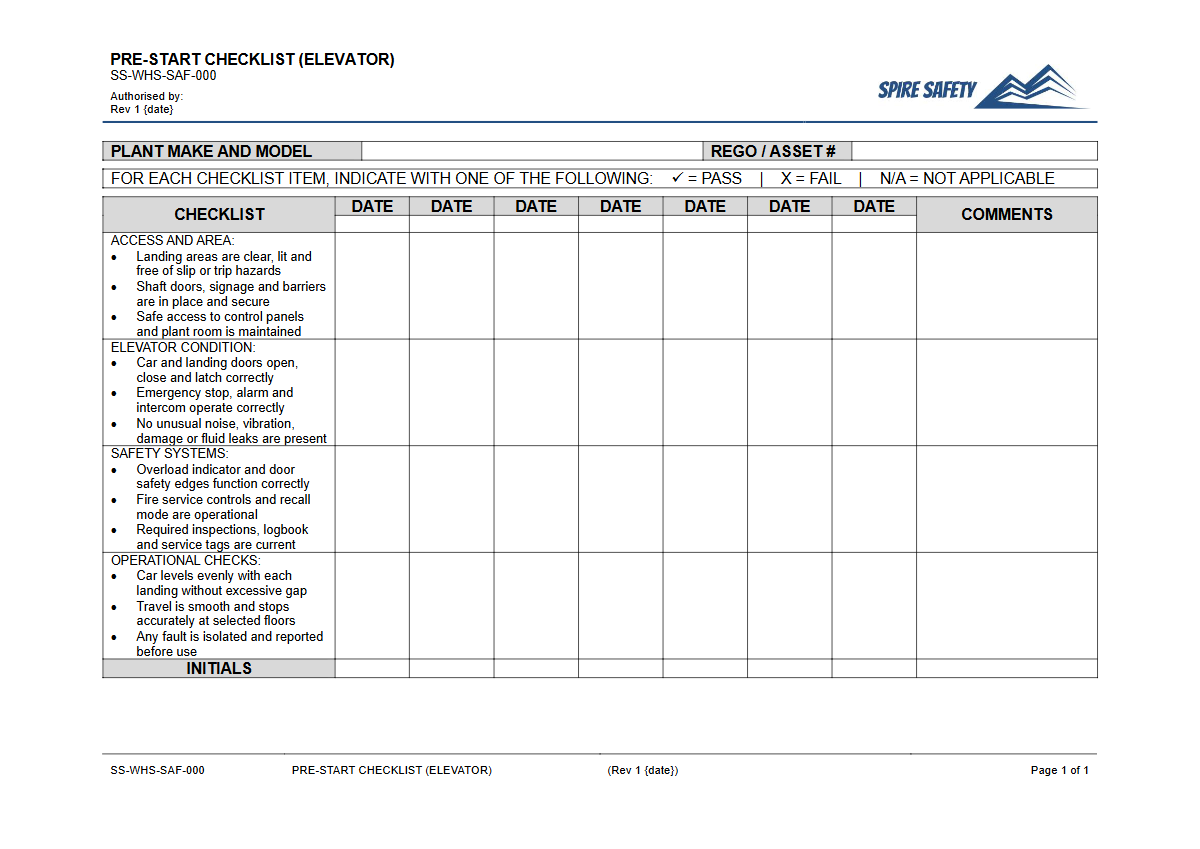
Regular inspections are a critical part of maintaining a safe working environment. This Free Pre-Start Checklist (Elevator) Template provides a structured framework for operators to conduct routine safety and operational checks before using an elevator or lift.
Formalising this process helps identify potential hazards, mechanical faults, or damage early, preventing incidents and equipment downtime. Consistent use of a pre-start checklist is a key component of a PCBU's duty of care, demonstrating proactive risk management and helping to fulfil WHS obligations.
It creates a documented record that checks were completed, which is an important part of safety due diligence.
Using a checklist standardises the inspection process, ensuring that no critical safety features are overlooked. It also encourages a safety-first mindset among operators.
For broader training on this topic, a pre-start checks and plant maintenance toolbox talk can help reinforce the importance of these daily routines across all types of workplace plant and equipment.
Video walkthrough
How to use the Free Pre-Start Checklist (Elevator) Template
Download the template in your preferred format. The DOCX file is fully editable, allowing you to add, remove, or modify checklist items to suit your specific equipment and workplace environment.
The PDF version is ready for immediate printing and use. Integrating this checklist is a practical step towards building a robust WHS management system.
Important: This document is a template and must be customised. We are not familiar with your specific elevator, operational context, or workplace risks.
It is your responsibility to ensure the final checklist is tailored to the manufacturer's instructions, Australian Standards, and the unique conditions of your site. We recommend having a competent person review and adapt the checklist before implementation.
If you need assistance with customisation or developing site-specific documents, our WHS consulting team can provide expert guidance.
Integrating with Management Systems
For organisations certified or aspiring to certification, well-maintained records like completed pre-start checklists serve as crucial documented information. This aligns with the operational planning and control requirements of international standards.
Professional ISO 45001 consulting services can help integrate such practical tools into a compliant and effective safety management framework.
When to use it
A pre-start check should be conducted at several key moments to ensure ongoing operational safety. The checklist is designed for use:
- At the beginning of each day or shift before the elevator is first used.
- After the elevator has been idle for an extended period.
- Following any maintenance, repair, or adjustment to verify its safe condition.
- If there is any reason to suspect the elevator's condition has changed or been compromised.
Completed checklists should be retained as part of your safety records. These records can be invaluable during incident investigations or WHS compliance audits, demonstrating a history of regular safety verification.
Who should use it
This pre-start checklist should be completed by a person who is trained, competent, and authorised to operate the specific elevator. This includes employees, maintenance staff, or contractors tasked with its use.
Supervisors or managers should also be familiar with the checklist to ensure checks are being performed correctly and consistently. The person conducting the check must understand each item and know what to look for, recognising the difference between normal operation and a potential fault.
In certain environments, such as healthcare facilities, ensuring elevator reliability is paramount for both staff and client safety. These checks complement other risk management processes, such as those covered in an Aged Care Manual Handling Toolbox Talk, to create a comprehensive safety culture.
It is the PCBU's responsibility to provide adequate information, training, and instruction to ensure operators are competent to perform these checks.
Common mistakes
Common mistakes to avoid
- Ticking boxes on the list without physically or visually inspecting the item ('pencil-whipping').
- Using the generic template without customising it for the specific elevator make, model, and site conditions.
- Failing to report 'minor' issues, which can escalate into major failures or safety incidents.
- Not immediately removing a faulty elevator from service and applying a lock-out/tag-out procedure.
Legal references
Legal considerations
The following legal requirements may be relevant to this type of work.
- Work Health and Safety Act (Harmonised) — Provides the primary duties for protecting workers and other people from work health and safety risks.
- Work Health and Safety Regulations (Harmonised) — Sets out requirements supporting the management of workplace hazards and risks.
The following codes may be relevant to this type of work.
- Managing WHS Risks Code of Practice — Provides practical guidance on identifying hazards, assessing risks and applying effective controls.
- Work Health and Safety Consultation, Cooperation and Coordination Code of Practice — Provides practical guidance on consulting workers and coordinating with other duty holders.
- Managing the Work Environment and Facilities Code of Practice — Provides practical guidance on safe work environments, workplace facilities and related controls.
Did you know
The Safety Elevator
Elisha Otis invented the 'safety elevator' brake in 1852. His device automatically locked the elevator cab in place if the hoisting rope failed, a revolutionary invention that made modern high-rise buildings possible.
Australian Standards
In Australia, the design, installation, and maintenance of lifts are primarily governed by the AS 1735 series of standards, which provides detailed technical requirements to ensure public and worker safety.
FAQ
Frequently asked questions
01Is this elevator pre-start checklist a legal document?
02How often should an elevator be professionally serviced?
03What should I do if a fault is found during a pre-start check?
04Can I use this template for a goods lift or hoist?
Share this resource
Free Pre-Start Checklist (Elevator) Template
Browse Categories
How To Use It
- 1Download and open in Word or PDF.
- 2Replace the placeholders with your business details.
- 3Get it reviewed by a WHS specialist before rollout.
Need it customised?
Our WHS consultants can adapt this template to your site, run a gap analysis, or audit what you already have in place.
Book a Free Consultation WHS consulting servicesor call 1300 156 382