
Free Pre-Start Checklist (Envelope Sealer) Template
Download our Free Pre-Start Checklist (Envelope Sealer) Template to formalise daily equipment safety inspections.
Free Pre-Start Checklist (Envelope Sealer) Template
DOCX • 125 KB + PDF
Updated Oct 2026
No signup required
Purpose of the Free Pre-Start Checklist (Envelope Sealer) Template
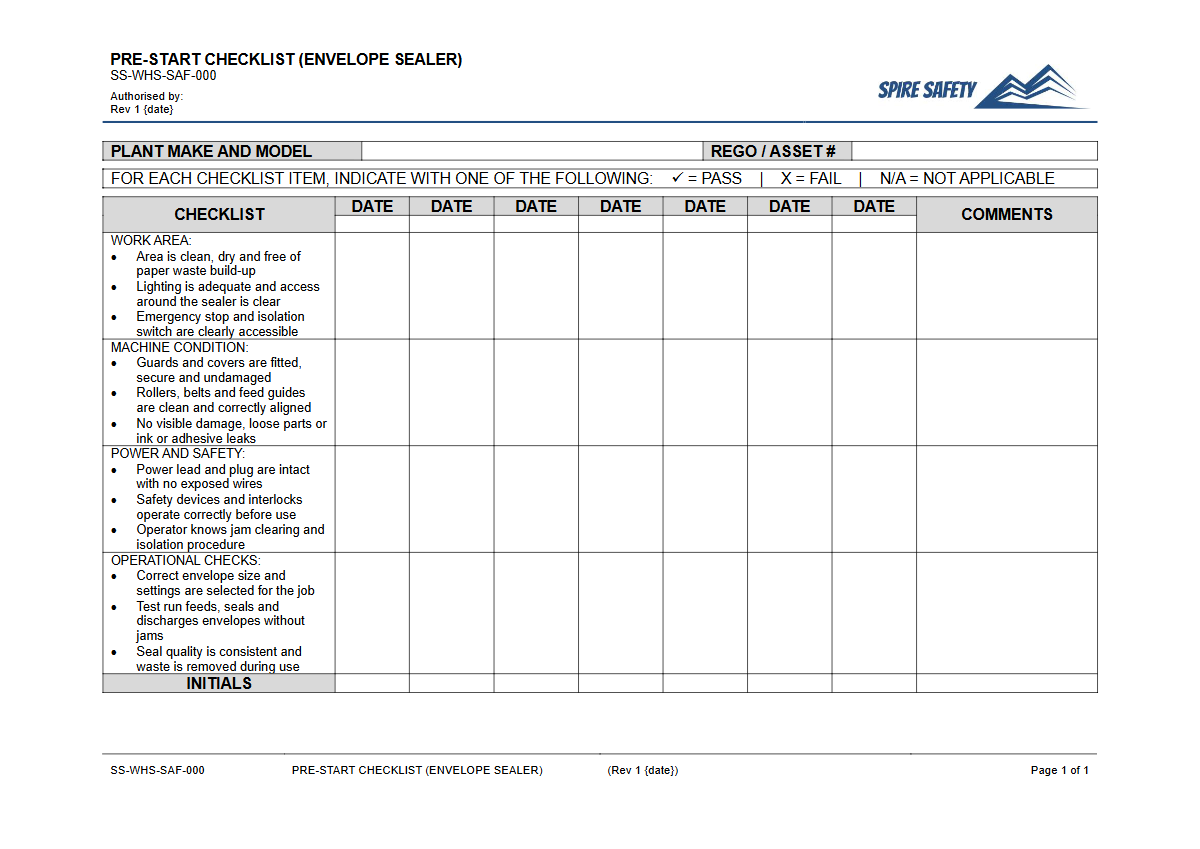
This Free Pre-Start Checklist (Envelope Sealer) Template provides a structured framework for conducting daily safety and operational inspections of mailroom envelope sealing machines. Regularly performing these checks helps identify potential hazards, defects, or malfunctions before the equipment is used, significantly reducing the risk of incidents, operator injury, or unexpected downtime.
Using a formal checklist promotes consistency in inspections and creates a documented record of due diligence, which is a key component of any effective safety management system.
Integrating such procedures demonstrates a commitment to proactive risk management and supports the operational aspect of your broader safety framework. A well-documented pre-start program is a crucial element when implementing a WHS management system aligned with standards like ISO 45001.
Video walkthrough
How to use the Free Pre-Start Checklist (Envelope Sealer) Template
This template is provided as a starting point. It should be downloaded and then tailored to the specific make and model of the envelope sealer used in your workplace.
Different machines will have unique features, guards, and operational requirements that must be reflected in the final document.
- Customise: Add or remove checkpoints based on the manufacturer's instructions and a site-specific risk assessment. Include fields for the date, operator's name, machine identifier, and supervisor sign-off.
- Train: Ensure all operators are trained not only on how to use the envelope sealer safely but also on the importance and correct procedure for completing the pre-start check. This process runs parallel to confirming operator skills, for which you can adapt documents like our Verification of Competency (Pipe Threader) Template for different equipment types.
- Implement: Integrate the checklist into your daily start-up procedures. Store completed checklists in a designated location for record-keeping and review.
- Review: Periodically review the checklist's effectiveness and update it as necessary, especially if new models are introduced or incidents occur.
Note: This document is a template only. It is not a substitute for a comprehensive risk assessment or professional WHS advice.
We strongly recommend that you customise this checklist to address the specific hazards and operational context of your workplace.
When to use it
An envelope sealer pre-start check should be completed before the machine is used for the first time each day or at the beginning of each new shift where operator changes. This frequency ensures that the equipment's condition is verified before it is put into operation, catching any issues that may have developed overnight or during a previous shift.
It is a preventative tool and should not be confused with scheduled maintenance or repairs.
To reinforce the importance of this daily habit, consider discussing the topic with your team. Our Pre-Start Checks and Plant Maintenance Toolbox Talk Template provides an excellent resource for facilitating this discussion and improving overall safety behaviour.
Who should use it
The primary user of this checklist is the person designated to operate the envelope sealer. The operator has the most direct interaction with the equipment and is best placed to notice subtle changes in its performance or condition.
Empowering operators to take ownership of this initial safety check is fundamental to building a strong safety culture.
Supervisors and managers also have a role. They are responsible for ensuring the checks are being completed correctly and consistently.
They must also take appropriate action when faults are reported, such as removing the equipment from service until it can be repaired by a qualified person. This verification process can be reviewed during regular WHS compliance auditing to ensure procedures are being followed effectively.
Key Items to Inspect on an Envelope Sealer
While your customised checklist will be more detailed, typical inspection points for an envelope sealer often include:
- Guards and Covers: Ensure all safety guards are in place, secured, and undamaged.
- Power Cord and Plug: Check for any fraying, cuts, or damage to the cord or plug pins.
- Emergency Stop: If fitted, test the emergency stop button to ensure it functions correctly.
- Rollers and Belts: Inspect for wear, damage, or foreign objects that could cause jams.
- Water Reservoir/Moistener: Check water levels and ensure the moistening pad or brush is clean and functional.
- General Condition: Look for loose screws, cracks in the housing, or any other signs of damage.
- Work Area: Ensure the area around the machine is clear, dry, and free from trip hazards.
The principle of checking specific components applies to all small appliances, from mailroom equipment to kitchen devices. For another example of a specific appliance checklist, see our Free Pre-Start Checklist (Coffee Grinder) Template. For a wider selection of safety documents, you can browse our complete free WHS resources library.
Common mistakes
Common mistakes to avoid
- Treating the check as a 'tick and flick' exercise without proper inspection.
- Failing to report minor faults found during the check, assuming they are not important.
- Using a generic checklist that doesn't cover the specific model of envelope sealer in use.
- Continuing to use the machine after a fault has been identified and reported.
Legal references
Legal considerations
The following legal requirements may be relevant to this type of work.
- Work Health and Safety Act (Harmonised) — Provides the primary duties for protecting workers and other people from work health and safety risks.
- Work Health and Safety Regulations (Harmonised) — Sets out requirements supporting the management of workplace hazards and risks.
The following codes may be relevant to this type of work.
- Managing WHS Risks Code of Practice — Provides practical guidance on identifying hazards, assessing risks and applying effective controls.
- Work Health and Safety Consultation, Cooperation and Coordination Code of Practice — Provides practical guidance on consulting workers and coordinating with other duty holders.
- Managing the Work Environment and Facilities Code of Practice — Provides practical guidance on safe work environments, workplace facilities and related controls.
Did you know
Minor Defects, Major Problems
Most equipment failures are preceded by minor, observable defects like unusual noises or vibrations. A daily pre-start check is the first line of defence in catching these issues before they lead to costly downtime or safety incidents.
Entanglement Risks
Mailroom machinery, including envelope sealers, often contains moving rollers and belts. These pose an entanglement risk for hair, clothing, and jewellery, which is why checking that all guards are in place is a critical pre-start step.
FAQ
Frequently asked questions
01What's the difference between a pre-start check and scheduled maintenance?
02How often should an envelope sealer pre-start check be done?
03Can this checklist template be used for other mailroom equipment?
04Who is responsible for ensuring pre-start checks are completed?
Share this resource
Free Pre-Start Checklist (Envelope Sealer) Template
Browse Categories
How To Use It
- 1Download and open in Word or PDF.
- 2Replace the placeholders with your business details.
- 3Get it reviewed by a WHS specialist before rollout.
Need it customised?
Our WHS consultants can adapt this template to your site, run a gap analysis, or audit what you already have in place.
Book a Free Consultation WHS consulting servicesor call 1300 156 382