
Free Pre-Start Checklist (Exercise Bike) Template
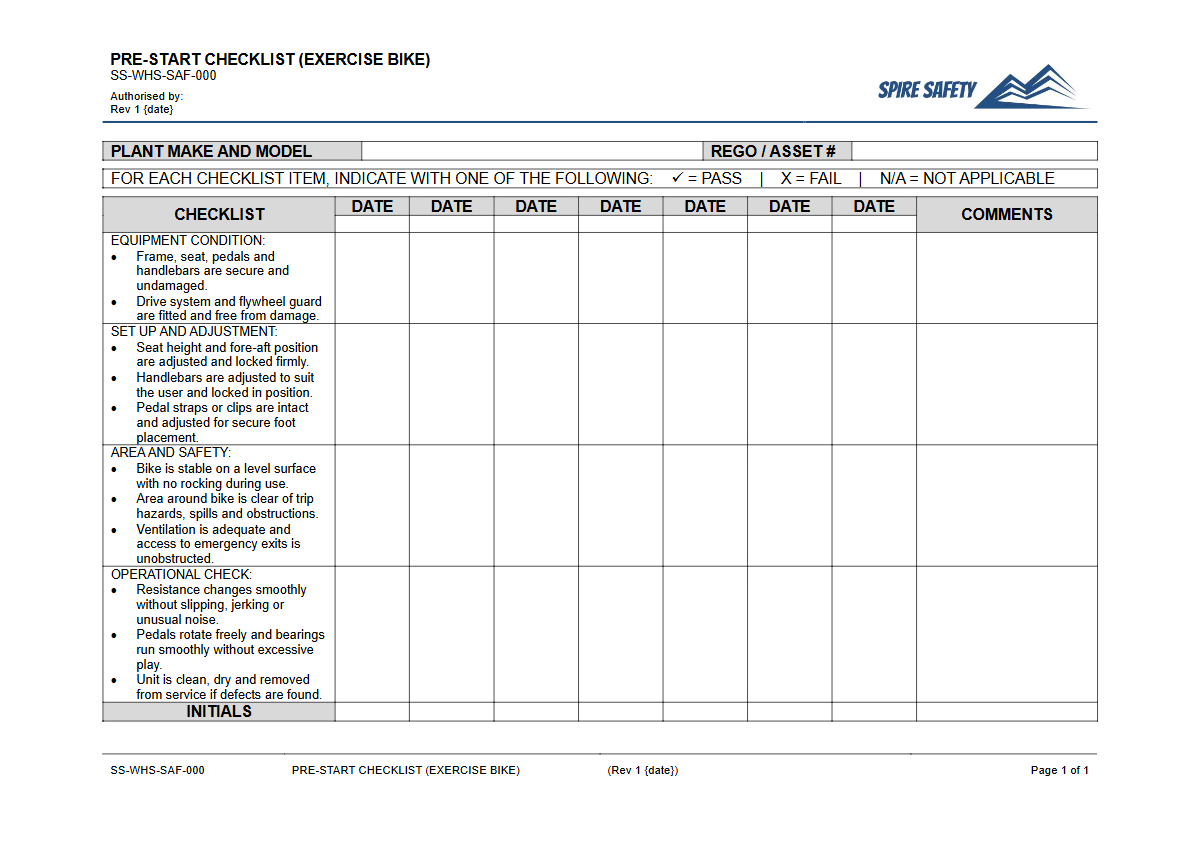
Download our free Pre-Start Checklist for Exercise Bikes. This DOCX & PDF template helps formalise daily equipment checks to manage WHS risks.
Free Pre-Start Checklist (Exercise Bike) Template
DOCX • 125 KB + PDF
Updated Oct 2026
No signup required
Purpose of the Free Pre-Start Checklist (Exercise Bike) Template
An exercise bike, while common in gyms, corporate wellness rooms, and physiotherapy clinics, is still a piece of plant that can pose risks if not properly maintained. Regular inspections are fundamental to any safety management system.
The primary purpose of this Free Pre-Start Checklist (Exercise Bike) Template is to provide a structured method for inspecting equipment before it's used, ensuring it is safe and fit for purpose. By formalising this process, you can systematically identify and address potential hazards like worn parts, loose fittings, or malfunctioning electronics before they lead to an incident or injury.
Using this checklist helps create a consistent standard for inspections across your organisation. It serves as a daily reminder of key safety components and encourages a proactive safety culture.
Documenting these checks also provides a valuable record of due diligence, demonstrating that you are taking reasonable steps to manage WHS risks. This process is a critical component of routine equipment safety.
A Pre-Start Checks and Plant Maintenance Toolbox Talk can help reinforce this proactive behaviour with your team.
Video walkthrough
How to use the Free Pre-Start Checklist (Exercise Bike) Template
This template is provided in both DOCX and PDF formats for your convenience. The DOCX file is fully editable, allowing you to tailor it to the specific models of exercise bikes at your workplace and your operational requirements.
Important: This document is a template only. You must customise it to suit the specific equipment, environment, and risks present in your workplace.
We are not responsible for your WHS outcomes, as successful safety management depends on your implementation and customisation of this resource.
To implement the checklist effectively:
- Customise: Add your company branding and modify the checklist items to reflect the features of your upright, recumbent, or spin bikes. Consider adding fields for asset numbers or locations.
- Train: Ensure the staff responsible for the checks understand what each item means and how to properly inspect it.
- Implement: Integrate the checklist into your daily opening procedures. Make it a non-negotiable step before any equipment is made available for use.
- Action: If a defect is found, the bike must be immediately removed from service, tagged with an "Out of Service" sign, and the issue reported to the designated supervisor or maintenance team for repair.
The principle of customising a pre-start checklist is scalable. It applies to all sorts of equipment, from simple appliances like those in our Free Pre-Start Checklist (Coffee Grinder) Template to more complex industrial machinery.
Key Inspection Areas
While you should customise the list, a thorough exercise bike inspection typically covers:
- Frame and Stability: Check for cracks, rust, or damage. Ensure the bike is stable and does not rock during use. Check that all base bolts and levelling feet are secure.
- Pedals and Cranks: Inspect pedals for wear, ensure straps are intact and adjustable, and confirm cranks rotate smoothly without noise or excessive movement.
- Seat and Handlebars: Verify that adjustment mechanisms for the seat and handlebars lock securely in place. Check for any damage to the saddle or grips.
- Resistance System: Test the resistance controls (knob or buttons) to ensure they function correctly and change the intensity as expected.
- Drive System: For chain or belt-driven bikes, check the guard is secure and intact. Listen for any unusual noises from the drive system.
- Console and Electronics: Power on the console (if applicable) and check that the display is working and buttons are responsive. Test any heart rate sensors.
- General Cleanliness: Ensure the bike is clean and free from sweat or grime, which can degrade components and create slip hazards.
Incorporating these checks into daily operations is a foundational part of a robust WHS management system, helping to formalise and document your risk management efforts.
When to use it
A pre-start check should be completed:
- Daily: Before the equipment is first used for the day.
- Per Shift: In 24/7 facilities like large gyms, a check should be conducted at the start of each new staff shift.
- After Maintenance: Following any repair, service, or adjustment to verify that the bike is safe to return to service.
- After Relocation: If the bike has been moved, it should be re-inspected to ensure it is stable and correctly set up in its new location.
You can find more templates and safety guides in our extensive free WHS resources library to support your safety procedures.
Who should use it
This checklist should be used by personnel who have been trained and deemed competent to perform the inspection. This could include:
- Gym Floor Staff or Personal Trainers
- Designated Health and Safety Representatives (HSRs)
- Maintenance or Facilities Management Personnel
- Clinic or Studio Managers
The key is that the individual understands the equipment and the potential hazards associated with it. For guidance on establishing clear roles, responsibilities, and effective safety procedures in your organisation, consider engaging professional WHS consulting services.
Common mistakes
Common mistakes to avoid
- Using a generic checklist without customising it for specific bike models.
- Staff 'pencil-whipping' the form without physically performing the checks.
- Failing to immediately remove and tag a faulty bike from service.
- Poor record-keeping, making it difficult to track defect trends or prove due diligence.
Legal references
Legal considerations
The following legal requirements may be relevant to this type of work.
- Work Health and Safety Act (Harmonised) — Provides the primary duties for protecting workers and other people from work health and safety risks.
- Work Health and Safety Regulations (Harmonised) — Sets out requirements supporting the management of workplace hazards and risks.
The following codes may be relevant to this type of work.
- Managing WHS Risks Code of Practice — Provides practical guidance on identifying hazards, assessing risks and applying effective controls.
- Work Health and Safety Consultation, Cooperation and Coordination Code of Practice — Provides practical guidance on consulting workers and coordinating with other duty holders.
- Managing the Work Environment and Facilities Code of Practice — Provides practical guidance on safe work environments, workplace facilities and related controls.
Did you know
Friction vs. Magnetic
Exercise bikes use two main resistance types: friction (felt pads) and magnetic. Magnetic systems are quieter and require less maintenance, but friction systems can often achieve higher resistance levels.
Ergonomic Impact
Incorrect bike setup is a leading cause of minor user injuries. Ensuring the seat height and handlebar position are correct for each person is as crucial for safety as the bike's mechanical integrity.
FAQ
Frequently asked questions
01How often should an exercise bike pre-start check be performed?
02What happens if a fault is found during the check?
03Is this checklist suitable for all types of exercise bikes?
04Why do we need to document pre-start checks?
Share this resource
Free Pre-Start Checklist (Exercise Bike) Template
Browse Categories
How To Use It
- 1Download and open in Word or PDF.
- 2Replace the placeholders with your business details.
- 3Get it reviewed by a WHS specialist before rollout.
Need it customised?
Our WHS consultants can adapt this template to your site, run a gap analysis, or audit what you already have in place.
Book a Free Consultation WHS consulting servicesor call 1300 156 382