
Free Pre-Start Checklist (Feed Mill) Template
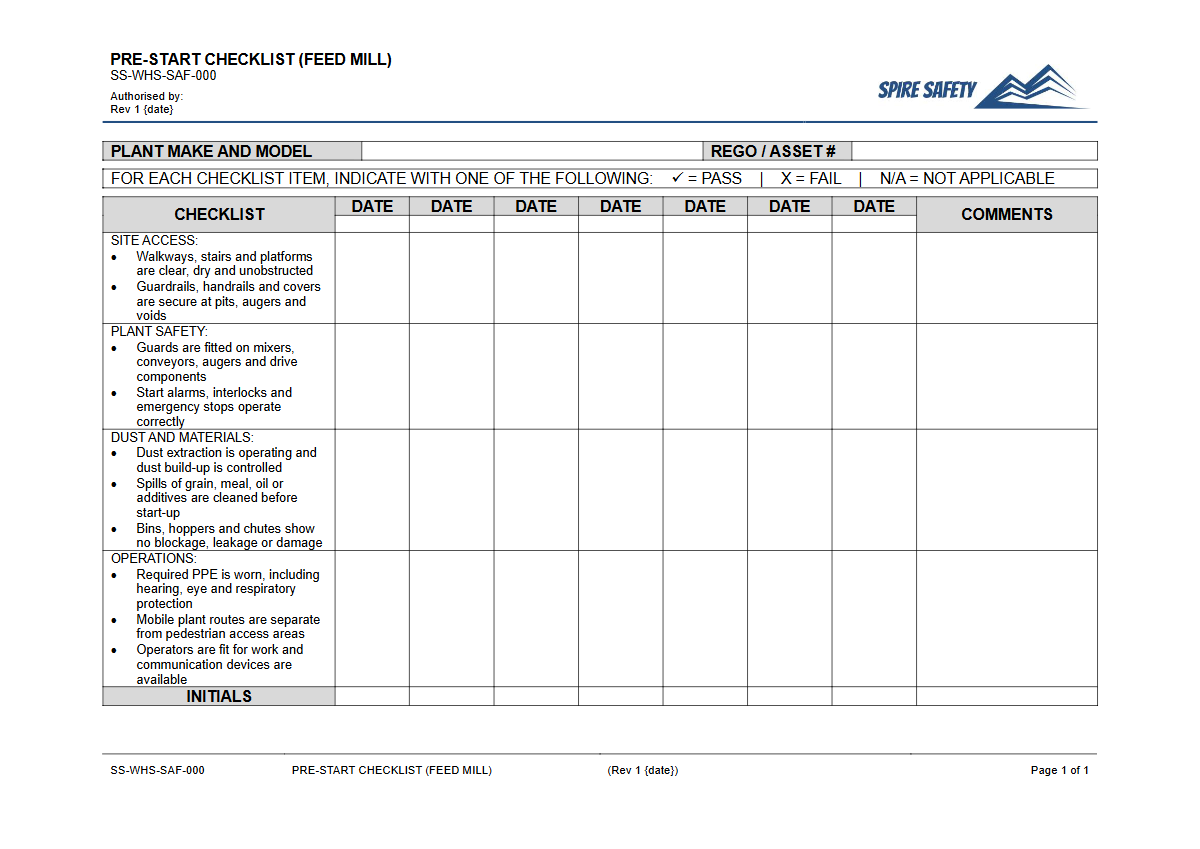
Download our Free Pre-Start Checklist (Feed Mill) Template to formalise daily safety inspections for your agricultural processing plant.
Free Pre-Start Checklist (Feed Mill) Template
DOCX • 125 KB + PDF
Updated Oct 2026
No signup required
Purpose of the Free Pre-Start Checklist (Feed Mill) Template
Operating a feed mill involves complex, heavy-duty machinery where safety and operational integrity are paramount. This Free Pre-Start Checklist (Feed Mill) Template provides a structured starting point for developing a robust daily inspection process.
Formalising these checks helps operators systematically verify that equipment is safe to use before each shift, minimising the risk of incidents, costly breakdowns, and product contamination. Using a checklist ensures that critical safety features—such as guarding, emergency stops, and dust control systems—are inspected consistently.
A documented pre-start process is a key component of proactive risk management. It helps identify and address potential hazards before they escalate, protecting workers from injuries related to moving parts, electrical systems, and hazardous substances.
This is especially critical in environments with a risk of combustible dust explosions. Regularly documenting these checks also provides a clear record of due diligence, which is fundamental to demonstrating a commitment to workplace health and safety.
For machinery with mixing functions, you may also find our Free Pre-Start Checklist (Agitator) Template a useful reference.
Video walkthrough
How to use the Free Pre-Start Checklist (Feed Mill) Template
This document is provided in both DOCX and PDF formats for your convenience. The DOCX file is fully editable, allowing you to tailor the checklist to the specific machinery and processes within your facility.
It is essential that you customise this template to reflect the unique makes, models, and configurations of your grinders, mixers, pelletisers, and conveying systems.
Important: This is a template, not a finished document. Every workplace is different, and you have a duty to ensure your safety documents are specific to your site's hazards and control measures.
We are not responsible for any incidents that may occur. You must customise this checklist by adding or removing items to match your specific equipment and operational risks before use.
For a deeper dive into embedding this culture of safety, consider running a Pre-Start Checks and Plant Maintenance Toolbox Talk with your team.
When customising, consider including items specific to your feed mill, such as checking the condition of auger guards, the integrity of dust extraction systems, the function of bin level sensors, and the cleanliness of magnetic separators. If your facility uses highly specific automated equipment, you might find it useful to review other specialised checklists, such as our Free Pre-Start Checklist (CNC Router) Template, to see how different controls are documented.
When to use this Pre-Start Checklist
This checklist should be completed by a competent operator at the beginning of every shift, or before using the equipment for the first time on any given day. It should also be used whenever a new operator takes over during a shift.
The purpose is to catch any faults or changes in the equipment's condition that may have occurred since its last use. Integrating this daily check into your operational workflow is a practical step towards building comprehensive WHS management systems that prioritise safety at every stage of production.
Who should use this Pre-Start Checklist
The checklist should be completed by the plant operators or technicians who will be directly using the feed mill machinery. These individuals have hands-on familiarity with the equipment and are best placed to notice subtle changes, unusual noises, or signs of wear.
Supervisors and managers are responsible for ensuring these checks are carried out correctly and that any identified issues are addressed promptly. They must also ensure that operators are adequately trained and deemed competent to perform both the inspection and the operation of the machinery.
Periodically, management should review the completed checklists to identify trends or recurring faults, which can inform maintenance schedules and broader safety improvements. Engaging external experts for WHS compliance auditing can provide valuable third-party oversight of your safety processes, including the effectiveness of your pre-start inspection program.
For other templates and safety resources relevant to plant and equipment, browse our complete free WHS resources library.
Common mistakes
Common mistakes to avoid
- Failing to customise the checklist for the specific machinery on site.
- "Pencil-whipping" the form – signing it off without performing the actual checks.
- Neglecting to isolate equipment from energy sources before inspecting moving parts.
- Ignoring minor issues like small leaks or unusual noises that could signal a larger impending failure.
Legal references
Legal considerations
The following legal requirements may be relevant to this type of work.
- Work Health and Safety Act (Harmonised) — Provides the primary duties for protecting workers and other people from work health and safety risks.
- Work Health and Safety Regulations (Harmonised) — Sets out requirements supporting the management of workplace hazards and risks.
The following codes may be relevant to this type of work.
- Managing WHS Risks Code of Practice — Provides practical guidance on identifying hazards, assessing risks and applying effective controls.
- Work Health and Safety Consultation, Cooperation and Coordination Code of Practice — Provides practical guidance on consulting workers and coordinating with other duty holders.
- Managing the Work Environment and Facilities Code of Practice — Provides practical guidance on safe work environments, workplace facilities and related controls.
Did you know
Combustible Dust
Grain dust is highly combustible. When suspended in air in a confined space, it can be ignited by a simple spark, leading to a violent explosion. Effective dust control and housekeeping are critical safety measures in any feed mill.
FAQ
Frequently asked questions
01What are the biggest WHS hazards in a feed mill?
02How often should feed mill equipment be inspected?
03Is this feed mill checklist enough to be WHS-aligned?
04Why is keeping a record of pre-start checks important?
Share this resource
Free Pre-Start Checklist (Feed Mill) Template
Browse Categories
How To Use It
- 1Download and open in Word or PDF.
- 2Replace the placeholders with your business details.
- 3Get it reviewed by a WHS specialist before rollout.
Need it customised?
Our WHS consultants can adapt this template to your site, run a gap analysis, or audit what you already have in place.
Book a Free Consultation WHS consulting servicesor call 1300 156 382