
Free Pre-Start Checklist (Fert Spreader) Template
Download our free Pre-Start Checklist for Fert Spreader Template (DOCX & PDF). A structured starting point to formalise equipment checks and manage WHS risks.
Free Pre-Start Checklist (Fert Spreader) Template
DOCX • 125 KB + PDF
Updated Oct 2026
No signup required
Purpose of the Free Pre-Start Checklist (Fert Spreader) Template
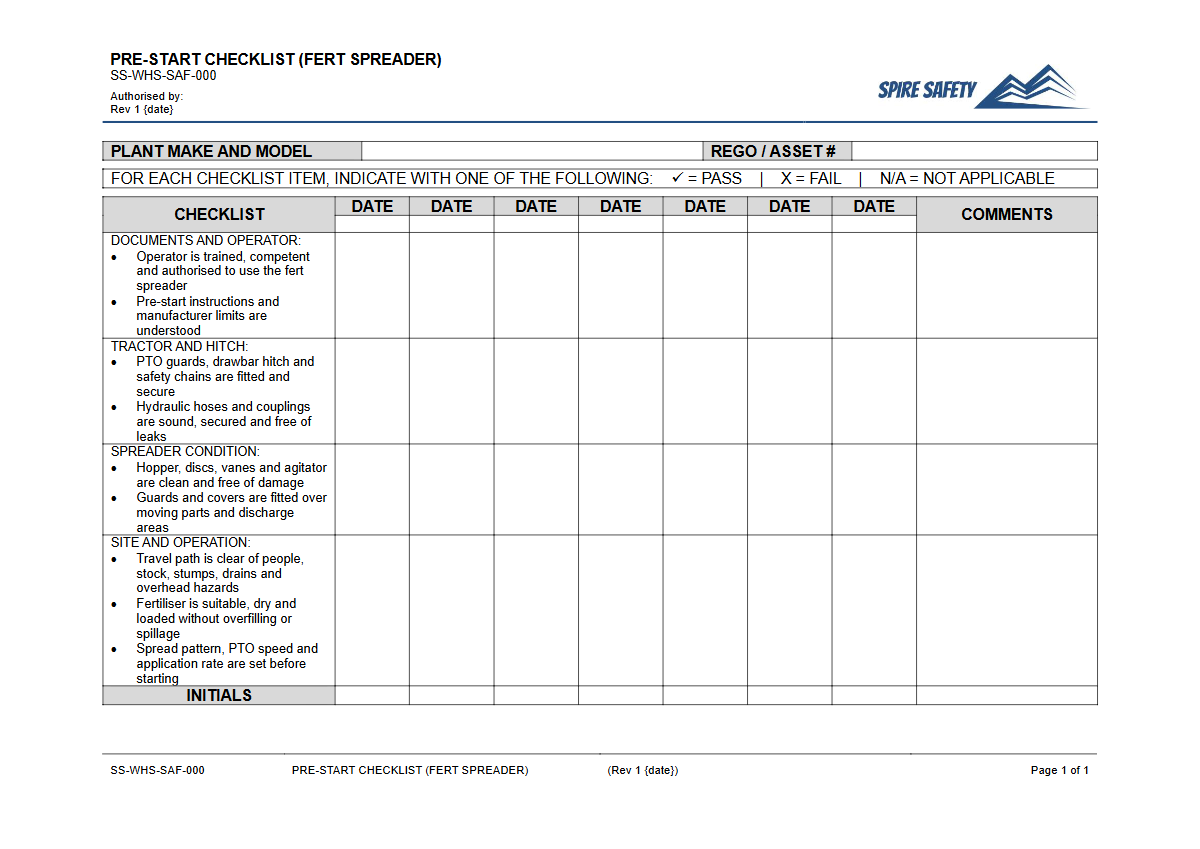
Using a formalised checklist before operating agricultural or groundskeeping machinery is a critical safety step. This Free Pre-Start Checklist (Fert Spreader) Template provides a structured method for operators to inspect the equipment before each use.
Its primary purpose is to systematically identify any mechanical defects, damage, or operational issues that could lead to an incident, equipment failure, or environmental harm. Consistent use helps ensure the fertiliser spreader is safe, fit for purpose, and operating according to manufacturer specifications.
It also creates a documented record of inspections, which is a key component of a proactive safety culture and due diligence.
By integrating this process into daily routines, organisations can reduce the risk of breakdowns, minimise costly repairs, and most importantly, protect workers from harm. Documenting these checks helps demonstrate compliance with WHS duties and provides valuable data for maintenance schedules.
This checklist serves as a practical tool within broader comprehensive WHS management systems, linking daily operational tasks to overarching safety objectives.
Video walkthrough
How to use the Free Pre-Start Checklist (Fert Spreader) Template
This template is designed for ease of use and customisation. After downloading the DOCX or PDF file, the first step is to adapt it to your specific equipment and workplace.
The checklist items provided are general and should be reviewed and modified to reflect the make, model, and configuration (e.g., tow-behind, self-propelled, linkage-mounted) of your fertiliser spreader. Consider adding checks specific to your operational environment, such as working on slopes or near sensitive areas.
Once customised, operators should be trained on how to complete the checklist correctly. This involves physically inspecting each item listed and noting its condition.
The form includes sections to record the date, operator's name, equipment identifier, and a sign-off. Any identified faults or defects must be recorded and reported immediately to a supervisor as per your organisation's fault-reporting procedure.
The equipment should be taken out of service until it is declared safe by a qualified person. For a more detailed guide on the operational phase, consider using our Spreader SOP (Safe Operating Procedure) Template to outline step-by-step instructions for safe use.
A Note on Customisation
It's vital to customise this template for your specific make and model of fertiliser spreader, your operational environment, and your organisation's specific safety procedures. We have provided a structured starting point, but you must adapt it to reflect the unique risks of your workplace.
Add or remove items to ensure the checklist is a practical and relevant tool for your operators.
When to use it
The pre-start checklist should be completed before the fertiliser spreader is used for the first time each day or at the beginning of each shift. This routine ensures that the equipment's condition is verified before any work commences.
It is also good practice to complete the checklist after extended breaks or if a new operator takes over mid-shift. Performing these checks consistently helps embed safe behaviour and reinforces the importance of machine integrity.
You can further support this with regular team meetings using a Pre-Start Checks and Plant Maintenance Toolbox Talk to discuss common issues and best practices.
Who should use it
The primary person responsible for completing the pre-start checklist is the trained and competent operator assigned to use the fertiliser spreader. They have the most direct interaction with the machine and are best positioned to notice changes or potential defects.
Supervisors and managers also have a role; they should periodically review completed checklists to ensure inspections are being done diligently and to identify recurring maintenance issues. These records can be valuable inputs for WHS compliance auditing to verify that safety procedures are being followed correctly in practice.
This checklist is relevant for any industry using fertiliser spreaders, including agriculture, horticulture, landscaping, and sports turf management. The principles of pre-use inspection apply universally to machinery, whether you are checking a spreader or using a similar tool like our Pre-Start Checklist (Aerator) Template for other groundskeeping tasks. For more templates and safety documents, browse our complete free WHS resources library.
Common mistakes
Common mistakes to avoid
- "Pencil-whipping" the checklist without physically inspecting the components.
- Ignoring minor issues like worn hoses or low tyre pressure that can escalate into major failures.
- Failing to thoroughly clean the hopper and spreading mechanism, leading to corrosion, blockages, and inaccurate application.
- Not checking that guards for moving parts, especially the PTO shaft and spinner discs, are secure and in good condition.
Legal references
Legal considerations
The following legal requirements may be relevant to this type of work.
- Work Health and Safety Act (Harmonised) — Provides the primary duties for protecting workers and other people from work health and safety risks.
- Work Health and Safety Regulations (Harmonised) — Sets out requirements supporting the management of workplace hazards and risks.
The following codes may be relevant to this type of work.
- Managing WHS Risks Code of Practice — Provides practical guidance on identifying hazards, assessing risks and applying effective controls.
- Work Health and Safety Consultation, Cooperation and Coordination Code of Practice — Provides practical guidance on consulting workers and coordinating with other duty holders.
- Managing the Work Environment and Facilities Code of Practice — Provides practical guidance on safe work environments, workplace facilities and related controls.
Did you know
PTO Shaft Dangers
Power Take-Off (PTO) shafts on tow-behind spreaders are a major hazard. Even at low speeds, a PTO shaft can entangle clothing, hair, or limbs in less than a second, often resulting in severe or fatal injuries.
Application Accuracy
Incorrectly calibrated or maintained spreaders can lead to uneven fertiliser application. This not only results in poor crop or turf health but can also cause environmental damage through nutrient runoff into waterways.
FAQ
Frequently asked questions
01What is a pre-start checklist for a fert spreader?
02Why are daily checks on a fertiliser spreader important?
03Who is responsible for completing the fert spreader pre-start?
04Does this template cover both tow-behind and self-propelled spreaders?
Share this resource
Free Pre-Start Checklist (Fert Spreader) Template
Browse Categories
How To Use It
- 1Download and open in Word or PDF.
- 2Replace the placeholders with your business details.
- 3Get it reviewed by a WHS specialist before rollout.
Need it customised?
Our WHS consultants can adapt this template to your site, run a gap analysis, or audit what you already have in place.
Book a Free Consultation WHS consulting servicesor call 1300 156 382