
Free Pre-Start Checklist (Fire Panel) Template
Download our free Pre-Start Checklist for Fire Panels to streamline safety checks. This DOCX & PDF template helps formalise your WHS processes. Get yours now.
Free Pre-Start Checklist (Fire Panel) Template
DOCX • 125 KB + PDF
Updated Oct 2026
No signup required
Purpose of the Free Pre-Start Checklist (Fire Panel) Template
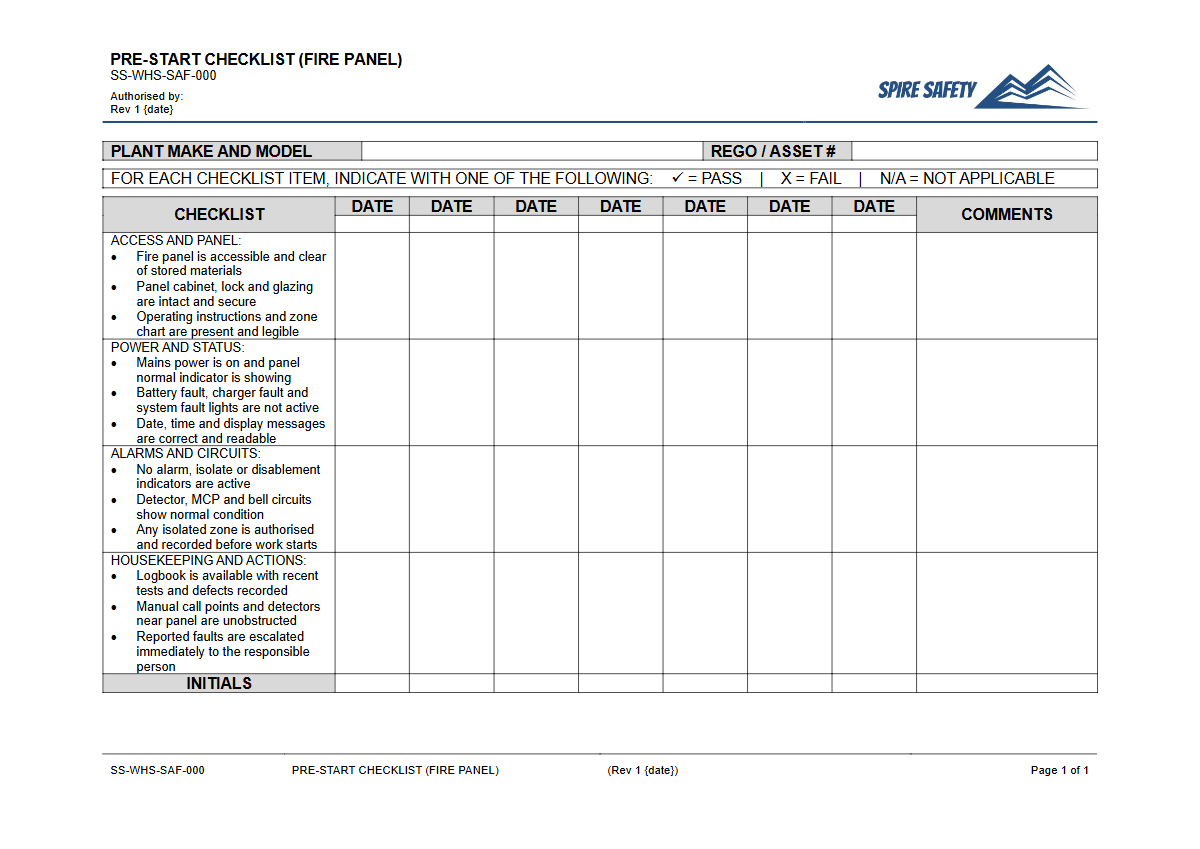
Ensuring your fire indicator panel (FIP) is operational is a critical component of workplace fire safety. Our Free Pre-Start Checklist (Fire Panel) Template provides a structured framework for conducting and recording routine inspections.
These checks are designed to complement, not replace, the mandatory professional servicing required by Australian Standards. Using this template helps competent workers identify potential faults, warning lights, or physical damage before they escalate, forming a vital part of your emergency preparedness procedures.
By formalising these checks, you create a documented history of the panel's status, which can be invaluable during safety audits or incident investigations.
Regularly completing this checklist helps embed safety checks into your daily operational rhythm. It supports the development of robust WHS management systems by providing a practical tool for risk monitoring.
A properly implemented checklist process demonstrates a commitment to proactive safety management, ensuring that the first line of defence in your fire detection system is ready to function as intended.
Video walkthrough
How to use the Free Pre-Start Checklist (Fire Panel) Template
This Pre-Start Checklist is provided as a starting point. To use it effectively, download the DOCX file and adapt it to the specific requirements of your workplace and the particular fire panel models you use.
The PDF version can be used for quick printing and immediate application once you have finalised your customisations.
Steps for implementation:
- Customise: Add your company branding and modify the checklist items to match the specific indicators, buttons, and potential faults of your fire panels. Include location details and any unique site requirements.
- Train: Ensure all personnel responsible for conducting the checks are trained on how to correctly interpret the panel's status lights and indicators, understand what they are looking for, and know the procedure for reporting faults.
- Implement: Integrate the checklist into your opening procedures, shift handovers, or other regular safety routines. Ensure completed checklists are filed correctly and any reported issues are escalated to the appropriate person for action.
- Review: Periodically review the checklist's effectiveness and update it as necessary, especially if new equipment is installed or procedures change.
Please note: This document is a template and not a complete safety solution. We strongly recommend you customise it to address the specific hazards and equipment in your workplace.
If you need assistance tailoring this resource, our WHS consulting team can provide expert guidance.
When to use it
This checklist should be used at regular intervals determined by your workplace's risk assessment. For many organisations, this means conducting the check at the beginning of each day or shift.
In lower-risk environments, a weekly check may be sufficient. The key is consistency.
It should also be used any time there is a change in the building's status, such as after maintenance work, a power outage, or a suspected fault.
These routine checks are an excellent topic for safety discussions and can be integrated into your regular site meetings. A focused Pre-Start Checks and Plant Maintenance Toolbox Talk can help reinforce the importance of these inspections with your team and ensure everyone understands the process.
Who should use it
The pre-start check should be conducted by a person deemed competent to do so. This typically includes site managers, facilities staff, WHS representatives, or designated team leaders who have been trained on the operation and visual inspection of the fire panel.
They must be familiar enough with the system to recognise normal operating conditions versus fault or alarm states, and they must understand the workplace procedure for reporting and escalating any identified issues immediately.
The effectiveness of this process is a key element of your overall safety program. Verifying that checks are being completed correctly and that issues are being managed is a common focus of a WHS compliance auditing program.
This ensures accountability and maintains the integrity of your fire safety measures. For more templates and safety guides, feel free to browse our complete free WHS resources library.
Common mistakes
Common mistakes to avoid
- Failing to customise the template for the specific fire panel model and site conditions.
- Not training staff on how to properly conduct the checks and what to look for.
- "Pencil-whipping" the checklist without actually inspecting the panel.
- Neglecting to escalate and action faults or issues identified during the check.
Legal references
Legal considerations
The following legal requirements may be relevant to this type of work.
- Work Health and Safety Act (Harmonised) — Provides the primary duties for protecting workers and other people from work health and safety risks.
- Work Health and Safety Regulations (Harmonised) — Sets out requirements supporting the management of workplace hazards and risks.
The following codes may be relevant to this type of work.
- Managing WHS Risks Code of Practice — Provides practical guidance on identifying hazards, assessing risks and applying effective controls.
- Work Health and Safety Consultation, Cooperation and Coordination Code of Practice — Provides practical guidance on consulting workers and coordinating with other duty holders.
- Managing the Work Environment and Facilities Code of Practice — Provides practical guidance on safe work environments, workplace facilities and related controls.
Did you know
The Rule on Servicing
In Australia, Australian Standard AS 1851 outlines the requirements for the routine service of fire protection systems and equipment. This standard specifies different frequencies for various tests, from monthly to annually, which must be carried out by qualified technicians.
Silent But Deadly
A fire panel in a 'fault' or 'isolate' state may not trigger alarms correctly during a fire. Routine checks help ensure that no zones have been inadvertently or improperly isolated, leaving parts of your building unprotected.
FAQ
Frequently asked questions
01What is a fire panel pre-start checklist?
02How often should fire panel checks be performed?
03Does using this template replace professional fire safety servicing?
04Who is considered a 'competent person' to use this checklist?
Share this resource
Free Pre-Start Checklist (Fire Panel) Template
Browse Categories
How To Use It
- 1Download and open in Word or PDF.
- 2Replace the placeholders with your business details.
- 3Get it reviewed by a WHS specialist before rollout.
Need it customised?
Our WHS consultants can adapt this template to your site, run a gap analysis, or audit what you already have in place.
Book a Free Consultation WHS consulting servicesor call 1300 156 382