
Free Pre-Start Checklist (Fire Pump) Template
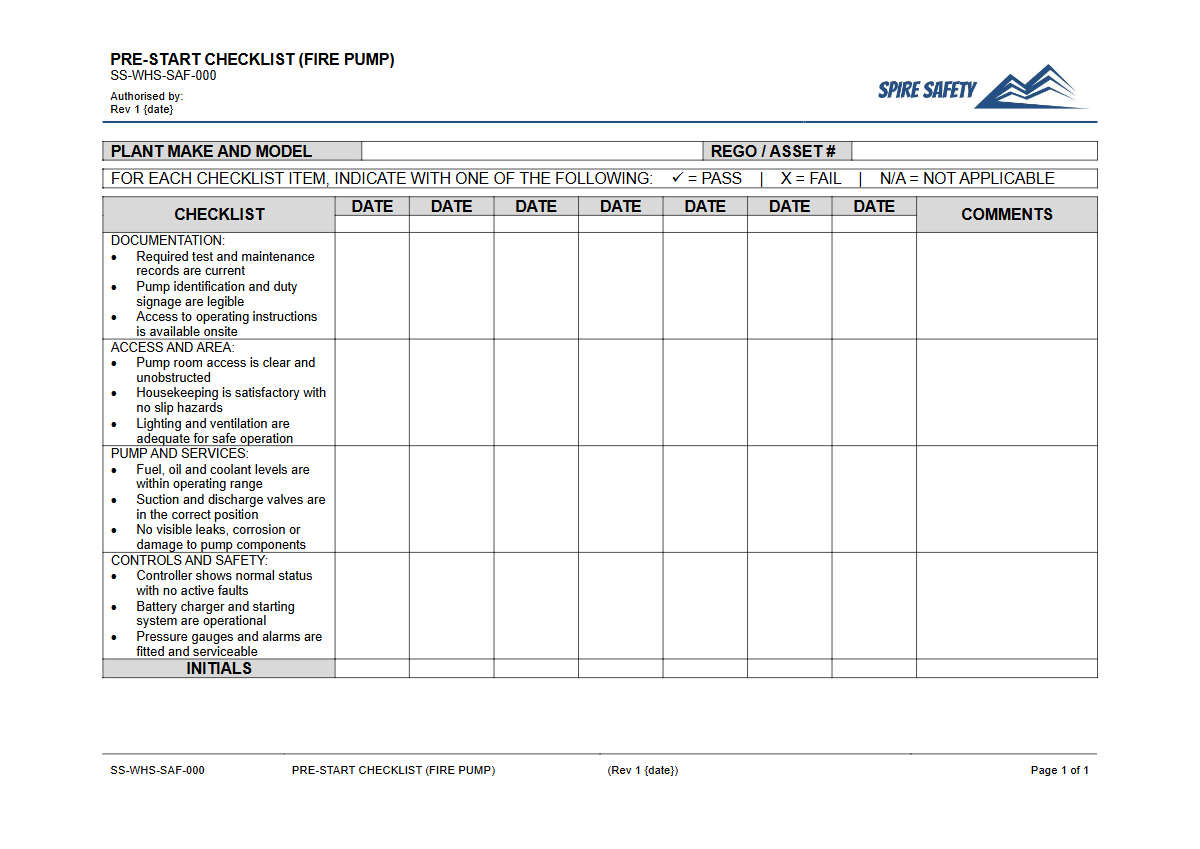
Download our free Pre-Start Checklist (Fire Pump) Template. This structured DOCX and PDF helps you formalise daily equipment safety checks for fire pumps.
Free Pre-Start Checklist (Fire Pump) Template
DOCX • 125 KB + PDF
Updated Oct 2026
No signup required
Purpose of the Free Pre-Start Checklist (Fire Pump) Template
The primary purpose of this checklist is to guide a competent person through a consistent, repeatable inspection of a fire pump before use or as part of a scheduled testing routine. It serves as a formal record that checks have been completed, promoting operator accountability and creating a paper trail for maintenance and compliance activities. Regularly conducting and documenting these inspections is a fundamental part of any effective program for pre-start checks and plant maintenance.
By systematically verifying the condition of key components—such as fuel levels, battery charge, lubrication, and control panel status—you can significantly reduce the risk of the pump failing to start or perform to specification during a fire. This proactive approach helps manage risks associated with critical life-saving equipment and supports your organisation's broader WHS duties to provide and maintain safe plant.
Video walkthrough
How to use the Free Pre-Start Checklist (Fire Pump) Template
To use this resource, download the template in your preferred format (DOCX for easy editing or PDF). The document is designed as a comprehensive foundation, aligned with Australian WHS principles, but it is not a universal, one-size-fits-all solution.
Important: We have provided a solid starting point, but you must customise this template to suit the specific make, model, and type (diesel or electric) of your fire pump, as well as your site-specific conditions and operational risks. A generic checklist may not cover all necessary inspection points for your particular asset.
Before implementation, a full water pump risk assessment should be completed to inform the specific checks required.
Once tailored to your needs, the checklist should be integrated into your daily operations and broader WHS management systems. Ensure all relevant personnel are trained on how to use the checklist correctly and understand the procedure for reporting and rectifying any defects found during the inspection.
When to use it
A fire pump pre-start checklist should be completed at a frequency determined by Australian Standards, manufacturer recommendations, and your organisation's risk assessment. Typically, this includes:
- Before any scheduled weekly or monthly test run.
- Daily or at the start of each shift in high-risk environments where pump readiness is paramount.
- After any maintenance or repair work has been performed on the pump.
The checklist complements, but does not replace, the detailed procedures for operation and emergency use. It is a verification tool, best used in conjunction with a comprehensive Pump SOP (Safe Operating Procedure) that outlines the step-by-step process for starting, running, and shutting down the equipment safely.
Who should use it
The pre-start check should be conducted by a person deemed competent to do so. This is typically a trained operator, a facilities maintenance team member, or a designated fire safety officer.
The individual must have sufficient knowledge of the specific fire pump system to recognise normal operating conditions and identify potential faults or abnormalities.
Supervisors and managers are responsible for ensuring these checks are being completed consistently and that any recorded issues are addressed promptly. Competency is key; simply handing an operator a checklist is not enough.
For complex equipment, you might formalise this with a process like a Verification of Competency for a stationary concrete pump to ensure operators understand the machinery.
Completed checklists should be reviewed by a supervisor and retained as a record of inspection. These records can be invaluable during safety investigations or for demonstrating due diligence during a WHS compliance auditing process.
Common mistakes
Common mistakes to avoid
- Failing to tailor the checklist to the specific make and model of the fire pump.
- Completing the form without physically verifying each check item (pencil-whipping).
- Not immediately reporting or escalating identified faults for corrective action.
- Poor record-keeping of completed checklists, making them difficult to retrieve for audits.
Legal references
Legal considerations
The following legal requirements may be relevant to this type of work.
- Work Health and Safety Act (Harmonised) — Provides the primary duties for protecting workers and other people from work health and safety risks.
- Work Health and Safety Regulations (Harmonised) — Sets out requirements supporting the management of workplace hazards and risks.
The following codes may be relevant to this type of work.
- Managing WHS Risks Code of Practice — Provides practical guidance on identifying hazards, assessing risks and applying effective controls.
- Work Health and Safety Consultation, Cooperation and Coordination Code of Practice — Provides practical guidance on consulting workers and coordinating with other duty holders.
- Managing the Work Environment and Facilities Code of Practice — Provides practical guidance on safe work environments, workplace facilities and related controls.
Did you know
Australian Standards
Australian Standard AS 2941 sets out the requirements for the design and installation of fire pump systems, while AS 1851 outlines the mandatory routine servicing and testing frequencies to ensure their ongoing reliability.
Weekly Churn Test
Most fire pumps undergo a weekly 'churn test' where the pump is run for a short period without discharging large volumes of water. This test verifies the pump's ability to start and run, and is the perfect time to use a pre-start checklist.
FAQ
Frequently asked questions
01Why is a weekly pre-start check for a fire pump important?
02What should be included in a fire pump pre-start checklist?
03Who is responsible for completing a fire pump pre-start check?
04Can this template be used for both diesel and electric fire pumps?
Share this resource
Free Pre-Start Checklist (Fire Pump) Template
Browse Categories
How To Use It
- 1Download and open in Word or PDF.
- 2Replace the placeholders with your business details.
- 3Get it reviewed by a WHS specialist before rollout.
Need it customised?
Our WHS consultants can adapt this template to your site, run a gap analysis, or audit what you already have in place.
Book a Free Consultation WHS consulting servicesor call 1300 156 382