
Free Pre-Start Checklist (Flail Mower) Template
Download our free Pre-Start Checklist for flail mowers. This DOCX & PDF template helps formalise equipment safety inspections and manage WHS risks.
Free Pre-Start Checklist (Flail Mower) Template
DOCX • 125 KB + PDF
Updated Oct 2026
No signup required
Purpose of the Free Pre-Start Checklist (Flail Mower) Template
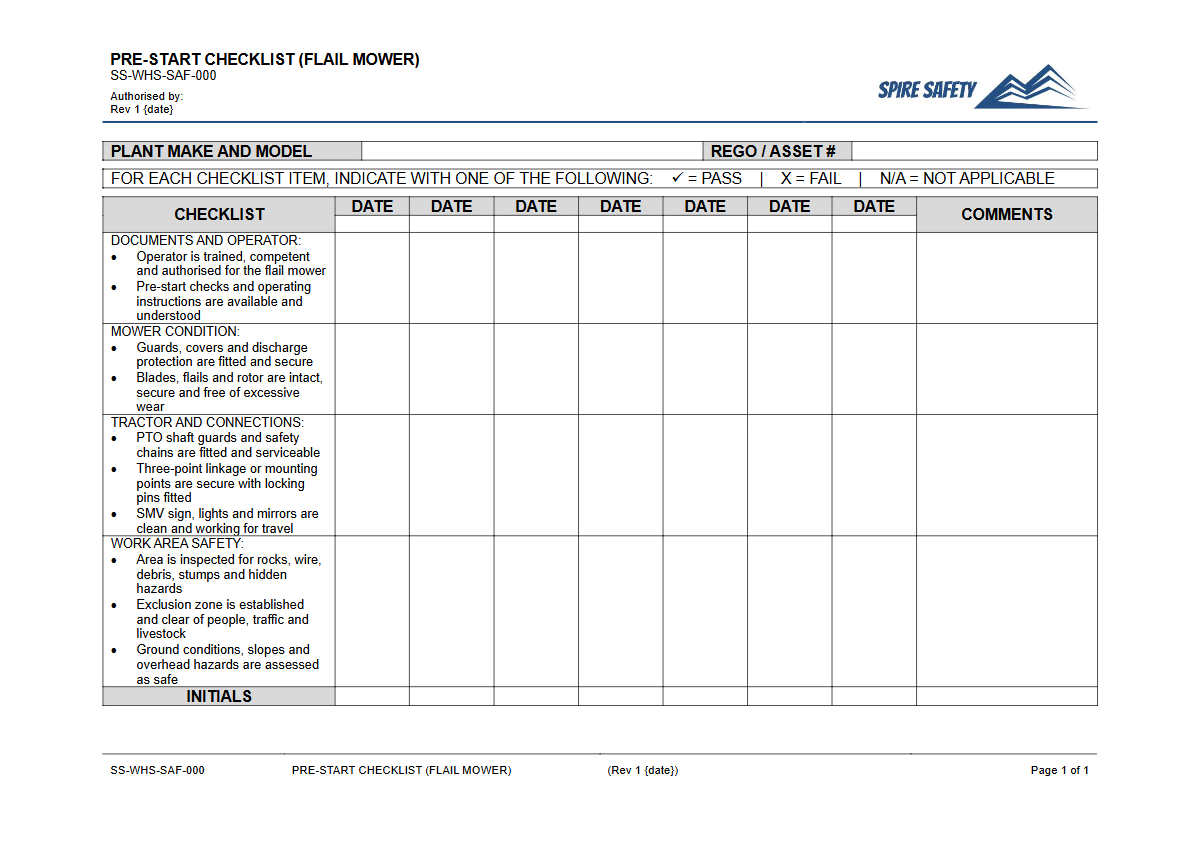
Operating a flail mower involves significant risks if the equipment is not properly maintained and inspected. This Free Pre-Start Checklist (Flail Mower) Template provides a structured framework for operators to conduct thorough, consistent safety inspections before each use.
Its primary purpose is to identify potential mechanical faults, damage, or wear and tear that could lead to an incident, equipment failure, or injury. By formalising this process, organisations can demonstrate due diligence in managing plant safety, reduce the likelihood of accidents, and minimise costly downtime.
Integrating regular equipment checks is a fundamental part of a proactive safety culture. For a broader perspective on how these checks fit into daily safety briefings, our Pre-Start Checks and Plant Maintenance Toolbox Talk template provides complementary material to reinforce these essential practices with your team.
Video walkthrough
How to use the Free Pre-Start Checklist (Flail Mower) Template
Using this template effectively involves a few simple steps. First, download the document in your preferred format—DOCX for easy editing or PDF for straightforward printing.
The next, most critical step is customisation. This document serves as a comprehensive starting point aligned with Australian WHS principles, but it must be adapted to your specific circumstances.
Important Note: We have designed this template as a guide. You must review and customise it to reflect the specific make and model of your flail mower, the unique hazards of your work environment, and your organisation's internal safety procedures.
This ensures the checklist is relevant and effective for your operators. A generic checklist may not cover critical inspection points specific to your equipment.
Proper customisation is a key component of building effective WHS management systems that genuinely control risk.
When to use it
The Pre-Start Checklist should be completed by the operator before the flail mower is used for the first time on any given day or shift. This routine ensures the equipment is in a safe condition before work commences.
If the operator changes during a shift, the incoming operator should also conduct their own pre-start check to verify the mower's condition. The checklist serves as a live record, confirming that safety diligence is an ongoing, operational priority rather than a periodic administrative task.
This process is similar to the requirements for other high-risk plant, where pre-operational checks are mandatory. For instance, developing a SWMS for Concrete Truck Operation also begins with confirming the vehicle is safe to use.
This principle of 'safe-to-start' applies across all industries and equipment types.
Who should use it
This Pre-Start Checklist is designed for use primarily by trained and competent flail mower operators. They are the individuals with hands-on responsibility for the equipment and are best positioned to notice subtle changes in its condition or performance.
Supervisors and line managers should also be familiar with the checklist to oversee its correct use and ensure any reported faults are addressed promptly. Furthermore, maintenance personnel can use completed checklists to track recurring issues, and WHS managers can use them as evidence of safety procedure implementation during audits.
The principle of documented, regular checks is transferable to other types of groundskeeping and agricultural machinery. For example, a similar systematic approach is vital when using a pre-start checklist for an aerator to ensure it is also fit for service.
Regular checks help build a strong foundation for your safety programs, but if you encounter complex issues, engaging specialist WHS consulting can provide the necessary expert guidance.
For organisations seeking to formalise their safety procedures further, undertaking periodic WHS compliance auditing can help verify that procedures like pre-start checks are being effectively implemented across all operations. If you're looking for more templates to support your safety system, you can browse our complete free WHS resources library for a wide range of documents.
Common mistakes
Common mistakes to avoid
- Skipping the check entirely to save time at the start of a shift.
- Failing to report or rectify minor faults found during the inspection.
- Using a generic checklist that doesn't cover model-specific safety features.
- Performing checks on blades or rotating parts without first isolating the power source and removing the key.
Legal references
Legal considerations
The following legal requirements may be relevant to this type of work.
- Work Health and Safety Act (Harmonised) — Provides the primary duties for protecting workers and other people from work health and safety risks.
- Work Health and Safety Regulations (Harmonised) — Sets out requirements supporting the management of workplace hazards and risks.
The following codes may be relevant to this type of work.
- Managing WHS Risks Code of Practice — Provides practical guidance on identifying hazards, assessing risks and applying effective controls.
- Work Health and Safety Consultation, Cooperation and Coordination Code of Practice — Provides practical guidance on consulting workers and coordinating with other duty holders.
- Managing the Work Environment and Facilities Code of Practice — Provides practical guidance on safe work environments, workplace facilities and related controls.
Did you know
Safer Debris Management
Flail mowers are generally considered safer than rotary mowers for use near roads and public areas because their design contains debris and prevents it from being thrown at high velocity.
The 'Flail' Mechanism
The name 'flail mower' comes from the small T- or Y-shaped blades (flails) that are attached to a rotating drum. This design allows them to bounce off solid objects, reducing the risk of damage to the mower.
FAQ
Frequently asked questions
01What is a flail mower pre-start checklist?
02Why is a flail mower pre-start inspection important?
03How often should a flail mower pre-start check be done?
04Is this template suitable for my specific flail mower model?
Share this resource
Free Pre-Start Checklist (Flail Mower) Template
Browse Categories
How To Use It
- 1Download and open in Word or PDF.
- 2Replace the placeholders with your business details.
- 3Get it reviewed by a WHS specialist before rollout.
Need it customised?
Our WHS consultants can adapt this template to your site, run a gap analysis, or audit what you already have in place.
Book a Free Consultation WHS consulting servicesor call 1300 156 382