
Free Pre-Start Checklist (Floor Grinder) Template
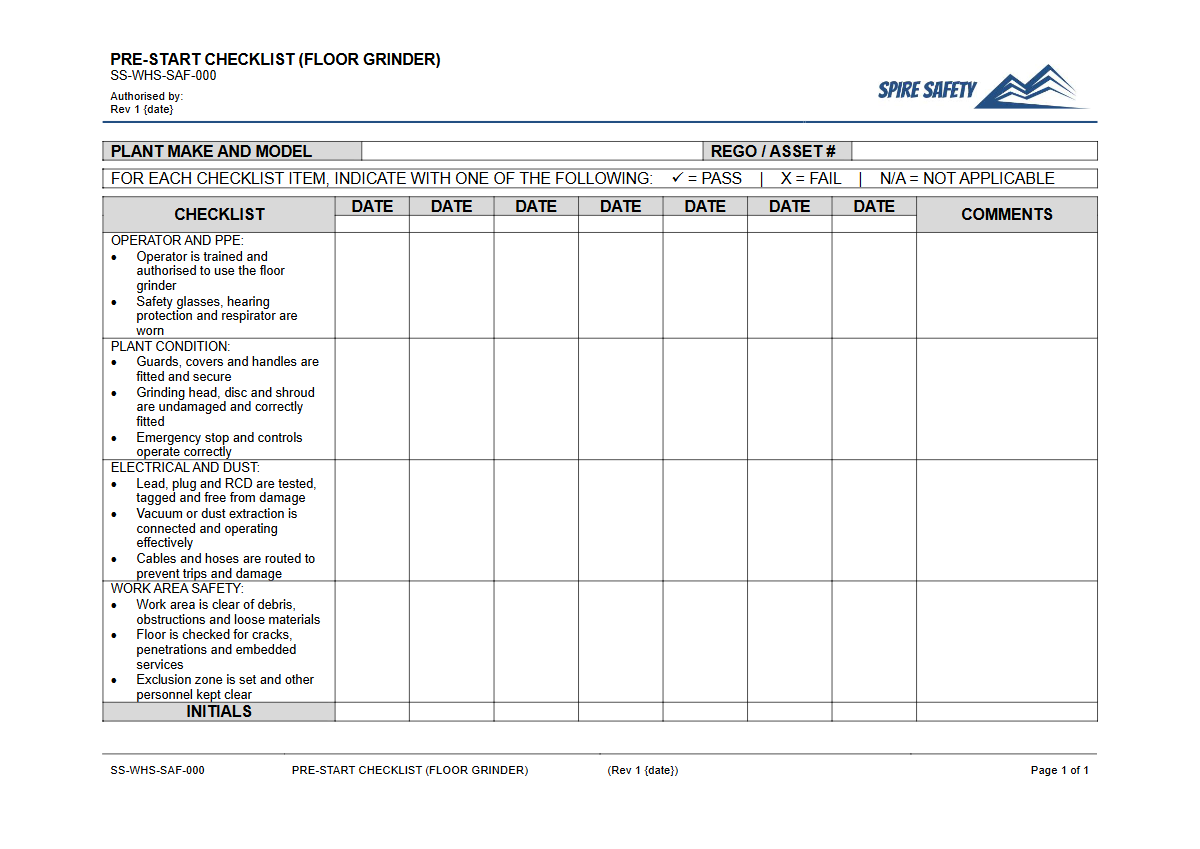
Download our free Pre-Start Checklist for floor grinders. This template helps formalise equipment inspections and improve safety. Get your DOCX & PDF now.
Free Pre-Start Checklist (Floor Grinder) Template
DOCX • 125 KB + PDF
Updated Oct 2026
No signup required
Purpose of the Free Pre-Start Checklist (Floor Grinder) Template
Operating a floor grinder involves significant workplace health and safety risks, including exposure to hazardous dust, noise, vibration, and mechanical or electrical hazards. Our Free Pre-Start Checklist (Floor Grinder) Template provides a structured starting point for organisations to formalise their daily equipment inspections.
Using this DOCX and PDF template helps ensure that floor grinders are in safe working order before use, mitigating risks and preventing incidents.
A systematic pre-start check is a fundamental control measure. It empowers operators to proactively identify and report faults, such as damaged guards, worn-out grinding discs, or faulty electrical cords.
Consistent use of this checklist helps build a positive safety culture and provides documented evidence of your organisation's commitment to plant safety. For a broader perspective on this daily habit, a Pre-Start Checks and Plant Maintenance Toolbox Talk can help reinforce its importance with your team.
Implementing pre-start checklists is a key activity within broader WHS management systems. They form part of the routine inspection and maintenance procedures required under Australian WHS law, helping to meet your primary duty of care to provide and maintain safe plant and equipment.
Video walkthrough
How to use the Free Pre-Start Checklist (Floor Grinder) Template
This checklist is designed as a foundational template. After downloading the Word document (DOCX) or PDF, you should review and adapt its contents to reflect the specific make and model of the floor grinders used in your workplace, the tasks they are used for (e.g., concrete polishing, coating removal), and your site-specific hazards.
Important Note: This document is a template and should not be used without customisation. It is provided as a starting point for developing your own site-specific procedure.
We make no representations about its suitability for your specific circumstances. It is the user’s responsibility to ensure the final document is tailored to their operational risks and complies with all relevant legislation and standards.
You must customise it to fit your workplace.
Once customised, the checklist should be integrated into your daily operational workflow. Operators must be trained not only on how to use the floor grinder safely but also on how to complete the pre-start check thoroughly.
A completed checklist is not a substitute for operator competence; it is a tool to support it. To formally assess an operator's skill, you can use our Floor Grinder Verification of Competency (VOC) template.
When to use it
A floor grinder pre-start checklist should be completed by the operator at the beginning of each shift or before the equipment is used for the first time that day. It should also be completed after any maintenance or repair work to verify that the equipment has been returned to a safe operational state.
Regular, documented checks create a valuable historical record of the equipment's condition over time, helping to identify recurring faults and inform maintenance schedules.
For high-risk activities involving grinding, a pre-start check is just one part of a safe system of work. It should be used in conjunction with other formal safety documents, such as an Angle Grinder SWMS or a Safe Operating Procedure, which outline the hazards and controls for the entire task.
Who should use it
The primary user of the pre-start checklist is the trained and authorised operator of the floor grinder. They have the most hands-on interaction with the equipment and are best placed to identify any defects or abnormalities before work commences.
It is their responsibility to complete the check diligently and accurately.
Supervisors and managers also have a role. They should periodically review completed checklists to ensure they are being filled out correctly and that any reported issues are being addressed promptly.
This oversight is crucial for ensuring the pre-start system is effective. This process of verifying operator skill is also essential for related equipment, as shown in resources like our Angle Grinder VOC (Verification of Competency) Template.
Completed checklists become part of your safety records. These documents can be reviewed during internal or external WHS compliance audits as evidence that your organisation has a system in place for inspecting and maintaining the safety of its plant and equipment.
Common mistakes
Common mistakes to avoid
- Using a generic checklist that doesn't match the specific make or model of the floor grinder.
- Performing a 'tick and flick' by signing the form without physically inspecting each item.
- Failing to immediately report, isolate, and tag out faulty equipment identified during the check.
- Not retaining completed checklists as a record of inspection and maintenance history.
Legal references
Legal considerations
The following legal requirements may be relevant to this type of work.
- Work Health and Safety Act (Harmonised) — Provides the primary duties for protecting workers and other people from work health and safety risks.
- Work Health and Safety Regulations (Harmonised) — Sets out requirements supporting the management of workplace hazards and risks.
The following codes may be relevant to this type of work.
- Managing WHS Risks Code of Practice — Provides practical guidance on identifying hazards, assessing risks and applying effective controls.
- Work Health and Safety Consultation, Cooperation and Coordination Code of Practice — Provides practical guidance on consulting workers and coordinating with other duty holders.
- Managing the Work Environment and Facilities Code of Practice — Provides practical guidance on safe work environments, workplace facilities and related controls.
Did you know
Silica Dust Hazard
Grinding concrete can generate high levels of respirable crystalline silica (RCS) dust, a hazardous substance that can cause silicosis, a serious and incurable lung disease. Effective dust extraction (like an M- or H-class vacuum) is a critical control.
Vibration Exposure
Prolonged use of floor grinders can expose operators to significant Hand-Arm Vibration (HAV), potentially leading to a painful and debilitating condition known as Hand-Arm Vibration Syndrome (HAVS). Job rotation and using low-vibration models can help manage this risk.
FAQ
Frequently asked questions
01What should be included in a floor grinder pre-start checklist?
02How often should a floor grinder pre-start check be done?
03Who is responsible for completing a floor grinder pre-start inspection?
04Is a digital pre-start checklist better than a paper one?
Share this resource
Free Pre-Start Checklist (Floor Grinder) Template
Browse Categories
How To Use It
- 1Download and open in Word or PDF.
- 2Replace the placeholders with your business details.
- 3Get it reviewed by a WHS specialist before rollout.
Need it customised?
Our WHS consultants can adapt this template to your site, run a gap analysis, or audit what you already have in place.
Book a Free Consultation WHS consulting servicesor call 1300 156 382