
Free Pre-Start Checklist (Floor Scrub) Template
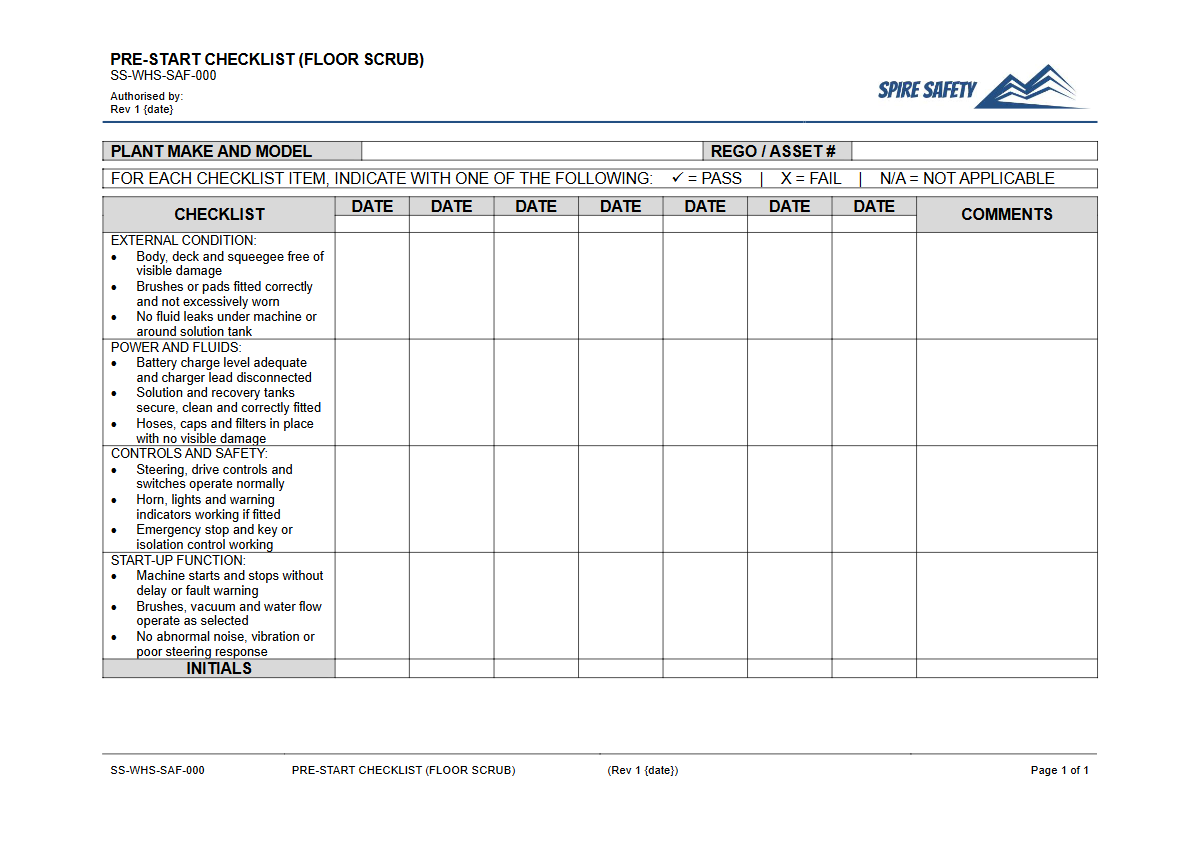
Download our free Pre-Start Checklist for floor scrubbers. This customisable DOCX & PDF template helps formalise safety checks. Get your template now.
Free Pre-Start Checklist (Floor Scrub) Template
DOCX • 125 KB + PDF
Updated Oct 2026
No signup required
Purpose of the Free Pre-Start Checklist (Floor Scrub) Template
Operating powered mobile plant like a floor scrubber introduces risks that must be managed to ensure worker safety. This Free Pre-Start Checklist (Floor Scrub) Template provides a structured starting point for organisations to formalise daily equipment inspections.
Using a checklist before every shift helps operators systematically verify that the machine is in safe working order, identifying potential faults or damage before they can cause an incident. Regular, documented checks are a fundamental component of proactive risk management.
These inspections help identify hazards such as fluid leaks, worn-out squeegees or brushes, non-functional safety features (like horns or lights), and battery or electrical issues. Addressing these minor problems promptly prevents them from escalating into major failures or contributing to incidents like slips, trips, and falls.
Integrating this process is a key part of maintaining robust WHS management systems that demonstrate due diligence and a commitment to safety.
Video walkthrough
How to use the Free Pre-Start Checklist (Floor Scrub) Template
This Pre-Start Checklist is designed as a guide and must be customised to your specific workplace needs. Before deployment, a competent person should review and adapt the checklist to reflect the exact make and model of the floor scrubbers used on-site, the environment they are used in (e.g., warehouses, hospitals, retail centres), and any unique site hazards.
For example, a checklist for a scrubber used in a healthcare setting might have different considerations than one used in a factory. It can be used alongside other equipment checks, such as those detailed in our Free Pre-Start Checklist (Patient Hoist) Template for relevant facilities.
To implement the checklist effectively:
- Customise: Add or remove items to match your equipment. Include brand and model numbers, asset IDs, and specific company details.
- Train: Ensure all operators are trained not only on how to use the floor scrubber but also on the importance of the pre-start inspection and how to complete the checklist correctly.
- Implement: Integrate the checklist into your daily start-of-shift procedures. Make it a non-negotiable step before any operator uses the equipment.
- Review: Establish a clear process for what an operator must do if a fault is found. This includes immediately taking the machine out of service, tagging it, and reporting the issue to a supervisor or the maintenance department.
- Record: File the completed checklists as part of your safety records. These documents provide valuable data for maintenance scheduling and can be reviewed during WHS compliance auditing to verify that procedures are being followed.
When to use it
A pre-start inspection should be completed at the beginning of every shift or before the floor scrubber is used for the first time each day. If operator shifts change during the day, the incoming operator should also perform a check to ensure the machine remains in a safe condition.
This consistent routine helps catch any damage that may have occurred since the last use or during charging. In environments with multiple types of mobile equipment, this process should be standard across all machinery, similar to the checks required when using a bin lifter checklist for waste management tasks.
Who should use it
This Pre-Start Checklist should be used by any worker or operator who is authorised and trained to use a walk-behind or ride-on floor scrubber. This includes cleaning staff, maintenance personnel, and facilities management teams in various sectors like retail, healthcare, logistics, and manufacturing.
Supervisors and WHS managers should also use the completed checklists to monitor equipment condition, track recurring faults, and supports your compliance efforts with the organisation's safety procedures. Using this template helps standardise the inspection process across all personnel and shifts, ensuring no steps are missed regardless of who is operating the machine. This is crucial in specialised areas like cold storage, where equipment must be reliable, much like the items on our Free Pre-Start Checklist (Freezer) Template.
By embedding this simple check into your daily operations, you create a powerful safety habit that protects operators and bystanders alike. Explore our complete free WHS resources library for more templates and guides to support your safety management system.
Common mistakes
Common mistakes to avoid
- Skipping the pre-start check to save time, assuming the machine is safe.
- Using a generic checklist that doesn't match the specific make and model of the floor scrubber.
- Failing to immediately tag out and report faulty equipment, leaving it available for others to use.
- Continuing to use a machine with a known 'minor' fault, which can escalate into a major failure or incident.
Legal references
Legal considerations
The following legal requirements may be relevant to this type of work.
- Work Health and Safety Act (Harmonised) — Provides the primary duties for protecting workers and other people from work health and safety risks.
- Work Health and Safety Regulations (Harmonised) — Sets out requirements supporting the management of workplace hazards and risks.
The following codes may be relevant to this type of work.
- Managing WHS Risks Code of Practice — Provides practical guidance on identifying hazards, assessing risks and applying effective controls.
- Work Health and Safety Consultation, Cooperation and Coordination Code of Practice — Provides practical guidance on consulting workers and coordinating with other duty holders.
- Managing the Work Environment and Facilities Code of Practice — Provides practical guidance on safe work environments, workplace facilities and related controls.
Did you know
Slips, Trips, and Falls
According to Safe Work Australia, slips, trips, and falls are a leading cause of serious workplace injuries, and wet or contaminated floors from cleaning activities are a common contributing factor.
FAQ
Frequently asked questions
01What are the main hazards of using a floor scrubber?
02How often should a pre-start check be done on a floor scrubber?
03Is training required to use a commercial floor scrubber?
04What should I do if I find a fault during a pre-start check?
Share this resource
Free Pre-Start Checklist (Floor Scrub) Template
Browse Categories
How To Use It
- 1Download and open in Word or PDF.
- 2Replace the placeholders with your business details.
- 3Get it reviewed by a WHS specialist before rollout.
Need it customised?
Our WHS consultants can adapt this template to your site, run a gap analysis, or audit what you already have in place.
Book a Free Consultation WHS consulting servicesor call 1300 156 382