
Free Pre-Start Checklist (Patient Hoist) Template
Formalise safety inspections for patient lifting equipment with our free Pre-Start Checklist (Patient Hoist) Template. Download your free DOCX & PDF today.
Free Pre-Start Checklist (Patient Hoist) Template
DOCX • 125 KB + PDF
Updated Oct 2026
No signup required
Purpose of the Free Pre-Start Checklist (Patient Hoist) Template
Patient hoists are essential pieces of equipment in healthcare, aged care, and disability support settings, significantly reducing the risk of manual handling injuries to both carers and patients. However, a malfunctioning hoist can lead to catastrophic failure, causing severe injury or death.
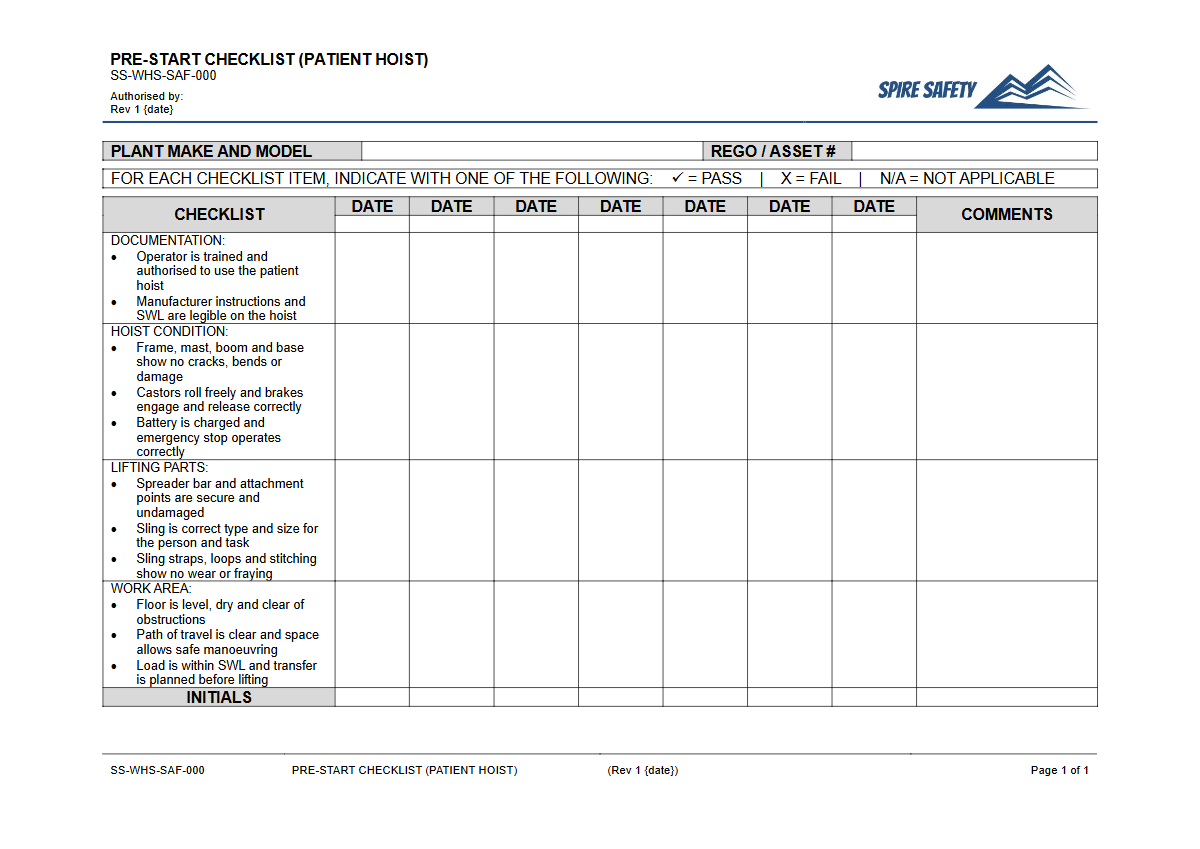
This free Pre-Start Checklist (Patient Hoist) Template provides a structured framework for operators to conduct consistent, documented safety inspections before use. Regular pre-start checks are a fundamental component of a safe system of work, helping to identify potential faults, prevent incidents, and meet your WHS duties of care.
Integrating these checks into daily practice helps create a proactive safety culture where equipment integrity is prioritised. Many of the principles involved overlap with general safety discussions, such as those covered in an Aged Care Manual Handling Toolbox Talk.
What's included in this Pre-Start Checklist?
This template is aligned with Australian WHS best practices and provides a starting point for developing a site-specific checklist. It prompts users to inspect key components, including:
- Frame and Base: Checking for cracks, damage, or instability.
- Lifting Arm/Boom: Inspecting for signs of stress, bending, or damage.
- Sling and Attachments: Ensuring the sling is free from rips, fraying, and that clips and hooks are secure.
- Castors and Brakes: Verifying wheels run smoothly and brakes engage effectively.
- Hand Controls and Electrics: Testing the functionality of all buttons, including the emergency stop.
- Battery Levels: Ensuring the hoist is adequately charged for use.
Video walkthrough
How to use the Free Pre-Start Checklist (Patient Hoist) Template
To implement this Pre-Start Checklist effectively, it must be adapted to your specific workplace and the equipment in use. Generic, off-the-shelf documents are rarely sufficient on their own.
Customisation is essential
Please note: This is a template, not a finished document. We have developed it as a starting point, but you are responsible for ensuring it is contextualised for your specific needs.
Your checklist should include the make, model, and asset number of each hoist, and you may need to add or remove items based on the manufacturer’s recommendations and your own risk assessments. Integrating this process into your overall WHS management systems ensures it becomes a routine and auditable part of your safety procedures.
Once customised, train all operators on how to use the checklist correctly. They must understand not just what to check, but why each check is important.
Store completed checklists as a record of your safety diligence. These records are invaluable during safety audits and incident investigations.
When to use it
A pre-start check for a patient hoist should be conducted at the beginning of each shift or before the first time the equipment is used each day. This routine establishes a baseline for the equipment's condition.
Additionally, a check should be performed if the hoist has been moved between locations, has undergone maintenance, or if there is any reason to suspect it may have been damaged. For a broader perspective on the importance of routine inspections, our Pre-Start Checks and Plant Maintenance Toolbox Talk can help reinforce these principles with your team.
Who should use it
Only personnel who have been trained and deemed competent in the safe operation of the specific patient hoist should perform the pre-start check and use the equipment. This typically includes nurses, healthcare assistants, personal care workers, and disability support workers. Competency isn't just about knowing how to operate the hoist; it includes the ability to identify potential hazards and knowing the correct procedure to follow if a fault is found. While we provide a specific Verification of Competency for electric hoists, the principles of assessing operator skill are universally applicable. If your organisation needs assistance developing robust competency frameworks or other safety documentation, Spire Safety offers expert WHS consulting services tailored to the healthcare and community service sectors.
Common mistakes
Common mistakes to avoid
- Skipping checks when busy, assuming the hoist was fine on the previous shift.
- Using a generic checklist without customising it for the specific hoist model and its unique features.
- Failing to report 'minor' faults like a stiff wheel or a small tear in the sling, which can escalate into major failures.
- Not physically checking items, instead just ticking boxes on the form without proper inspection.
Legal references
Legal considerations
The following legal requirements may be relevant to this type of work.
- Work Health and Safety Act (Harmonised) — Provides the primary duties for protecting workers and other people from work health and safety risks.
- Work Health and Safety Regulations (Harmonised) — Sets out requirements supporting the management of workplace hazards and risks.
The following codes may be relevant to this type of work.
- Managing WHS Risks Code of Practice — Provides practical guidance on identifying hazards, assessing risks and applying effective controls.
- Work Health and Safety Consultation, Cooperation and Coordination Code of Practice — Provides practical guidance on consulting workers and coordinating with other duty holders.
- Managing the Work Environment and Facilities Code of Practice — Provides practical guidance on safe work environments, workplace facilities and related controls.
Did you know
Manual Handling Injuries
According to Safe Work Australia, the healthcare and social assistance industry has one of the highest rates of serious claims for work-related musculoskeletal disorders, with manual handling of people being a major cause.
Lifting Equipment Standards
In Australia, patient lifting equipment is covered by AS/NZS ISO 10535:2011, which outlines requirements and test methods for hoists and slings used for the transfer of persons with disabilities.
FAQ
Frequently asked questions
01What should I do if I find a fault during a patient hoist pre-start check?
02How often should a patient hoist be professionally serviced?
03Is this pre-start checklist enough to be WHS-aligned?
04Can this template be used for all types of patient hoists?
Share this resource
Free Pre-Start Checklist (Patient Hoist) Template
Browse Categories
How To Use It
- 1Download and open in Word or PDF.
- 2Replace the placeholders with your business details.
- 3Get it reviewed by a WHS specialist before rollout.
Need it customised?
Our WHS consultants can adapt this template to your site, run a gap analysis, or audit what you already have in place.
Book a Free Consultation WHS consulting servicesor call 1300 156 382